Twenty-year trends in the incidence of stroke complicating acute myocardial infarction: Worcester Heart Attack Study
- PMID: 18955639
- PMCID: PMC2717800
- DOI: 10.1001/archinte.168.19.2104
Twenty-year trends in the incidence of stroke complicating acute myocardial infarction: Worcester Heart Attack Study
Abstract
Background: Given the improved survival of patients after acute myocardial infarction (AMI), more patients are at risk for cerebrovascular complications of AMI. Trends in the magnitude of stroke in the setting of AMI are not well characterized, however, and neither have contemporary trends in the hospital death rates of patients developing acute stroke been examined.
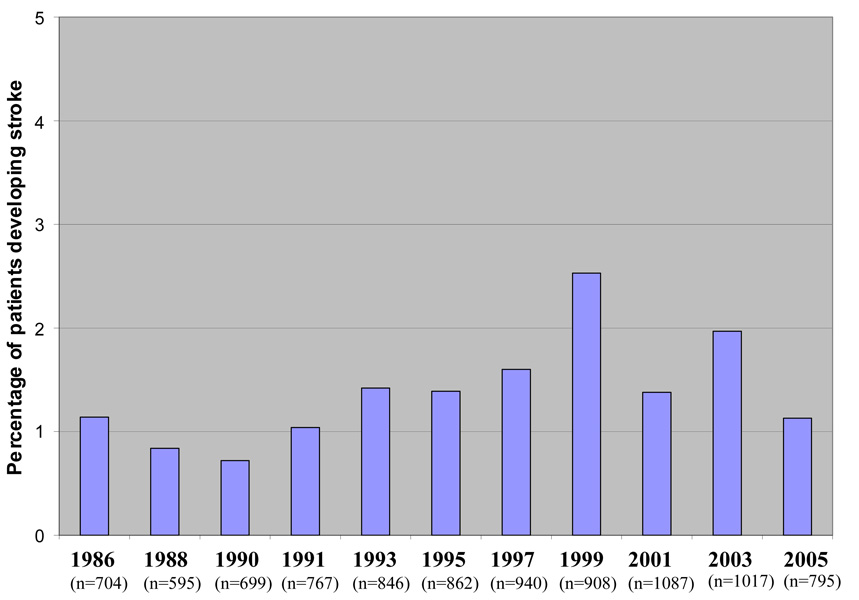
Results: Of 9220 patients without a history of stroke hospitalized with confirmed AMI between 1986 and 2005 in all greater Worcester medical centers, 132 (1.4%) experienced an acute stroke during hospitalization. The proportion of patients with AMI who developed a stroke increased through the 1980s and 1990s but declined slightly thereafter. Advanced age, female sex, a previous myocardial infarction (MI), and the occurrence of atrial fibrillation during hospitalization were associated with a greater risk of stroke. Receipt of a percutaneous coronary intervention during hospitalization was associated with a lower risk of stroke. Compared with patients who did not experience a stroke, patients developing a stroke in the 1990s were approximately 3 times more likely to die during hospitalization (odds ratio [OR], 2.91; 95% confidence interval [CI], 1.72-5.19), whereas those experiencing a stroke in the 2000s were 5 times more likely to die (OR, 5.36; 95% CI, 2.71-10.64).
Conclusions: Although the incidence rates of stroke complicating AMI have declined somewhat since 1999, there is not a corresponding decline in the odds of dying during hospitalization in those developing a stroke. Although contemporary therapies may be reducing the risk of stroke in patients with AMI, more attention should be directed to improving the short-term prognosis of these high-risk patients.
Figures
References
-
- Goldberg RJ, Spencer FA, Yarzebski J, et al. A 25-year perspective into the changing landscape of patients hospitalized with acute myocardial infarction (the Worcester Heart Attack Study) The American Journal of Cardiology. 2004;94:1373–1378. - PubMed
-
- Witt BJ, Ballman KV, Brown JRD, Meverden RA, Jacobsen SJ, Roger VL. The Incidence of Stroke after Myocardial Infarction: A Meta-Analysis. The American Journal of Medicine. 2006;119:354.e1–354.e9. - PubMed
-
- Tanne D, Gottlieb S, Hod H, Reicher-Reiss H, Boyko V, Behar S. Incidence and Mortality From Early Stroke Associated With Acute Myocardial Infarction in the Prethrombolytic and Thrombolytic Eras. Journal of the American College of Cardiology. 1997;30:1484–1490. - PubMed
-
- Budaj A, Flasinska K, Gore JM, et al. Magnitude of and Risk Factors for In-Hospital and Postdischarge Stroke in Patients With Acute Coronary Syndromes: Findings From a Global Registry of Acute Coronary Events. Circulation. 2005;111:3242–3247. - PubMed
-
- Witt BJ, Brown RD, Jr, Jacobsen SJ, Weston SA, Yawn BP, Roger VL. A Community-Based Study of Stroke Incidence after Myocardial Infarction. Ann Intern Med. 2005;143:785–792. - PubMed
Publication types
MeSH terms
Grants and funding
LinkOut - more resources
Full Text Sources
Medical