. 2008 Nov 4;105(44):17139-44.
doi: 10.1073/pnas.0807412105. Epub 2008 Oct 27.

Brain vasopressin is an important regulator of maternal behavior independent of dams' trait anxiety

Affiliations

Brain vasopressin is an important regulator of maternal behavior independent of dams' trait anxiety

Oliver J Bosch et al. Proc Natl Acad Sci U S A. .

Abstract

The neuropeptide arginine vasopressin (AVP) is arguably among the most potent regulators of social behaviors in mammals identified to date. However, only the related neuropeptide oxytocin (OXT) has been shown to promote maternal behavior. Here, we assess the role of AVP in maternal care, in particular in arched back nursing, pup retrieval, and pup contact by using complementary pharmacological and genetic approaches. Also, experiments were performed in rat dams with differences in trait anxiety, i.e., rats bred for either high (HAB) or low (LAB) anxiety-related behavior as well as nonselected (NAB) dams. Viral vector-mediated up-regulation of AVP V1a receptors (AVP-Rs) within the medial preoptic area of lactating NAB rats and chronic central AVP treatment of NAB and LAB dams improved, whereas local blockade of AVP-R expression by means of antisense oligodeoxynucleotides or central AVP-R antagonism impaired, maternal care in NAB dams. Also, in HAB rats with a genetically determined elevated brain AVP activity, intrinsically high levels of maternal care were reversed by blockade of AVP-R actions. Treatment-induced impairment of AVP-mediated maternal behavior increased adult emotionality and impaired social interactions in male offspring of NAB dams. These findings provide direct evidence for an essential and highly potent role of brain AVP in promoting maternal behavior, which seems to be independent of the dam's trait anxiety.


Conflict of interest statement

The authors declare no conflict of interest.

Figures

Fig. 1.
Fig. 1.
Effects of manipulation of brain AVP or OXT systems on maternal behavior between LD 1 and LD 5 (A and B) or LD 2 and LD 6 (C and D). Dams were daily injected i.c.v. with VEH, AVP-A, or OXT-A at 9 AM (A and B), or chronically infused with VEH, AVP or OXT i.c.v. by means of osmotic minipumps starting on LD 1 (C and D) and monitored every second minute between 8 and 9 AM. Shown are the frequency of ABN (A and C) and the mean frequency of ABN and the time the dams spent in direct pup contact (dam on; B and D) over LD 2 to LD 5 (B) or over LD 2 to LD 5 (D). Numbers in parentheses indicate group size. Data represent mean plus SEM. **, P < 0.01; *, P < 0.05 vs. VEH; ##, P < 0.01; #, P < 0.05 vs. OXT-A and vs. OXT, respectively.
Fig. 2.
Fig. 2.
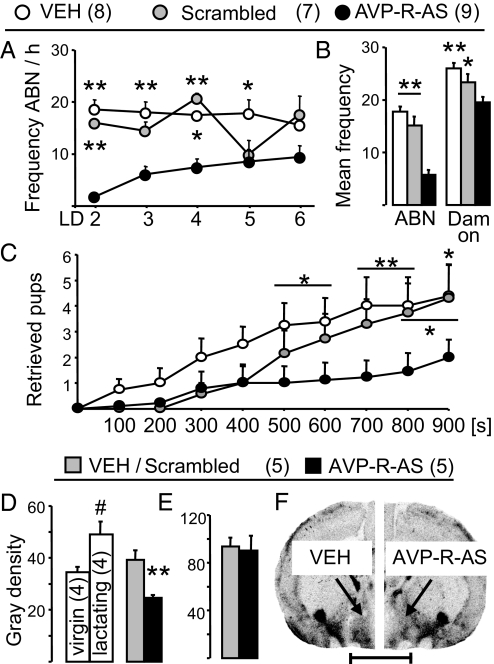
Effects of antisense-induced down-regulation of AVP-R expression within the MPOA on maternal behavior and local AVP-R and OXT-R binding. Dams were chronically infused with VEH, scrambled sequence, or AVP-R antisense (AVP-R-AS) into the left and right MPOA starting on LD 1. Frequency of ABN between LD 2 and LD 6 (A) and the mean frequency of ABN and dam on over LD 2 to LD 5 (B) is indicated. Also, the number of retrieved pups in a novel cage during a 900-s observation period was monitored (C). AVP-R binding in untreated virgin (V) and lactating (L) rats and after respective treatment (D and F) as well as OXT-R binding (E) within the MPOA was quantified as gray density on coronal sections by receptor autoradiography. (Scale bar, 500 μm.) Numbers in parentheses indicate group size. Data represent mean plus SEM. **, P < 0.01; *, P < 0.05 vs. AVP-R-AS; #, P < 0.05 vs. virgin.
Fig. 3.
Fig. 3.
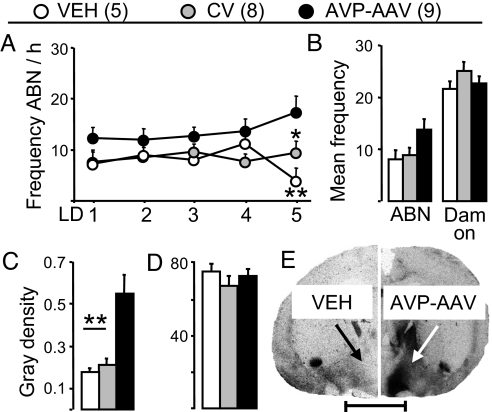
Effects of up-regulation of AVP-R expression within the MPOA on maternal behavior and local AVP-R and OXT-R binding. Dams received a single, bilateral infusion of VEH, control virus (CV), or an adeno-associated viral vector for overexpression of the AVP-R (AVP-AAV) on pregnancy day 10. Frequency of ABN between LD 1 and LD 5 (A) and the mean frequency of ABN and dam on over LD 2 to LD 5 (B) is indicated. AVP-R (C and E) and OXT-R (D) binding within the MPOA was quantified as gray density on coronal sections by receptor autoradiography. (Scale bar, 500 μm.) Data represent mean plus SEM. **, P < 0.01; *, P < 0.05 vs. AVP-AAV.
Fig. 4.
Fig. 4.
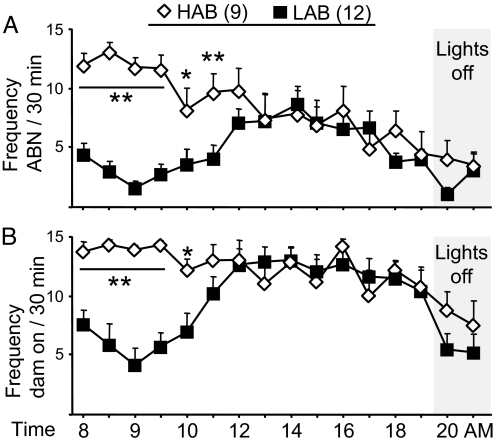
ABN (A) and time spent in direct contact with the pups (dam on) (B) of HAB and LAB dams on LD 4. Data represent mean plus SEM. **, P < 0.01; *, P < 0.05 vs. LAB.
Fig. 5.
Fig. 5.
Effects of manipulation of brain AVP and OXT systems on maternal behavior of HAB (A and B) and LAB (C and D) dams. HAB dams received a daily i.c.v. infusion of VEH, AVP-A, or OXT-A at 9 AM; LAB dams were chronically i.c.v. infused with VEH, synthetic AVP, or OXT i.c.v. starting on LD 1. For details, see Fig. 1. **, P < 0.01; *, P < 0.05 vs. VEH; ##, P < 0.01; # P < 0.05 vs. OXT-A; +, P < 0.05 vs. VEH and LAB AVP.
Fig. 6.
Fig. 6.
Differential effects of manipulation of the brain AVP and OXT systems on anxiety-related behavior on the plus-maze of NAB, HAB, and LAB dams. Lactating NAB (from Fig. 1 A and B) and HAB (from Fig. 5 A and B) rats received a daily i.c.v. infusion of VEH, AVP-A, or OXT-A (A). NAB (from Fig. 1 C and D) and LAB (from Fig. 5 C and D) dams were chronically treated with VEH, synthetic AVP, or OXT (B). Anxiety is reflected by the percentage time spent on the open arms. Data represent mean plus SEM. **, P < 0.01; *, P < 0.05 vs. VEH; ##, P < 0.01; #, P < 0.05 vs. OXT-A (A) or OXT (B).

References

    1. Caldwell HK, Lee HJ, Macbeth AH, Young WS., III Vasopressin: Behavioral roles of an “original” neuropeptide. Prog Neurobiol. 2008;84:1–24. - PMC - PubMed
    1. Ferguson JN, Young LJ, Insel TR. The neuroendocrine basis of social recognition. Front Neuroendocrinol. 2002;23:200–224. - PubMed
    1. Bielsky IF, Young LJ. Oxytocin, vasopressin, and social recognition in mammals. Peptides. 2004;25:1565–1574. - PubMed
    1. Landgraf R, et al. Viral vector-mediated gene transfer of the vole V1a vasopressin receptor in the rat septum: Improved social discrimination and active social behaviour. Eur J Neurosci. 2003;18:403–411. - PubMed
    1. Landgraf R, et al. V1 vasopressin receptor antisense oligodeoxynucleotide into septum reduces vasopressin binding, social discrimination abilities, and anxiety-related behavior in rats. J Neurosci. 1995;15:4250–4258. - PMC - PubMed

Publication types