. 2008 Oct 17;135(2):261-71.
doi: 10.1016/j.cell.2008.08.016.

RTEL1 maintains genomic stability by suppressing homologous recombination

Affiliations

RTEL1 maintains genomic stability by suppressing homologous recombination

Louise J Barber et al. Cell. .

Abstract

Homologous recombination (HR) is an important conserved process for DNA repair and ensures maintenance of genome integrity. Inappropriate HR causes gross chromosomal rearrangements and tumorigenesis in mammals. In yeast, the Srs2 helicase eliminates inappropriate recombination events, but the functional equivalent of Srs2 in higher eukaryotes has been elusive. Here, we identify C. elegans RTEL-1 as a functional analog of Srs2 and describe its vertebrate counterpart, RTEL1, which is required for genome stability and tumor avoidance. We find that rtel-1 mutant worms and RTEL1-depleted human cells share characteristic phenotypes with yeast srs2 mutants: lethality upon deletion of the sgs1/BLM homolog, hyperrecombination, and DNA damage sensitivity. In vitro, purified human RTEL1 antagonizes HR by promoting the disassembly of D loop recombination intermediates in a reaction dependent upon ATP hydrolysis. We propose that loss of HR control after deregulation of RTEL1 may be a critical event that drives genome instability and cancer.


Figures
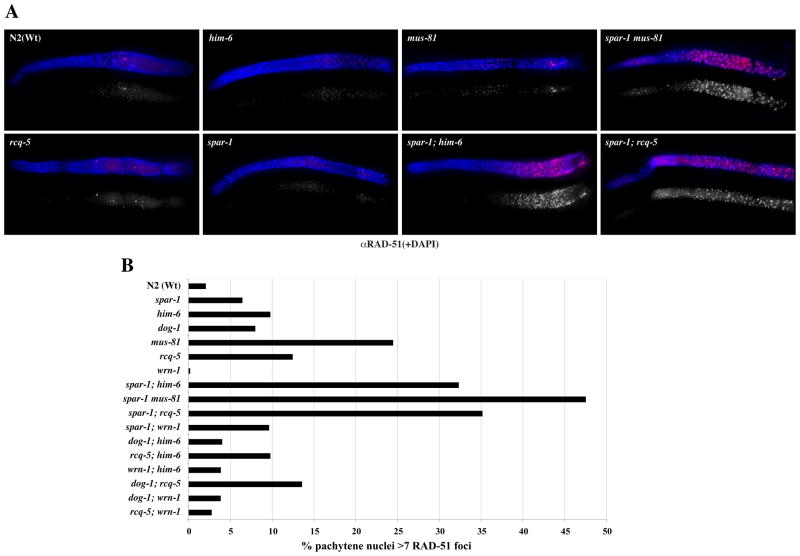
Figure 1
Figure 1. Synthetic lethality correlates with elevated levels of RAD-51 foci
A. Representative images of germ lines (genotype as indicated) stained with α-RAD-51 (Red) and DNA is counter-strained with DAPI (blue). Top RAD-51 + DAPI merge; bottom RAD-51 in greyscale. The distal end of the germline is on the left. B. Quantification of nuclei containing >6 RAD-51 foci in the pachytene region of the germline. At least 5 animals were scored for each genotype. A detailed quantification of total germline RAD-51 staining is shown in Fig. S3.
Figure 2
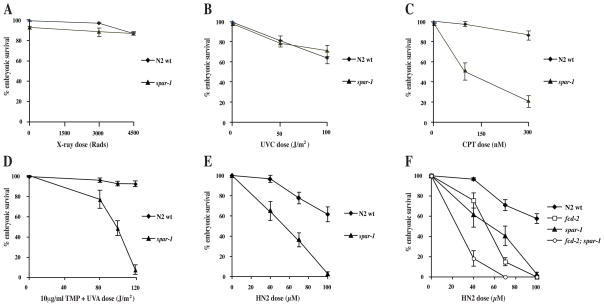
Figure 2. spar-1 mutants are sensitive to specific types of DNA damage
(A–E) Percentage progeny survival of worms treated with the indicated doses of (A) X-rays, (B) UVC (245 nm), (C) camptothecin (D) trimethylpsoralen activated with increasing doses of UVA (365 nm), and (E) nitrogen mustard (HN2). (F) Epistasis analysis of spar-1, fcd-2 and fcd-2; spar-1 mutants for sensitivity to HN2.
Figure 3
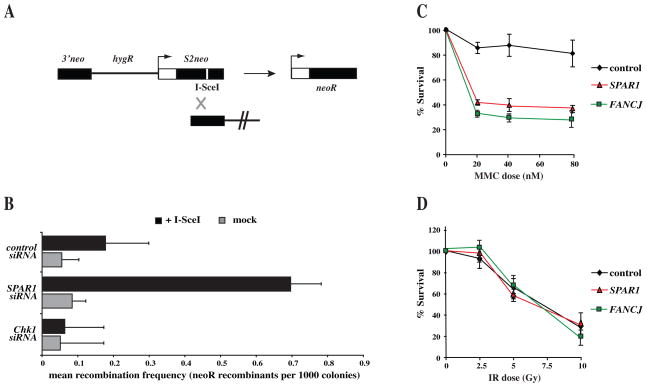
Figure 3. Human cells depleted for SPAR1 exhibit similar hyper-recombination and DNA damage sensitivity phenotypes to C. elegans spar-1 mutants
A. Schematic of the integrated SCneo substrate used to measure recombination frequencies, comprising two non-functional alleles of the neomycin resistance gene. Initiation of a DSB at the I-SceI restriction site (white line) induces HR, restoring a functional neoR cassette through gene conversion. B. Analysis of I-SceI induced HR at the SCneo construct after non-targeting control, SPAR1, or CHK1 siRNA depletion, and subsequent transfection of I-SceI expression vector in SW480/SN3 cells. Neomycin resistant colonies were scored at 10 days after transfection. Error bars indicate s.e.m. from 3 independent experiments. C, D. Sensitivity of siRNA depleted cells to the indicated doses of (C) mitomycin C and (D) IR. Error bars indicate s.e.m. from 3 independent experiments.
Figure 4
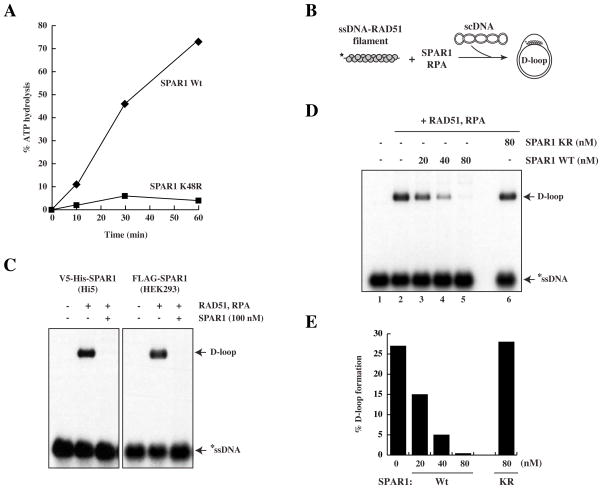
Figure 4. Human SPAR1 inhibits D loop formation in an ATP-dependent manner
A. ATP hydrolysis assay of human wild-type and mutant (K48R) SPAR1 performed in the presence of single stranded DNA. B. Schematic of the D loop assay. C. D loop assay with 100nM of Wt SPAR1 purified from Hi5 insect cells or HEK293 cells, as indicated. The D loop species migrates slower than the ssDNA probe. D. D loop assay with Wt or K48R SPAR1, as indicated. E. Quantification of D loop formation.
Figure 5
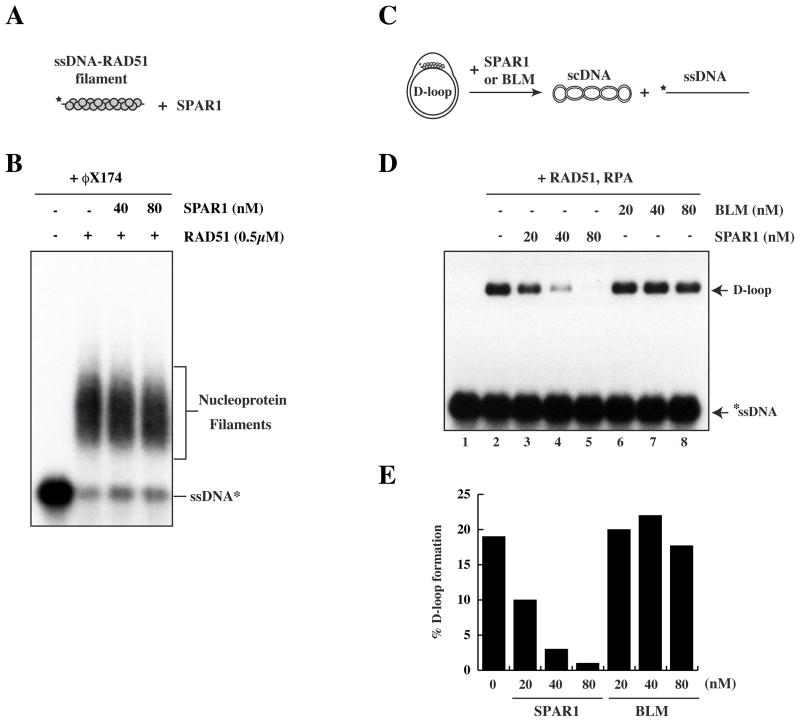
Figure 5. SPAR1 specifically disrupts performed D loops
A. Schematic of the ssDNA–RAD51 filament disruption assay. B. Pre-formed ssDNA-RAD51 filaments were incubated with the indicated concentrations of SPAR1 followed by addition of a 200-fold excess of cold φX174 ssDNA competitor. C. Schematic of the modified D loop disruption assay. D. Preformed D loops were incubated with the indicated concentrations of SPAR1 and BLM. E. Quantification of D loop disruption.

Comment in

References

    1. Aboussekhra A, Chanet R, Adjiri A, Fabre F. Semidominant suppressors of Srs2 helicase mutations of Saccharomyces cerevisiae map in the RAD51 gene, whose sequence predicts a protein with similarities to procaryotic RecA proteins. Mol Cell Biol. 1992;12:3224–3234. - PMC - PubMed
    1. Aboussekhra A, Chanet R, Zgaga Z, Cassier-Chauvat C, Heude M, Fabre F. RADH, a gene of Saccharomyces cerevisiae encoding a putative DNA helicase involved in DNA repair. Characteristics of radH mutants and sequence of the gene. Nucleic Acids Res. 1989;17:7211–7219. - PMC - PubMed
    1. Aguilera A, Klein HL. Genetic control of intrachromosomal recombination in Saccharomyces cerevisiae. I. Isolation and genetic characterization of hyper-recombination mutations. Genetics. 1988;119:779–790. - PMC - PubMed
    1. Ahmed S, Alpi A, Hengartner MO, Gartner A. C. elegans RAD-5/CLK-2 defines a new DNA damage checkpoint protein. Curr Biol. 2001;11:1934–1944. - PubMed
    1. Alpi A, Pasierbek P, Gartner A, Loidl J. Genetic and cytological characterization of the recombination protein RAD-51 in Caenorhabditis elegans. Chromosoma. 2003;112:6–16. - PubMed

Publication types

MeSH terms