


Animal models of polyglutamine diseases and therapeutic approaches
- PMID: 18957429
- PMCID: PMC2658038
- DOI: 10.1074/jbc.R800065200
Animal models of polyglutamine diseases and therapeutic approaches
Abstract
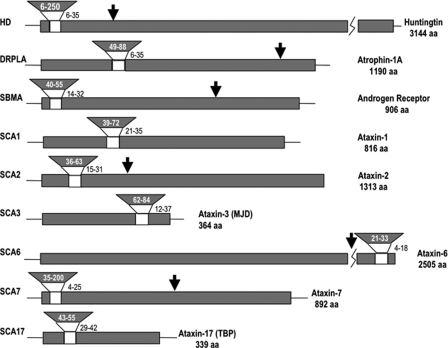
The dominant gain-of-function polyglutamine repeat diseases, in which the initiating mutation is known, allow development of models that recapitulate many aspects of human disease. To the extent that pathology is a consequence of disrupted fundamental cellular activities, one can effectively study strategies to ameliorate or protect against these cellular insults. Model organisms allow one to identify pathways that affect disease onset and progression, to test and screen for pharmacological agents that affect pathogenic processes, and to validate potential targets genetically as well as pharmacologically. Here, we describe polyglutamine repeat diseases that have been modeled in a variety of organisms, including worms, flies, mice, and non-human primates, and discuss examples of how they have broadened the therapeutic landscape.
Figures
References
-
- Orr, H. T., and Zoghbi, H. Y. (2007) Annu. Rev. Neurosci. 30 575–621 - PubMed
-
- Katsuno, M., Banno, H., Suzuki, K., Takeuchi, Y., Kawashima, M., Tanaka, F., Adachi, H., and Sobue, G. (2008) Curr. Mol. Med. 8 221–234 - PubMed
-
- Cattaneo, E., Zuccato, C., and Tartari, M. (2005) Nat. Rev. Neurosci. 6 919–930 - PubMed
-
- Dorval, V., and Fraser, P. E. (2007) Biochim. Biophys. Acta 1773 694–706 - PubMed
Publication types
MeSH terms
Substances
Grants and funding
LinkOut - more resources
Full Text Sources
Molecular Biology Databases
