


Staged assembly of histone gene expression machinery at subnuclear foci in the abbreviated cell cycle of human embryonic stem cells
- PMID: 18957539
- PMCID: PMC2579361
- DOI: 10.1073/pnas.0809273105
Staged assembly of histone gene expression machinery at subnuclear foci in the abbreviated cell cycle of human embryonic stem cells
Abstract
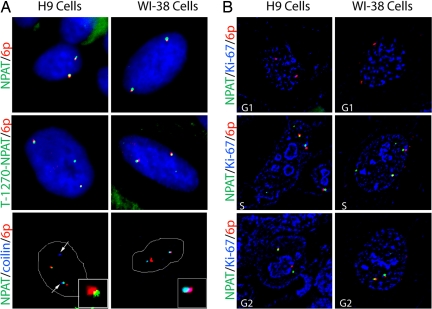
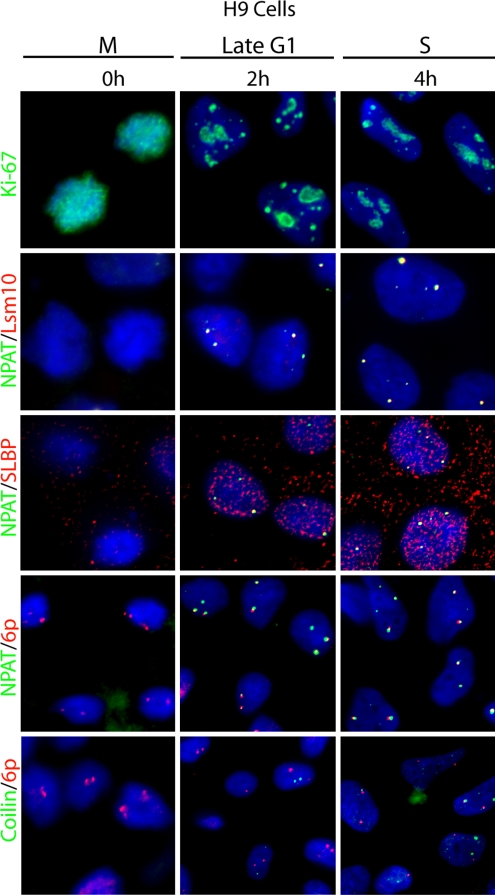
Human embryonic stem (hES) cells have an abbreviated G(1) phase of the cell cycle. How cells expedite G(1) events that are required for the initiation of S phase has not been resolved. One key regulatory pathway that controls G(1)/S-phase transition is the cyclin E/CDK2-dependent activation of the coactivator protein nuclear protein, ataxia-telangiectasia locus/histone nuclear factor-P (p220(NPAT)/HiNF-P) complex that induces histone gene transcription. In this study, we use the subnuclear organization of factors controlling histone gene expression to define mechanistic differences in the G(1) phase of hES and somatic cells using in situ immunofluorescence microscopy and fluorescence in situ hybridization (FISH). We show that histone gene expression is supported by the staged assembly and modification of a unique subnuclear structure that coordinates initiation and processing of transcripts originating from histone gene loci. Our results demonstrate that regulatory complexes that mediate transcriptional initiation (e.g., p220(NPAT)) and 3'-end processing (e.g., Lsm10, Lsm11, and SLBP) of histone gene transcripts colocalize at histone gene loci in dedicated subnuclear foci (histone locus bodies) that are distinct from Cajal bodies. Although appearance of CDK2-phosphorylated p220(NPAT) in these domains occurs at the time of S-phase entry, histone locus bodies are formed approximately 1 to 2 h before S phase in embryonic cells but 6 h before S phase in somatic cells. These temporal differences in the formation of histone locus bodies suggest that the G(1) phase of the cell cycle in hES cells is abbreviated in part by contraction of late G(1).
Conflict of interest statement
The authors declare no conflict of interest.
Figures


References
-
- Becker KA, et al. Self-renewal of human embryonic stem cells is supported by a shortened G1 cell cycle phase. J Cell Physiol. 2006;209:883–893. - PubMed
-
- Becker KA, Stein JL, Lian JB, van Wijnen AJ, Stein GS. Establishment of histone gene regulation and cell cycle checkpoint control in human embryonic stem cells. J Cell Physiol. 2007;210:517–526. - PubMed
-
- Pardee AB. G1 events and regulation of cell proliferation. Science. 1989;246:603–608. - PubMed
-
- Stein GS, Stein JL, van Wijnen AJ, Lian JB. Transcriptional control of cell cycle progression: The histone gene is a paradigm for the G1/S phase and proliferation/differentiation transitions. Cell Biol Int. 1996;20:41–49. - PubMed
Publication types
MeSH terms
Substances
Grants and funding
LinkOut - more resources
Full Text Sources
