


Stay@Work: Participatory Ergonomics to prevent low back and neck pain among workers: design of a randomised controlled trial to evaluate the (cost-)effectiveness
- PMID: 18959799
- PMCID: PMC2588446
- DOI: 10.1186/1471-2474-9-145
Stay@Work: Participatory Ergonomics to prevent low back and neck pain among workers: design of a randomised controlled trial to evaluate the (cost-)effectiveness
Abstract
Background: Low back pain (LBP) and neck pain (NP) are a major public health problem with considerable costs for individuals, companies and society. Therefore, prevention is imperative. The Stay@Work study investigates the (cost-)effectiveness of Participatory Ergonomics (PE) to prevent LBP and NP among workers.
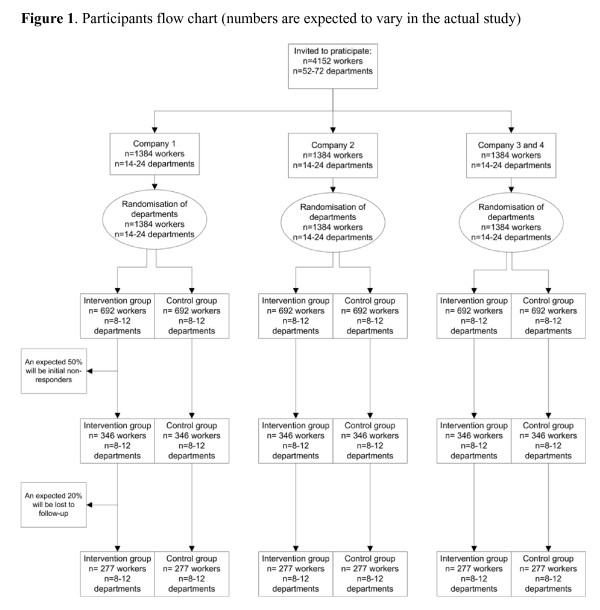
Methods: In a randomised controlled trial (RCT), a total of 5,759 workers working at 36 departments of four companies is expected to participate in the study at baseline. The departments consisting of about 150 workers are pre-stratified and randomised. The control departments receive usual practice and the intervention departments receive PE. Within each intervention department a working group is formed including eight workers, a representative of the management, and an occupational health and safety coordinator. During a one day meeting, the working group follows the steps of PE in which the most important risk factors for LBP and NP, and the most adequate ergonomic measures are identified on the basis of group consensus. The implementation of ergonomic measures at the department is performed by the working group. To improve the implementation process, so-called 'ergocoaches' are trained. The primary outcome measure is an episode of LBP and NP. Secondary outcome measures are actual use of ergonomic measures, physical workload, psychosocial workload, intensity of pain, general health status, sick leave, and work productivity. The cost-effectiveness analysis is performed from the societal and company perspective. Outcome measures are assessed using questionnaires at baseline and after 6 and 12 months. Data on the primary outcome as well as on intensity of pain, sick leave, work productivity, and health care costs are collected every 3 months.
Discussion: Prevention of LBP and NP is beneficial for workers, employers, and society. If the intervention is proven (cost-)effective, the intervention can have a major impact on LBP and NP prevention and, thereby, on work disability prevention. Results are expected in 2010.
Trial registration: ISRCTN27472278.
References
-
- Heinrich J, Blatter MN. RSI-klachten in de Nederlandse beroepsbevolking. Trends risicofactoren en verklaringen (Work-related musculoskeletal disorders of neck an upper extremity in the Dutch working population. Trends, risk factors and explanations) Tijdschr Gezondheidsw. 2005;83:25–35.
-
- Ariëns GA, Bongers PM, Hoogendoorn WE, Wal G van der, van Mechelen W. High physical and psychosocial load at work and sickness absence due to neck pain. Scand J Work Environ Health. 2002;28:222–231. - PubMed
Publication types
MeSH terms
Associated data
LinkOut - more resources
Full Text Sources
Medical
Miscellaneous
