. 1991 Oct;88(4):853-60.

Standards for selected anthropometric measurements in Prader-Willi syndrome

Affiliations

Standards for selected anthropometric measurements in Prader-Willi syndrome

M G Butler et al. Pediatrics. 1991 Oct.

Abstract

We report standards (95th, 50th, and 5th centiles) in Prader-Willi syndrome for weight, height, sitting height, head circumference, head length, head breadth, hand length, middle finger length, palm length, hand breadth, foot length, foot breadth, triceps skinfold, and subscapular skinfold. For comparison with Prader-Willi syndrome standardized curves, normal control data from the literature were plotted similarly and standard curves were produced. We encourage the use of these standards with the examination of patients who have Prader-Willi syndrome and in the comparison of the patient who has Prader-Willi syndrome with other similarly affected individuals. The standards may also be useful for assisting in the diagnosis of Prader-Willi syndrome, particularly in younger individuals.


Figures

Fig 1.
Fig 1.
Standardized curves for weight of Prader-Willi syndrome (PWS) male and female patients (solid line) and healthy individuals (broken line).
Fig 2.
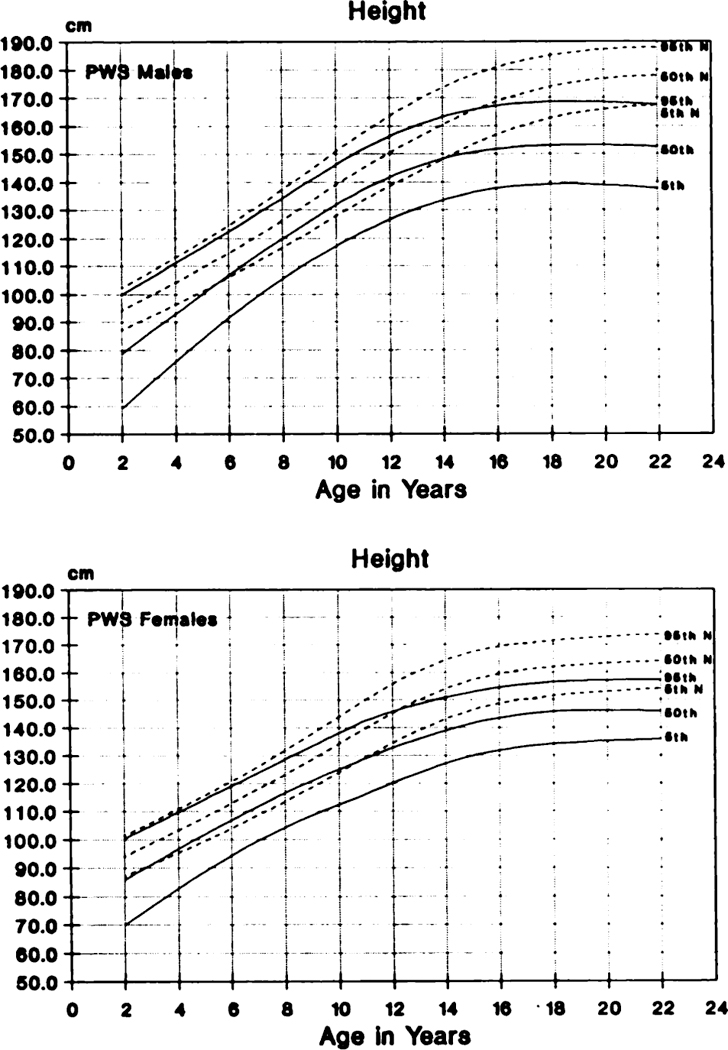
Fig 2.
Standardized curves for height of Prader-Willi syndrome (PWS) male and female patients (solid line) and healthy individuals (broken line).
Fig 3.
Fig 3.
Standardized curves for sitting height of Prader-Willi syndrome (PWS) male and female patients (solid line) and healthy individuals (broken line).
Fig 4.
Fig 4.
Standardized curves for head circumference of Prader-Willi syndrome (PWS) male and female patients (solid line) and healthy individuals (broken line).
Fig 5.
Fig 5.
Standardized curves for head length of Prader-Willi syndrome (PWS) male and female patients (solid line) and healthy individuals (broken line).
Fig 6.
Fig 6.
Standardized curves for head breadth of Prader-Willi syndrome (PWS) male and female patients (solid line) and healthy individuals (broken line).
Fig 7.
Fig 7.
Standardized curves for hand length of Prader-Willi syndrome (PWS) male and female patients (solid line) and healthy individuals (broken line).
Fig 8.
Fig 8.
Standardized curves for middle finger length of Prader-Willi syndrome (PWS) male and female patients (solid line) and healthy individuals (broken line).
Fig 9.
Fig 9.
Standardized curves for palm length of Prader-Willi syndrome (PWS) male and female patients (solid line) and healthy individuals (broken line).
Fig 10.
Fig 10.
Standardized curves for hand breath of Prader-Willi syndrome (PWS) male and female patients (solid line) and healthy individuals (broken line).
Fig 11.
Fig 11.
Standardized curves for foot length of Prader-Willi syndrome (PWS) male and female patients (solid line) and healthy individuals (broken line).
Fig 12.
Fig 12.
Standardized curves for foot breadth of Prader-Willi syndrome (PWS) male and female patients (solid line) and healthy individuals (broken line).
Fig 13.
Fig 13.
Standardized curves for triceps skinfold of Prader-Willi syndrome (PWS) male and female patients (solid line) and healthy individuals (broken line).
Fig 14.
Fig 14.
Standardized curves for subscapular skinfold of Prader-Willi syndrome (PWS) male and female patients (solid line) and healthy individuals (broken line).

References

    1. Prader A, Labhart A, Willi H. Ein Syndrome von Adipositas, Kleinwuchs, Kryptochismus and Oligophrenie nach myatonieartigem Zustand in Neugeborenenalter. Schweiz Med Wochenschr. 1956;86:1260–1261
    1. Hall BD, Smith DW. Prader-Willi syndrome. J Pediatr. 1972;81:286–293 - PubMed
    1. Cassidy SB. Prader-Willi syndrome. Curr Probl Pediatr. 1984;14:1–55 - PubMed
    1. Bray GA, Dahms WT, Swerdloff RS, Fiser RH, Atkinson RL, Carrel RE. The Prader-Willi syndrome. Medicine. 1983;62:59–80 - PubMed
    1. Butler MG, Meaney FJ, Palmer CG. Clinical and cytogenetic survey of 39 individuals with Prader-Labhart-Willi syndrome. Am J Med Genet. 1986;23:793–809 - PMC - PubMed

Publication types

LinkOut - more resources