Exercise, affect, and adherence: an integrated model and a case for self-paced exercise
- PMID: 18971508
- PMCID: PMC4222174
- DOI: 10.1123/jsep.30.5.471
Exercise, affect, and adherence: an integrated model and a case for self-paced exercise
Abstract
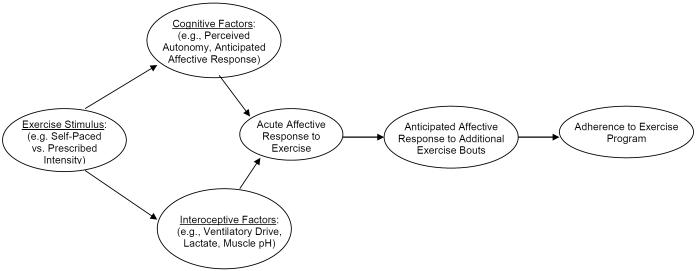
The article reviews research relevant to a proposed conceptual model of exercise adherence that integrates the dual mode model and hedonic theory. Exercise intensity is posited to influence affective response to exercise via interoceptive (e.g., ventilatory drive) and cognitive (e.g., perceived autonomy) pathways; affective response to exercise is posited to influence exercise adherence via anticipated affective response to future exercise. The potential for self-paced exercise to enhance exercise adherence is examined in the context of the proposed model and suggestions are given for future research. Further evidence in support of self-paced exercise could have implications for exercise prescription, especially among overweight, sedentary adults, who are most in need of interventions that enhance adherence to exercise programs.
Figures

References
-
- Abraham C, Sheeran P. Acting on intentions: the role of anticipated regret. British Journal of Social Psychology. 2003;42(4):495–511. - PubMed
-
- Abraham C, Sheeran P. Deciding to exercise: the role of anticipated regret. British Journal of Health Psychology. 2004;9(2):269–278. - PubMed
-
- Aellen R, Hollmann W, Boutellier U. Effects of aerobic and anaerobic training on plasma lipoproteins. International Journal of Sports Medicine. 1993;14(7):396–400. - PubMed
-
- Ahmaidi S, Masse-Biron J, Adam B, Choquet D, Freville M, Libert JP, et al. Effects of interval training at the ventilatory threshold on clinical and cardiorespiratory responses in elderly humans. European Journal of Applied Physiology and Occupational Physiology. 1998;78(2):170–176. - PubMed
-
- Ajzen I. The theory of planned behavior. Organizational Behavior and Human Decision Processes. 1991;50:179–211.