


Evaluation of dichloroacetic acid for carcinogenicity in genetically modified Tg.AC hemizygous and p53 haploinsufficient mice
- PMID: 18974089
- PMCID: PMC2638641
- DOI: 10.1093/toxsci/kfn228
Evaluation of dichloroacetic acid for carcinogenicity in genetically modified Tg.AC hemizygous and p53 haploinsufficient mice
Abstract
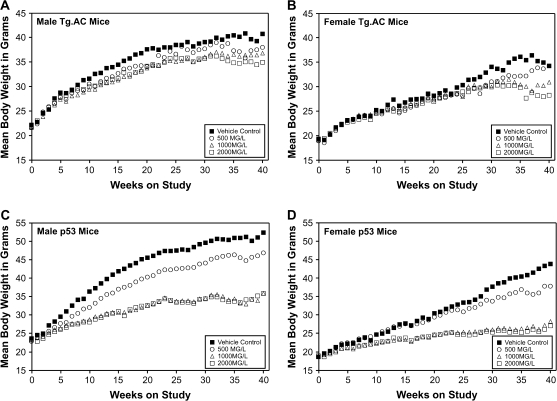
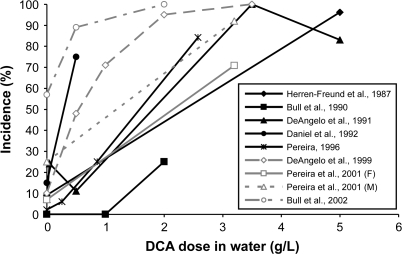
There has been considerable interest in the use of genetically modified mice for detecting potential environmental carcinogens. For this reason, the National Toxicology Program has been evaluating Tg.AC hemizygous and p53 haploinsufficient mice as models to detect potential carcinogens. It was reasoned that these mouse models might also prove more effective than standard rodent models in evaluating the numerous disinfection byproducts that are found in low concentrations in drinking water. Dichloroacetic acid (DCA) is one of the most frequently found disinfection byproducts and DCA has been consistently shown to cause hepatocellular tumors in rats and mice in standard rodent studies. Tg.AC hemizygous and p53 haploinsufficient mice were exposed in the drinking water to DCA for up to 41 weeks. In a second study Tg.AC mice were subjected to dermal DCA exposure for up to 39 weeks. Increased incidences and severity of cytoplasmic vacuolization of hepatocytes were seen in the p53 mice, but there was no evidence of carcinogenic activity at exposures of up to 2000 mg/l in the drinking water. Increased incidences and severity of cytoplasmic vacuolization of hepatocytes were seen in the drinking water study with Tg.AC mice and a modest non-dose-related increase in pulmonary adenomas was observed in males exposed to 1000 mg/l in the drinking water. Dermal exposure up to 500 mg/kg for 39 weeks resulted in increased dermal papillomas at the site of application in Tg.AC mice. No significant increase in papillomas under the same study conditions was seen in the 26-week study. For DCA under these study conditions, the p53 and Tg.AC mice appear less sensitive to hepatocarcinogenesis than standard rodent models. These results suggest caution for the use of Tg.AC and p53 mice to screen unknown chemicals in drinking water for potential carcinogenicity.
Figures
References
-
- Barton HA, Bull R, Schultz I, Anderson ME. Dichloroacetate (DCA) dosimetry: Interpreting DCA-induced liver cancer dose response and the potential for DCA to contribute to trichloroethylene-induced liver cancer. Toxicol. Lett. 1999;106:9–21. - PubMed
-
- Boorman GA, Eustis SL. The pathology working group as a means for assuring pathology quality in toxicological studies. In: Hoover BK, Baldwin JK, Uelner AF, Whitmire CE, Davies CL, Bristol DW, editors. Managing Conduct and Data Quality of Toxicological Studies. Vol. 1. Princeton, NJ: Princeton Scientific Publishing Co., Inc.; 1986. pp. 271–275.
-
- Bull RJ, Orner GA, Cheng RS, Stillwell L, Stauber AJ, Sasser LB, Lingohr MK, Thrall BD. Contribution of dichloroacetate and trichloroacetate to liver tumor induction in mice by trichloroethylene. Toxicol. Appl. Pharmacol. 2002;182:55–65. - PubMed
-
- Bull RJ, Sanchez IM, Nelson MA, Larson JL, Lansing AJ. Liver tumor induction in B6C3F1 mice by dichloroacetate and trichloroacetate. Toxicology. 1990;63:341–359. - PubMed
Publication types
MeSH terms
Substances
Grants and funding
LinkOut - more resources
Full Text Sources
Other Literature Sources
Molecular Biology Databases
Research Materials
Miscellaneous
