


TcSNP: a database of genetic variation in Trypanosoma cruzi
- PMID: 18974180
- PMCID: PMC2686512
- DOI: 10.1093/nar/gkn874
TcSNP: a database of genetic variation in Trypanosoma cruzi
Abstract
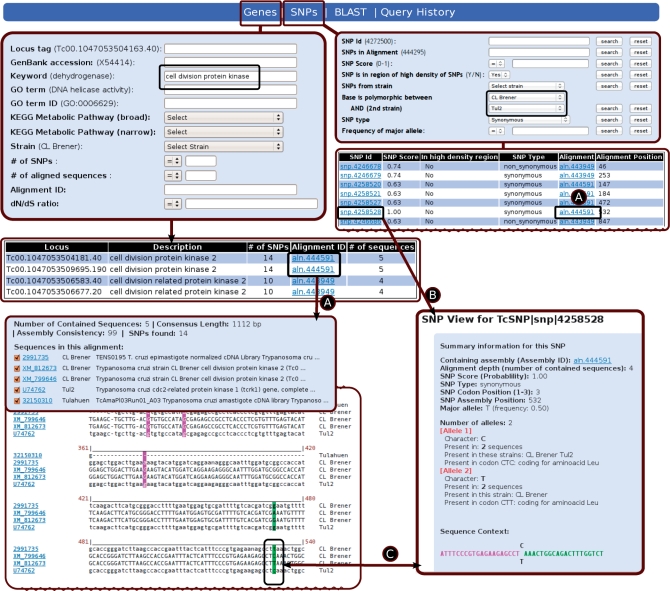
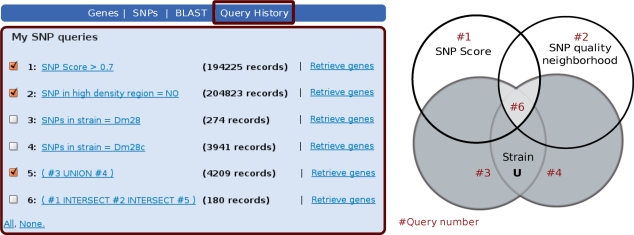
The TcSNP database (http://snps.tcruzi.org) integrates information on genetic variation (polymorphisms and mutations) for different stocks, strains and isolates of Trypanosoma cruzi, the causative agent of Chagas disease. The database incorporates sequences (genes from the T. cruzi reference genome, mRNAs, ESTs and genomic sequences); multiple sequence alignments obtained from these sequences; and single-nucleotide polymorphisms and small indels identified by scanning these multiple sequence alignments. Information in TcSNP can be readily interrogated to arrive at gene sets, or SNP sets of interest based on a number of attributes. Sequence similarity searches using BLAST are also supported. This first release of TcSNP contains nearly 170,000 high-confidence candidate SNPs, derived from the analysis of annotated coding sequences. As new sequence data become available, TcSNP will incorporate these data, mapping new candidate SNPs onto the reference genome sequences.
Figures
References
-
- Barrett MP, Burchmore RJS, Stich A, Lazzari JO, Frasch AC, Cazzulo JJ, Krishna S. The trypanosomiases. Lancet. 2003;362:1469–1480. - PubMed
-
- Tibayrenc M, Ayala FJ. Evolutionary genetics of Trypanosoma and Leishmania. Microbes Infect. 1999;1:465–472. - PubMed
-
- Henriksson J, Dujardin JC, Barnabé C, Brisse S, Timperman G, Venegas J, Pettersson U, Tibayrenc M, Solari A. Chromosomal size variation in Trypanosoma cruzi is mainly progressive and is evolutionarily informative. Parasitology. 2002;124:277–286. - PubMed
Publication types
MeSH terms
LinkOut - more resources
Full Text Sources
Research Materials
