Differential effects of high and low steroidogenic factor-1 expression on CYP11B2 expression and aldosterone production in adrenocortical cells
- PMID: 18974272
- PMCID: PMC2654740
- DOI: 10.1210/en.2008-0667
Differential effects of high and low steroidogenic factor-1 expression on CYP11B2 expression and aldosterone production in adrenocortical cells
Abstract
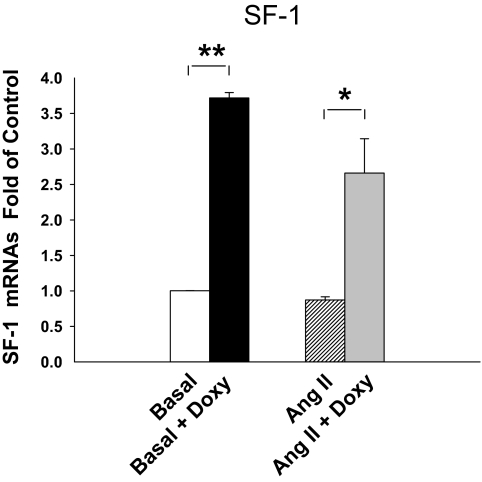
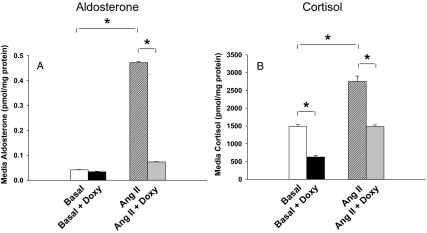
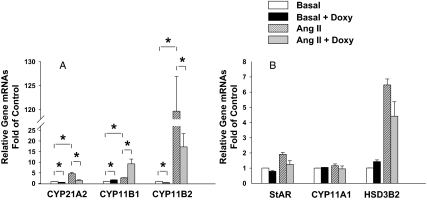
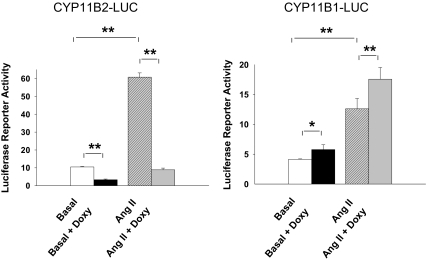
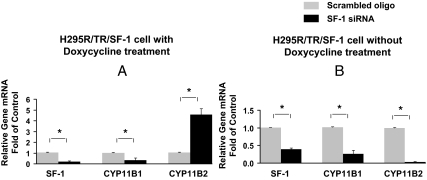
Steroidogenic factor-1 (SF-1/Ad4BP/NR5A1) plays a major role in regulating steroidogenic enzymes. We have previously shown that SF-1 inhibits aldosterone synthase (CYP11B2) reporter gene activity. Herein, we used the H295R/TR/SF-1 adrenal cells that increase SF-1 in a doxycycline-dependent fashion. Cells were incubated with or without doxycycline to induce SF-1 and then treated with angiotensin II (Ang II). Aldosterone was measured by immunoassay. SF-1 mRNA was silenced by small interfering RNA (siRNA) by Nucleofector technology. mRNA levels were measured by real-time RT-PCR. Ang II treatment without doxycycline increased aldosterone production by 11.3-fold and CYP11B2 mRNA by 116-fold. Doxycycline treatment increased SF-1 mRNA levels by 3.7-fold and inhibited Ang II-induced aldosterone by 84%. Doxycycline treatment inhibited Ang II-stimulated CYP11B2 mRNA levels by 86%. Doxycycline decreased basal CYP11B2 promoter activity by 68%. Doxycycline inhibited Ang II stimulation by 85%. Ang II increased CYP21 mRNA expression by 4.6-fold, whereas doxycycline inhibited induction by 69%. In contrast, doxycycline treatment increased CYP11B1 mRNA by 1.7-fold in basal cells and increased Ang II induction by 3.6-fold. SF-1-specific siRNA significantly reduced SF-1 mRNA expression as compared with cells treated with control siRNA. SF-1 siRNA reversed doxycycline stimulation of CYP B1 and its inhibition of CYP11B2. However, in H295R/TR/SF-1 cells without doxycycline treatment, both CYP11B1 and CYP11B2 mRNAs were significantly decreased, suggesting that both enzymes require a minimal level of SF-1 for basal expression. In summary, SF-1 overexpression dramatically inhibited CYP11B2 expression and decreased aldosterone production. The opposing effects of SF-1 on CYP11B1 and CYP11B2 suggest that the regulation of SF-1 activity may play a role that determines the relative ability to produce mineralocorticoid and glucocorticoid.
Figures
References
-
- Parker KL, Rice DA, Lala DS, Ikeda Y, Luo X, Wong M, Bakke M, Zhao L, Frigeri C, Hanley NA, Stallings N, Schimmer BP 2002 Steroidogenic factor 1: an essential mediator of endocrine development. Recent Prog Horm Res 57:19–36 - PubMed
-
- Hammer GD, Ingraham HA 1999 Steroidogenic factor-1: its role in endocrine organ development and differentiation. Front Neuroendocrinol 20:199–223 - PubMed
-
- Luo X, Ikeda Y, Parker KL 1994 A cell-specific nuclear receptor is essential for adrenal and gonadal development and sexual differentiation. Cell 77:481–490 - PubMed
-
- Sadovsky Y, Crawford PA, Woodson KG, Polish JA, Clements MA, Tourtellotte LM, Simburger K, Milbrandt J 1995 Mice deficient in the orphan receptor steroidogenic factor 1 lack adrenal glands and gonads but express P450 side-chain-cleavage enzyme in the placenta and have normal embryonic serum levels of corticosteroids. Proc Natl Acad Sci USA 92:10939–10943 - PMC - PubMed
Publication types
MeSH terms
Substances
Grants and funding
LinkOut - more resources
Full Text Sources
Miscellaneous