


Dynamic cerebral autoregulation during repeated squat-stand maneuvers
- PMID: 18974368
- PMCID: PMC2636935
- DOI: 10.1152/japplphysiol.90822.2008
Dynamic cerebral autoregulation during repeated squat-stand maneuvers
Abstract
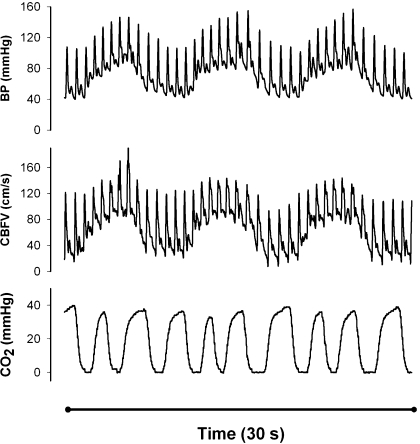
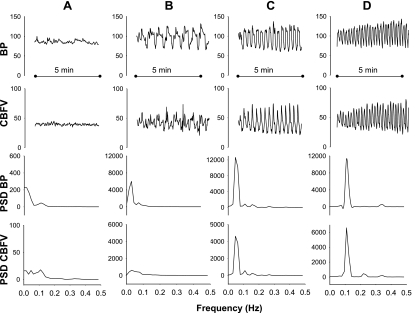
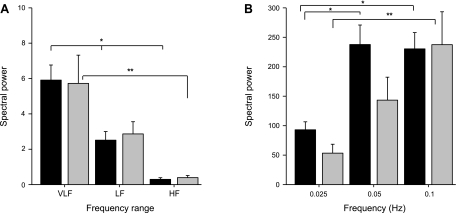
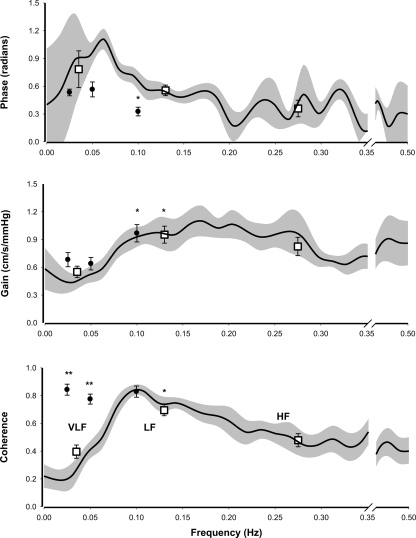
Transfer function analysis of spontaneous oscillations in blood pressure (BP) and cerebral blood flow (CBF) can quantify the dynamic relationship between BP and CBF. However, such oscillation amplitudes are often small and of questionable clinical significance, vary substantially, and cannot be controlled. At the very low frequencies (<0.07 Hz), coherence between BP and CBF often is low (<0.50) and their causal relationship is debated. Eight healthy subjects performed repeated squat-stand maneuvers to induce large oscillations in BP at frequencies of 0.025 and 0.05 Hz (very low frequency) and 0.1 Hz (low frequency), respectively. BP (Finapres), CBF velocity (CBFV; transcranial Doppler), and end-tidal CO(2) (capnography) were monitored. Spectral analysis was used to quantify oscillations in BP and CBFV and to estimate transfer function phase, gain, and coherence. Compared with spontaneous oscillations, induced oscillations had higher coherence [mean 0.8 (SD 0.11); >0.5 in all subjects at all frequencies] and lower variability in phase estimates. However, gain estimates remained unchanged. Under both conditions, the "high-pass filter" characteristics of dynamic autoregulation were observed. In conclusion, using repeated squat-stand maneuvers, we were able to study dynamic cerebral autoregulation in the low frequencies under conditions of hemodynamically strong and causally related oscillations in BP and CBFV. This not only enhances the confidence of transfer function analysis as indicated by high coherence and improved phase estimation but also strengthens the clinical relevance of this method as induced oscillations in BP and CBFV mimic those associated with postural changes in daily life.
Figures
References
-
- Aaslid R, Blaha M, Sviri G, Douville CM, Newell DW. Asymmetric dynamic cerebral autoregulatory response to cyclic stimuli. Stroke 38: 1465–1469, 2007. - PubMed
-
- Aaslid R, Lindegaard KF, Sorteberg W, Nornes H. Cerebral autoregulation dynamics in humans. Stroke 20: 45–52, 1989. - PubMed
-
- Birch AA, Dirnhuber MJ, Hartley-Davies R, Iannotti F, Neil-Dwyer G. Assessment of autoregulation by means of periodic changes in blood pressure. Stroke 26: 834–837, 1995. - PubMed
-
- Birch AA, Neil-Dwyer G, Murrills AJ. The repeatability of cerebral autoregulation assessment using sinusoidal lower body negative pressure. Physiol Meas 23: 73–83, 2002. - PubMed
-
- Bryan RM Jr, Marrelli SP, Steenberg ML, Schildmeyer LA, Johnson TD. Effects of luminal shear stress on cerebral arteries and arterioles. Am J Physiol Heart Circ Physiol 280: H2011–H2022, 2001. - PubMed
Publication types
MeSH terms
Substances
Grants and funding
LinkOut - more resources
Full Text Sources
Other Literature Sources
Medical
