. 2008 Dec 2;47(48):12853-9.
doi: 10.1021/bi801488c.

Promiscuous sulfatase activity and thio-effects in a phosphodiesterase of the alkaline phosphatase superfamily

Affiliations

Promiscuous sulfatase activity and thio-effects in a phosphodiesterase of the alkaline phosphatase superfamily

Jonathan K Lassila et al. Biochemistry. .

Abstract

The nucleotide phosphodiesterase/pyrophosphatase from Xanthomonas axonopodis (NPP) is a structural and evolutionary relative of alkaline phosphatase that preferentially hydrolyzes phosphate diesters. With the goal of understanding how these two enzymes with nearly identical Zn(2+) bimetallo sites achieve high selectivity for hydrolysis of either phosphate monoesters or diesters, we have measured a promiscuous sulfatase activity in NPP. Sulfate esters are nearly isosteric with phosphate esters but carry less charge, offering a probe of electrostatic contributions to selectivity. NPP exhibits sulfatase activity with k(cat)/K(M) value of 2 x 10(-5) M(-1) s(-1), similar to the R166S mutant of alkaline phosphatase. We further report the effects of thio-substitution on phosphate monoester and diester reactions. Reactivities with these noncognate substrates illustrate a reduced dependence of NPP reactivity on the charge of the nonbridging oxygen situated between the Zn(2+) ions relative to that in alkaline phosphatase. This reduced charge dependence can explain about 10(2) of the 10(7)-fold differential catalytic proficiency for the most similar monoester and diester substrates in the two enzymes. The results further suggest that active site contacts to substrate oxygen atoms that do not contact the Zn(2+) ions may play an important role in defining the selectivity of the enzymes.


Figures
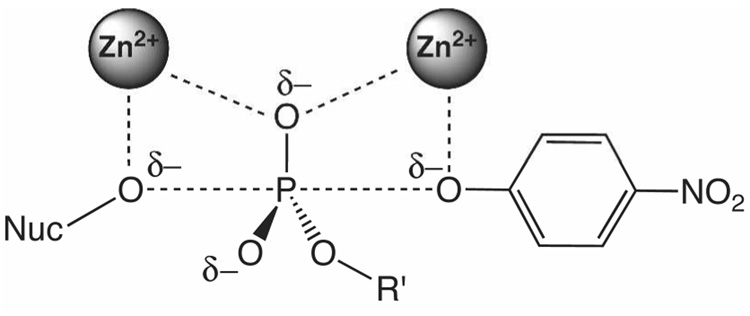
Figure 1
Figure 1
A nonbridging oxygen lies between two Zn2+ ions in AP and NPP transition state models (see reference and Figure 7 for more detailed comparisons). The ester substituent of diesters is indicated by R’.
Figure 2
Figure 2
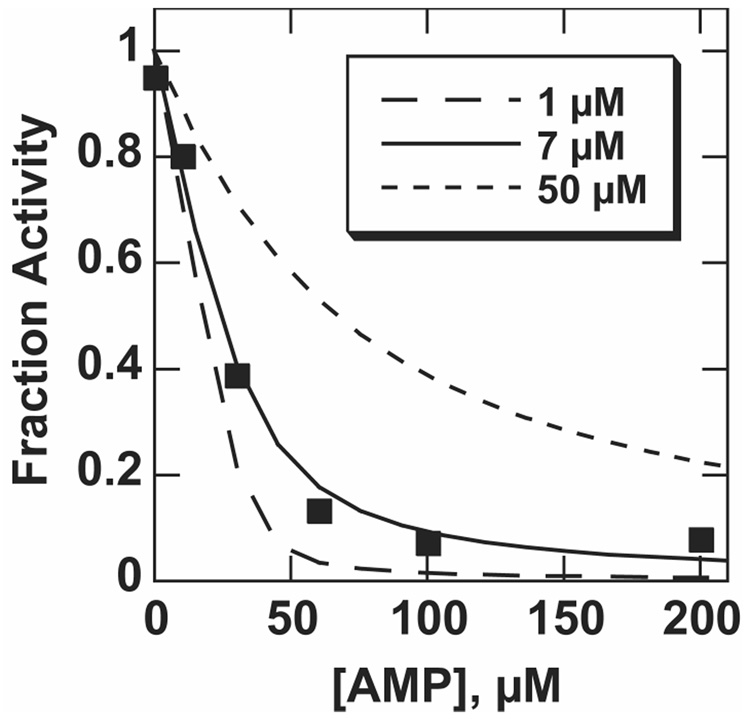
Inhibition of pNPS hydrolysis with AMP at pH 6.5. Because high enzyme concentrations were used, the standard expression for competitive inhibition could not be used for pNPS inhibition (see Materials and Methods). Curves shown were calculated using the indicated value of Ki and the expression described in Materials and Methods. Data for this experiment were collected with [E] = 34 µM, [S] = 9.8 mM, in 0.1 M MES, pH 6.5, 0.5 M NaCl, 100 µM ZnCl2, at 25 °C. The Ki measured for MepNPP at pH 6.5 and in the same buffer conditions was 6.9 ± 0.2 µM (data not shown), and the pNPS inhibition data fit the inhibition expression with a Ki value of 6.1 ± 1.4 µM.
Figure 3
Figure 3
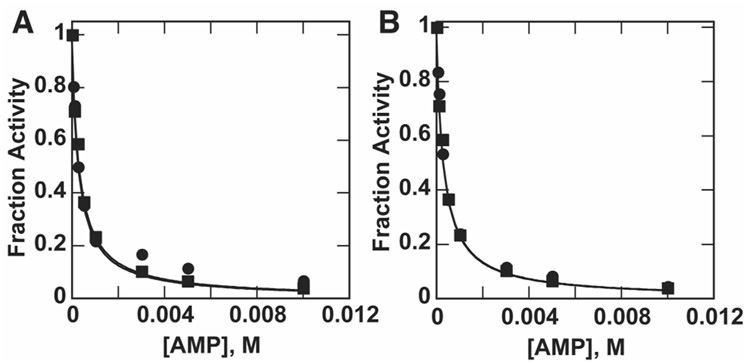
(A) Inhibition of pNPPS hydrolysis (circles) and MepNPP hydrolysis (squares) by AMP at pH 8.0. Ki values obtained from curve fitting are 294 ± 41 µM (pNPPS) and 318 ± 24 µM (MepNPP). Fitted curves overlap and thus appear as one curve. (B) Inhibition of MepNPPS hydrolysis (circles) and MepNPP hydrolysis (squares) by AMP at pH 8.0. Ki values obtained from curve fitting are 307 ± 17 µM (MepNPPS) and 318 ± 24 µM (MepNPP). Fitted curves overlap and thus appear as one curve. Fraction activity was determined by normalizing the measured rates to the uninhibited rate constant. Note that the Ki value for AMP inhibition is different at pH 8.0 than at 6.5, the pH used in Figure 2 (see text).
Figure 4
Figure 4
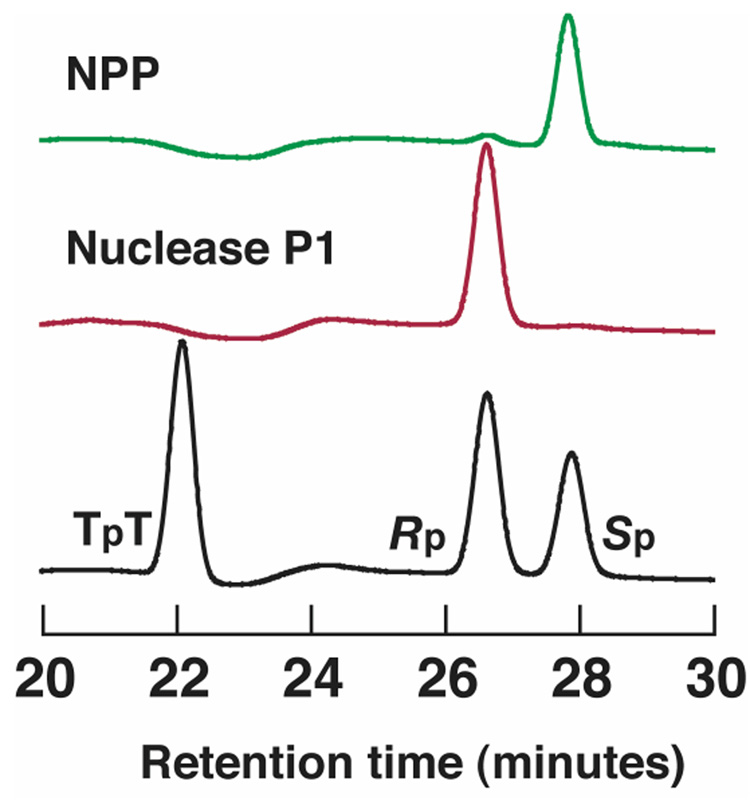
HPLC traces showing separation of phosphorothioate dinucleotide diastereomers (Rp, Sp) and phosphate dinucleotide (TpT). The untreated mixture is shown in black, and enzyme-treated mixtures are shown in red (nuclease P1) and green (NPP). Detection is by absorbance at 260 nm. Diastereomer assignments were made based on nuclease P1 selectivity and HPLC retention times (18).
Figure 5
Figure 5
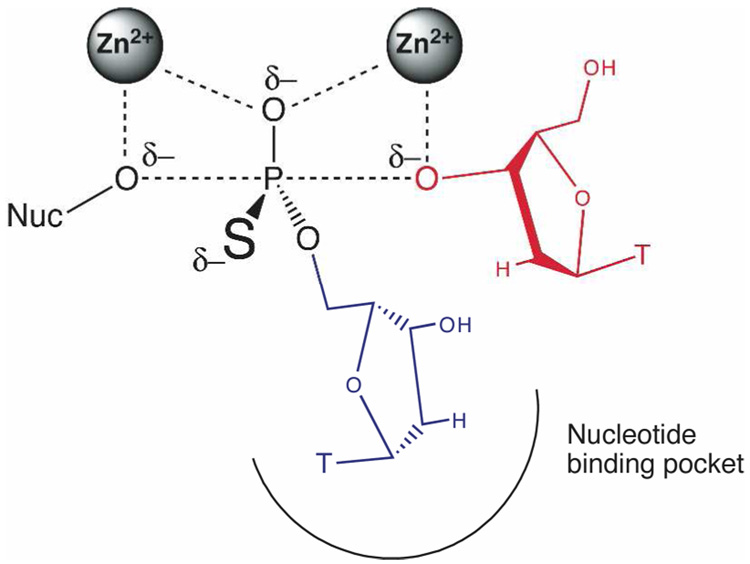
Model of the transition state arrangement for the Rp-TT dinucleotide. Hydrogen bonding patterns in AMP-bound crystal structure (Ref. 9) strongly suggest placement of the 3’ nucleotide (blue) within the nucleotide binding pocket, while the leaving group nucleotide (red) position is strongly suggested by the structure in complex with transition state analog vanadate (Ref. 9). This arrangement is further suggested by observed 3’ to 5’ nuclease activity of NPP (Ref. 9). Selectivity for Rp stereochemistry thus indicates that the sulfur atom is preferentially positioned as indicated in the figure by the large S. This is the expected result, as the Rp stereochemistry avoids placement of the larger sulfur atom between the Zn2+ atoms (31).
Figure 6
Figure 6
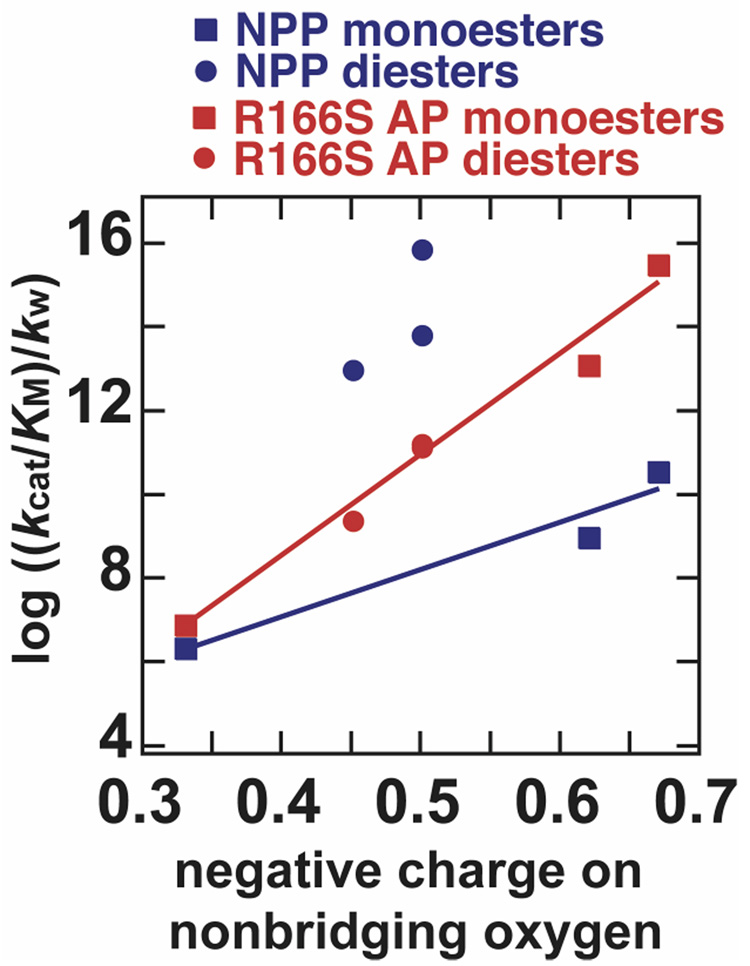
Log of catalytic proficiency, (kcat/KM)/kw, plotted against estimated fractional charge on each nonbridging oxygen of the substrate, using the data from Table 1 and Table 2. Estimated charges are from Reference . The MepNPP and bis-pNPP points for R166S AP overlap.
Figure 7
Figure 7
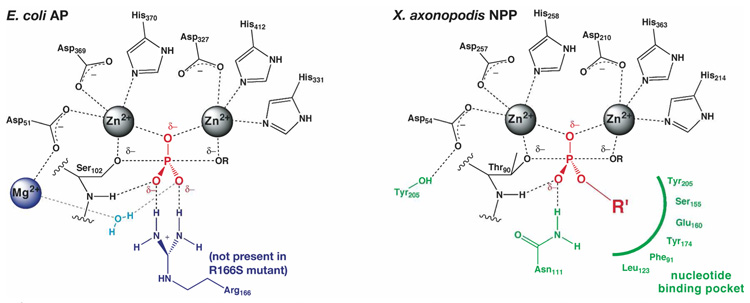
Active site differences between AP and NPP. See reference for additional discussion.
Scheme 1
Scheme 1

References

    1. Westheimer FH. Why nature chose phosphates. Science. 1987;235:1173–1178. - PubMed
    1. Lad C, Williams NH, Wolfenden R. The rate of hydrolysis of phosphomonoesters dianions and the exceptional catalytic proficiencies of protein and inositol phosphatases. Proc. Natl. Acad. Sci. USA. 2003;100:5607–5610. - PMC - PubMed
    1. Coleman JE. Structure and mechanism of alkaline phosphatase. Annu. Rev. Biophys. Biomol. Struct. 1992;21:441–483. - PubMed
    1. Kim EE, Wyckoff HW. Reaction mechanism of alkaline phosphatase based on crystal structures. Two-metal ion catalysis. J. Mol. Biol. 1991;218:449–464. - PubMed
    1. Galperin MY, Bairoch A, Koonin EV. A superfamily of metalloenzymes unifies phosphopentomutase and cofactor-independent phosphoglycerate mutase with alkaline phosphatases and sulfatases. Protein Sci. 1998;7:1829–1835. - PMC - PubMed

Publication types