


Identifying genetic traces of historical expansions: Phoenician footprints in the Mediterranean
- PMID: 18976729
- PMCID: PMC2668035
- DOI: 10.1016/j.ajhg.2008.10.012
Identifying genetic traces of historical expansions: Phoenician footprints in the Mediterranean
Abstract
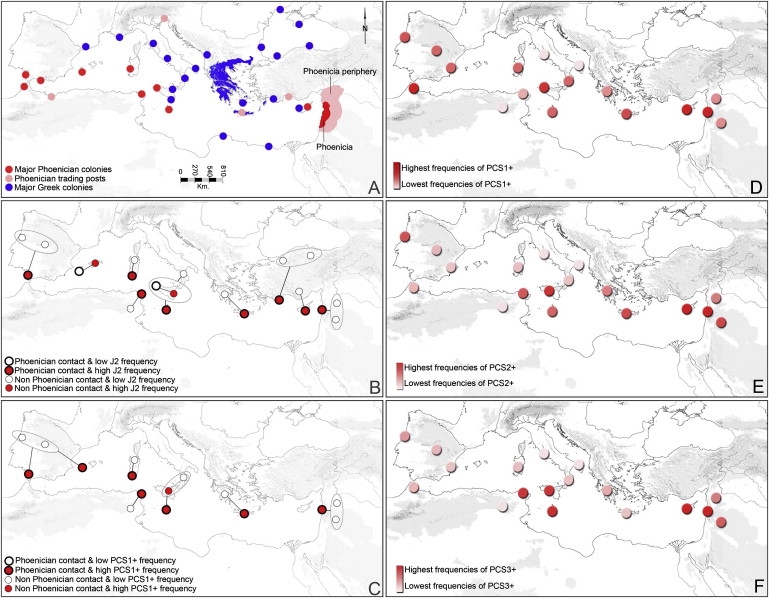
The Phoenicians were the dominant traders in the Mediterranean Sea two thousand to three thousand years ago and expanded from their homeland in the Levant to establish colonies and trading posts throughout the Mediterranean, but then they disappeared from history. We wished to identify their male genetic traces in modern populations. Therefore, we chose Phoenician-influenced sites on the basis of well-documented historical records and collected new Y-chromosomal data from 1330 men from six such sites, as well as comparative data from the literature. We then developed an analytical strategy to distinguish between lineages specifically associated with the Phoenicians and those spread by geographically similar but historically distinct events, such as the Neolithic, Greek, and Jewish expansions. This involved comparing historically documented Phoenician sites with neighboring non-Phoenician sites for the identification of weak but systematic signatures shared by the Phoenician sites that could not readily be explained by chance or by other expansions. From these comparisons, we found that haplogroup J2, in general, and six Y-STR haplotypes, in particular, exhibited a Phoenician signature that contributed > 6% to the modern Phoenician-influenced populations examined. Our methodology can be applied to any historically documented expansion in which contact and noncontact sites can be identified.
Figures
References
-
- Stieglitz R.R. The geopolitics of the Phoenician Littoral in the Early Iron Age. Bull. Am. Schools Orient. Res. 1990;279:9–12.
-
- Moscati S. Weidenfeld and Nicolson Ltd.; London: 1973. The World of Phoenicians.
-
- Markoe G. British Museum Press; London: 2000. Phoenicians.
-
- Aubet M.E. Cambridge University Press; Cambridge: 2001. The Phoenicians and the West: Politics, Colonies and Trade.
-
- Marston E. Benchmark Books; New York: 2002. The Phoenicians.
Publication types
MeSH terms
Grants and funding
LinkOut - more resources
Full Text Sources
