Review
. 2009 Feb 12;364(1515):341-55.
doi: 10.1098/rstb.2008.0269.

Molecular mechanisms of experience-dependent plasticity in visual cortex

Affiliations
Review

Molecular mechanisms of experience-dependent plasticity in visual cortex

Daniela Tropea et al. Philos Trans R Soc Lond B Biol Sci. .

Abstract

A remarkable amount of our current knowledge of mechanisms underlying experience-dependent plasticity during cortical development comes from study of the mammalian visual cortex. Recent advances in high-resolution cellular imaging, combined with genetic manipulations in mice, novel fluorescent recombinant probes, and large-scale screens of gene expression, have revealed multiple molecular mechanisms that underlie structural and functional plasticity in visual cortex. We situate these mechanisms in the context of a new conceptual framework of feed-forward and feedback regulation for understanding how neurons of the visual cortex reorganize their connections in response to changes in sensory inputs. Such conceptual advances have important implications for understanding not only normal development but also pathological conditions that afflict the central nervous system.


Figures
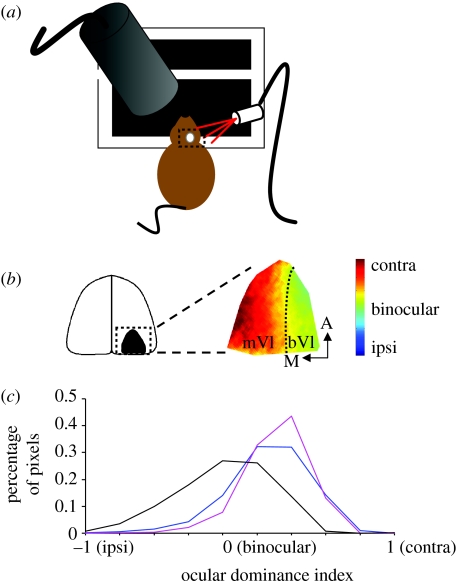
Figure 1
Figure 1
Testing the role of candidate molecules in ocular dominance plasticity using optical imaging of intrinsic signals. Similar measurements of ocular dominance shifts have been made using a number of physiological techniques, such as single unit recordings, visually evoked potentials (VEP) and optical imaging of intrinsic signals (OI). These techniques have been used to evaluate the relative activity evoked by each eye, but while single unit recordings measure spike-related events, VEP and OI also measure synaptic events. Optical imaging provides a particularly rapid and effective measurement of population responses from an expanse of cortex, and can be carried out repeatedly in the same cortex and with minimal invasiveness. (a) During intrinsic signal imaging, mice are placed in a stereotaxic apparatus in front of a monitor displaying a periodic drifting bar, and metabolically related changes in light reflectance (630 nm) are captured through the thinned skull with a charge-coupled device camera. Contralateral and ipsilateral eye responses are determined per pixel using Fourier analysis to isolate the component of the response at the stimulus frequency, and are used to define the monocular (mV1) and binocular (bV1) regions of V1. (b) An ocular dominance index (ODI) is calculated as the difference between the contralateral eye response and ipsilateral eye response, divided by the summed response, indicating a contralateral (+1) or ipsilateral (−1) bias. (c) Under normal conditions, the cortex is more strongly activated by stimulation of the contralateral eye, as indicated by the histogram of pixel ODI values (blue line). Deprivation of this eye during the critical period shifts the cortical activation towards the open, ipsilateral eye (black line). The influence of specific molecules can be evaluated by their effect on this ocular dominance shift. For example, treatment with (1–3) insulin-like growth factor 1 (IGF1; Tropea et al. 2006) concurrent with deprivation prevents this shift (pink line), confirming a key modulatory role of IGF1 in ocular dominance plasticity.
Figure 2
Figure 2
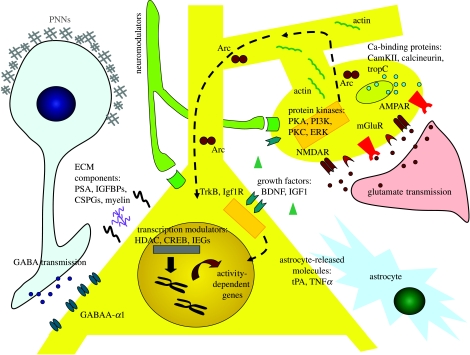
Schematic of key cellular and molecular mechanisms that mediate plasticity in visual cortex. A pyramidal neuron (yellow) receives inputs from a GABAergic neuron (blue, on the left) and from a glutamatergic presynaptic terminal (pink, on the right). The composition and density of GABA and glutamate receptors modulate cortical plasticity, as do the molecules involved in receptor trafficking (Arc). Molecules that detect and bind to post-synaptic calcium, such as cardiac Troponin C, calcineurin and CamKII, are also important for ocular dominance plasticity. Other effectors include MHC (major histocompatibility complex) molecules and growth factors, such as BDNF and IGF1 and neuromodulators (serotonin, acetylcholine and noradrenaline). Changes in calcium influx are followed by signalling cascades that include several protein kinases (such as ERK, PKA and CamKII), and terminate in activation of CREB-mediated transcription. This transcription is further controlled by chromatin-remodelling enzymes. The functional synaptic modifications are coupled with structural rearrangement of dendrites and spines, which most likely is mediated by actin remodelling. At the extracellular level, myelin-related receptors (NogoR) and components of the extracellular matrix (chondroitin sulphate proteoglycans, polysialic acid, insulin-like growth factor-binding protein and tissue plasminogen activator) regulate the capacity for structural plasticity and/or the access of molecular effectors to the cell soma. Some also form nets around inhibitory parvalbuminergic neurons (perineuronal nets, PNNs), which appear to restrict plasticity. Serotoninergic, cholinergic and noradrenergic afferents also modulate visual plasticity. Finally, glial cells (astrocytes) contribute to cortical plasticity by modulating glutamatergic transmission and producing plasticity-related molecules such as IGFBPs, tPA and TNFα. Abbreviations: PNNs, peri-neuronal nets; PSA, polysialic acid; ECM, extracellular matrix; IGFBPs, insulin-like growth factor-1-binding proteins; CSPGs, chondroitin-sulphate proteoglycans; HDAC, histone deacetylases; IEGs, immediate early genes; CREB, cAMP-responsive element-binding protein; tPA, tissue-type plasminogen activator; TNFα, tumour necrosis factor alpha; PKA, protein kinase A; PKC, protein kinase C; PI3K, phosphatidylinositol 3-kinase; ERK, extracellular signal-regulated kinase; tropC, cardiac troponin C; CamKII, calcium/calmodulin-dependent protein kinase II; BDNF, brain-derived neurotrophic factor; Igf1R, insulin-like growth factor 1 receptor; TrkB, tyrosine receptor kinase B.

References

    1. Alonso M., Medina J.H., Pozzo-Miller L. ERK1/2 activation is necessary for BDNF to increase dendritic spine density in hippocampal CA1 pyramidal neurons. Learn. Mem. 2004;11:172–178. doi:10.1101/lm.67804 - DOI - PMC - PubMed
    1. Antonini A., Stryker M.P. Rapid remodeling of axonal arbors in the visual cortex. Science. 1993;260:1819–1821. doi:10.1126/science.8511592 - DOI - PubMed
    1. Antonini A., Fagiolini M., Stryker M.P. Anatomical correlates of functional plasticity in mouse visual cortex. J. Neurosci. 1999;19:4388–4406. - PMC - PubMed
    1. Bear M.F., Singer W. Modulation of visual cortical plasticity by acetylcholine and noradrenaline. Nature. 1986;320:172–176. doi:10.1038/320172a0 - DOI - PubMed
    1. Beaver C.J., Ji Q., Fisher Q.S., Daw N.W. Cyclic AMP-dependent protein kinase mediates ocular dominance shifts in cat visual cortex. Nat. Neurosci. 2001;4:159–163. - PubMed

Substances

LinkOut - more resources