


Obesity, race/ethnicity and life course socioeconomic status across the transition from adolescence to adulthood
- PMID: 18977809
- PMCID: PMC2627789
- DOI: 10.1136/jech.2008.075721
Obesity, race/ethnicity and life course socioeconomic status across the transition from adolescence to adulthood
Abstract
Background: Differences in the association of socioeconomic status (SES) with obesity may underlie the racial/ethnic disparities in obesity that increase dramatically across the transition to adulthood in the United States. The aim of this study was to examine racial/ethnic differences in the influence of life course SES on longitudinal obesity patterns from adolescence to adulthood.
Methods: Latent class analysis was used on a nationally representative, diverse sample of 12 940 adolescents followed into young adulthood (mean age = 21.7 years) to identify life course SES group profiles based on SES data in adolescence and young adulthood. Gender-stratified multinomial logistic regression models estimated the association of SES groups with obesity incidence and persistence versus staying non-obese.
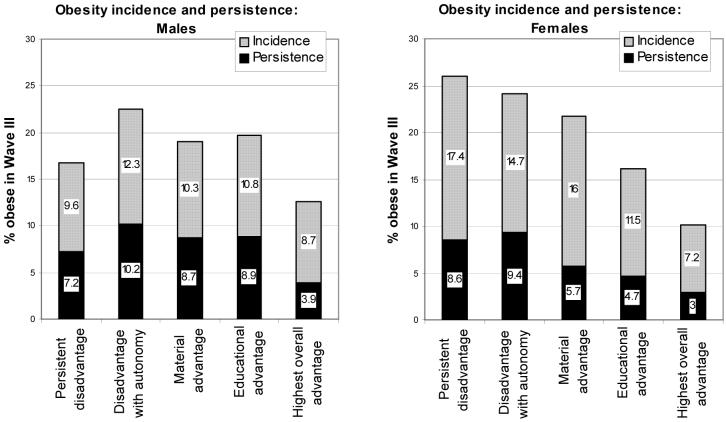
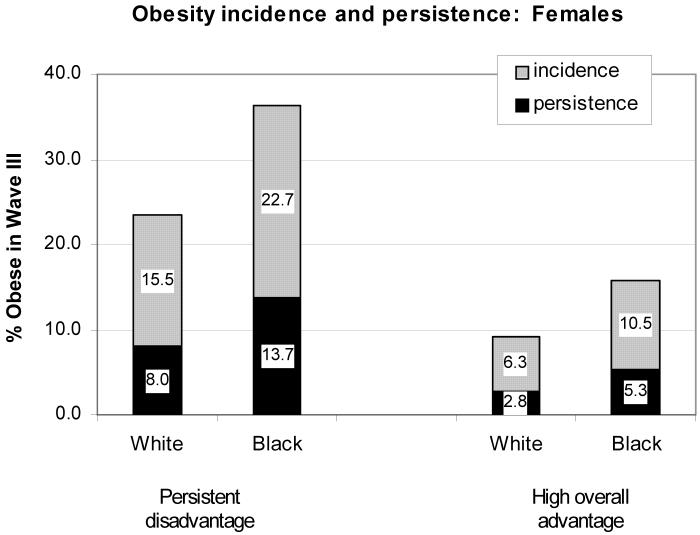
Results: No significant interactions with race/ethnicity were observed, although racial/ethnic minorities had the highest obesity risk across SES groups. Racial/ethnic-pooled associations between disadvantaged SES exposure and higher obesity risk were strong but differed by gender. Males with a disadvantaged background who experienced early transitions into the labour force, marriage and residential independence had the highest risk of obesity incidence (relative risk ratio (RRR) = 1.64; 95% confidence interval (CI) 1.12 to 2.40), while females exposed to persistent adversity were at highest risk (RRR = 3.01, 95% CI 1.95 to 4.66). In general, SES group membership had a stronger relationship with obesity persistence than incidence.
Conclusions: The relationship between SES and obesity patterns is similar across race/ethnicity and differs by gender during the transition to adulthood. However, stronger associations with obesity persistence and enduring racial/ethnic disparities in obesity risk across SES groups suggest that these social factors play a larger role in disparities earlier in the life course.
Figures
References
-
- Ogden CL, Carroll MD, Curtin LR, et al. Prevalence of overweight and obesity in the United States, 1999-2004. Jama. 2006;295:1549–55. - PubMed
-
- Sobal J, Stunkard AJ. Socioeconomic status and obesity: a review of the literature. Psychol Bull. 1989;105:260–75. - PubMed
-
- Gordon-Larsen P, Adair LS, Popkin BM. The relationship of ethnicity, socioeconomic factors, and overweight in US adolescents. Obes Res. 2003;11:121–9. - PubMed
-
- Kimm SY, Obarzanek E, Barton BA, et al. Race, socioeconomic status, and obesity in 9- to 10-year-old girls: the NHLBI Growth and Health Study. Ann Epidemiol. 1996;6:266–75. - PubMed
-
- Farmer MM, Ferraro KF. Are racial disparities in health conditional on socioeconomic status? Soc Sci Med. 2005;60:191–204. - PubMed
Publication types
MeSH terms
Grants and funding
- P30 ES010126/ES/NIEHS NIH HHS/United States
- R01 HD039183/HD/NICHD NIH HHS/United States
- NIH P30-ES10126/ES/NIEHS NIH HHS/United States
- DK56350/DK/NIDDK NIH HHS/United States
- F31-HD049334-01/HD/NICHD NIH HHS/United States
- R01 HD041375/HD/NICHD NIH HHS/United States
- K01-HD044263/HD/NICHD NIH HHS/United States
- K01 HD044263/HD/NICHD NIH HHS/United States
- R01 HD39183/HD/NICHD NIH HHS/United States
- P30 DK056350/DK/NIDDK NIH HHS/United States
- F31 HD049334/HD/NICHD NIH HHS/United States
- R01 HD057194/HD/NICHD NIH HHS/United States
LinkOut - more resources
Full Text Sources
Medical
