


Biodiversity of thermophilic prokaryotes with hydrolytic activities in hot springs of Uzon Caldera, Kamchatka (Russia)
- PMID: 18978089
- PMCID: PMC2612224
- DOI: 10.1128/AEM.00607-08
Biodiversity of thermophilic prokaryotes with hydrolytic activities in hot springs of Uzon Caldera, Kamchatka (Russia)
Abstract
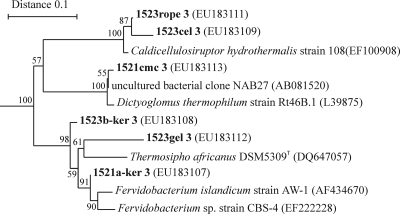
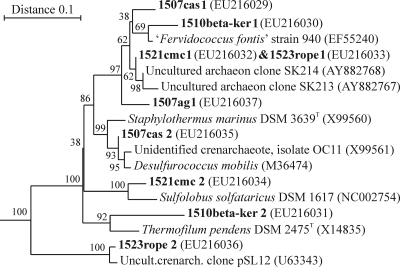
Samples of water from the hot springs of Uzon Caldera with temperatures from 68 to 87 degrees C and pHs of 4.1 to 7.0, supplemented with proteinaceous (albumin, casein, or alpha- or beta-keratin) or carbohydrate (cellulose, carboxymethyl cellulose, chitin, or agarose) biological polymers, were filled with thermal water and incubated at the same sites, with the contents of the tubes freely accessible to the hydrothermal fluid. As a result, several enrichment cultures growing in situ on different polymeric substrates were obtained. Denaturing gradient gel electrophoresis (DGGE) analysis of 16S rRNA gene fragments obtained after PCR with Bacteria-specific primers showed that the bacterial communities developing on carbohydrates included the genera Caldicellulosiruptor and Dictyoglomus and that those developing on proteins contained members of the Thermotogales order. DGGE analysis performed after PCR with Archaea- and Crenarchaeota-specific primers showed that archaea related to uncultured environmental clones, particularly those of the Crenarchaeota phylum, were present in both carbohydrate- and protein-degrading communities. Five isolates obtained from in situ enrichments or corresponding natural samples of water and sediments represented the bacterial genera Dictyoglomus and Caldanaerobacter as well as new archaea of the Crenarchaeota phylum. Thus, in situ enrichment and consequent isolation showed the diversity of thermophilic prokaryotes competing for biopolymers in microbial communities of terrestrial hot springs.
Figures
References
-
- Bredholt, S., J. Sonne-Hansen, P. Nielsen, I. M. Mathrani, and B. K. Ahring. 1999. Caldicellulosiruptor kristjanssonii sp. nov., a cellulolytic, extremely thermophilic, anaerobic bacterium. Int. J. Syst. Bacteriol. 49:991-996. - PubMed
-
- Dib, R., J.-M. Chobert, M. Dalgalarrondo, G. Barbier, and T. Haertlé. 1998. Purification, molecular properties and specificity of a thermoactive and thermostable proteinase from Pyrococcus abyssi, strain st 549, hyperthermophilic archaea from deep-sea hydrothermal ecosystem. FEBS Lett. 431:279-284. - PubMed
-
- Egorova, K., and G. Antranikian. 2005. Industrial relevance of thermophilic Archaea. Curr. Opin. Microbiol. 8:649-655. - PubMed
Publication types
MeSH terms
Substances
Associated data
- Actions
- Actions
- Actions
- Actions
- Actions
- Actions
- Actions
- Actions
LinkOut - more resources
Full Text Sources
Molecular Biology Databases
Research Materials
