


Gastric residual volume and aspiration in critically ill patients receiving gastric feedings
- PMID: 18978236
- PMCID: PMC2627559
Gastric residual volume and aspiration in critically ill patients receiving gastric feedings
Abstract
Background: The helpfulness of bedside assessment of gastric residual volume in the prediction of aspiration has been questioned, as has the volume that signals increased risk of aspiration.
Objective: To describe the association between gastric residual volumes and aspiration of gastric contents.
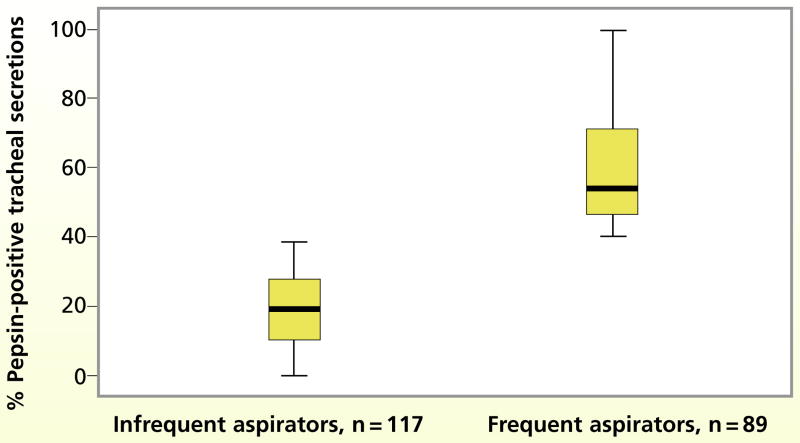
Methods: In a prospective study of 206 critically ill patients receiving gastric tube feedings for 3 consecutive days, gastric residual volumes were measured with 60-mL syringes every 4 hours. Measured volumes were categorized into 3 overlapping groups: at least 150 mL, at least 200 mL, and at least 250 mL. Patients were categorized as frequent aspirators if 40% or more of their tracheal secretions were positive for pepsin and as infrequent aspirators if less than 40% of their secretions were positive for pepsin. Gastric residual volumes were compared between the 2 aspiration groups.
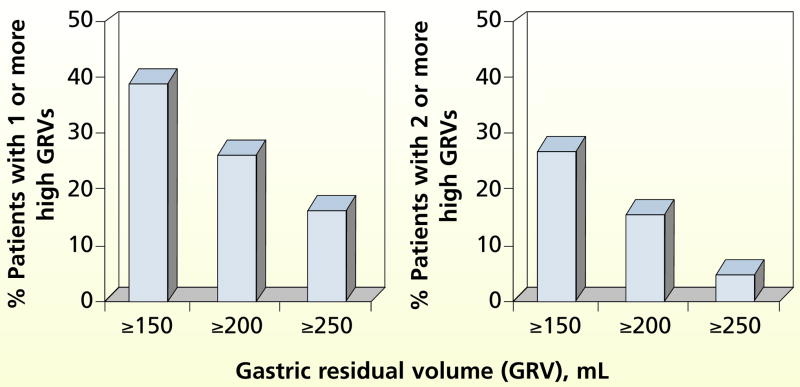
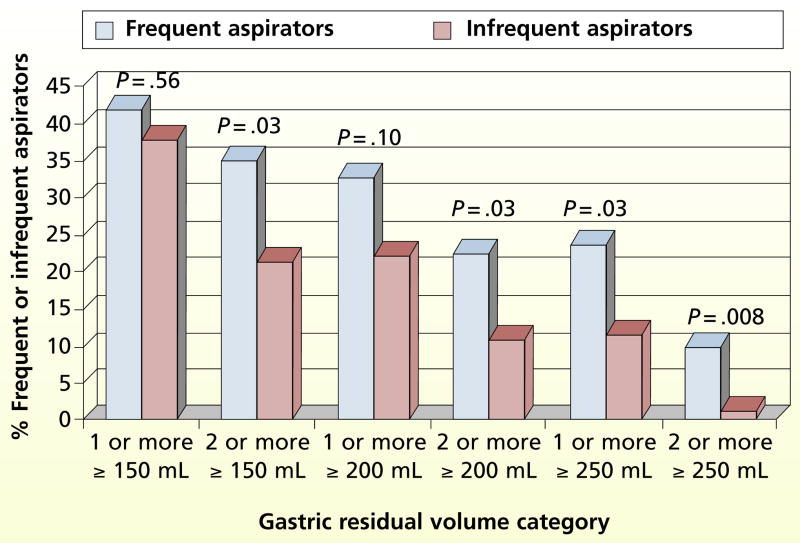
Results: Approximately 39% of the 206 patients had 1 or more gastric residual volumes of at least 150 mL, 27% had 1 or more volumes of at least 200 mL, and 17% had 1 or more volumes of at least 250 mL. Large-bore tubes identified most of the high volumes. Eighty-nine patients were frequent aspirators. Volumes less than 150 mL were common in both aspiration groups. However, the frequent aspirators had a significantly greater frequency of 2 or more volumes of at least 200 mL and 1 or more volumes of at least 250 mL.
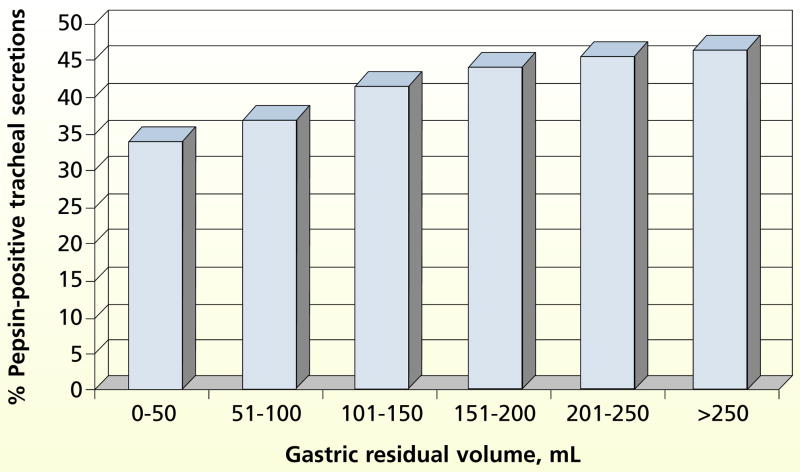
Conclusions: No consistent relationship was found between aspiration and gastric residual volumes. Although aspiration occurs without high gastric residual volumes, it occurs significantly more often when volumes are high.
Figures
Comment in
-
Care and patience needed for accurate measure of gastric residual volumes.Am J Crit Care. 2009 Jan;18(1):10; author reply 10. doi: 10.4037/ajcc2009385. Am J Crit Care. 2009. PMID: 19116398 No abstract available.
References
-
- Guenter P, Silkroski M. Tube Feeding: Practical Guidelines and Nursing Protocols. Gaithersburg, MD: Aspen Publishers; 2001.
-
- Pullen RL., Jr Measuring gastric residual volume. Nursing. 2004;34(4):18. - PubMed
-
- Mayer AP, Durward A, Turner C, et al. Amylin is associated with delayed gastric emptying in critically ill children. Intensive Care Med. 2002;28(3):336–340. - PubMed
-
- Kompan L, Vidmar G, Spindler-Vesel A, Pecar J. Is early enteral nutrition a risk factor for gastric intolerance and pneumonia? Clin Nutr. 2004;23(4):527–532. - PubMed
-
- Mihatsch WA, von Schoenaich P, Fahnenstich H, et al. The significance of gastric residuals in the early enteral feeding advancement of extremely low birth weight infants. Pediatrics. 2002;109(3):457–459. - PubMed
Publication types
MeSH terms
Grants and funding
LinkOut - more resources
Full Text Sources
Other Literature Sources