


doi: 10.1038/nn.2219.
Epub 2008 Nov 2.
Real-time chemical responses in the nucleus accumbens differentiate rewarding and aversive stimuli
Affiliations
- PMID: 18978779
- PMCID: PMC3171188
- DOI: 10.1038/nn.2219
Item in Clipboard
Real-time chemical responses in the nucleus accumbens differentiate rewarding and aversive stimuli
Nat Neurosci.
2008 Dec.
Abstract
Rewarding and aversive stimuli evoke very different patterns of behavior and are rapidly discriminated. Here taste stimuli of opposite hedonic valence evoked opposite patterns of dopamine and metabolic activity within milliseconds in the nucleus accumbens. This rapid encoding may serve to guide ongoing behavioral responses and promote plastic changes in underlying circuitry.
Figures
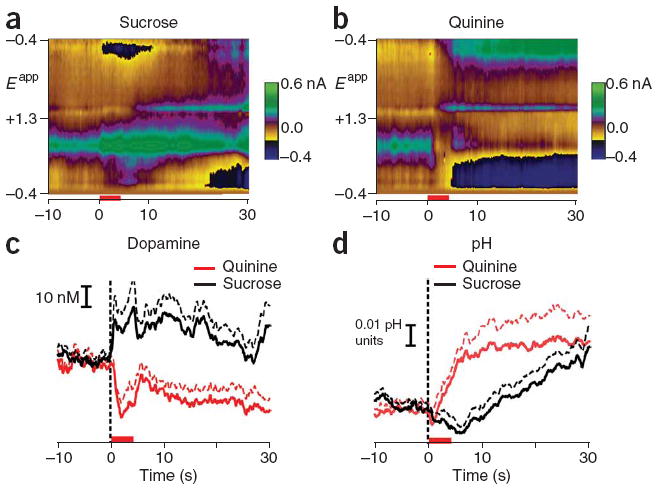
Average fluctuations in chemical signaling in response to rewarding and aversive taste stimuli. (a,b) Voltammetric responses to rewarding (a) and aversive (b) stimuli. The color plots indicate changes in dopamine and pH in response to intra-oral infusions of sucrose (denoted by red bar). Time is the abscissa, the electrode potential is the ordinate and current changes are encoded in color. Average dopamine concentration (identified by its oxidation (~0.6 V) and reduction (~−0.2 V on the negative going scan) features) increased during and after the infusion. In addition, changes in pH can be seen as multiple, longer lasting peaks, with a pronounced peak at ~−0.2 V on the positive going scan. (c) Average dopamine concentration changes for sucrose (mean ± s.e.m. denoted by black solid and broken lines, respectively) and quinine (red). (d) Average pH changes for sucrose and quinine, shown as in c.
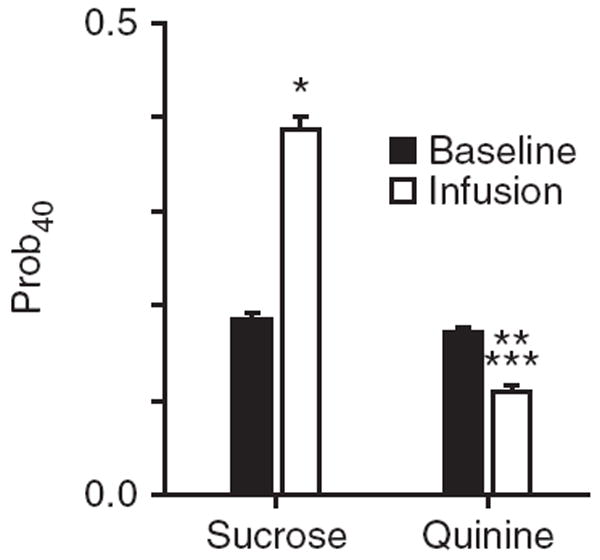
Rewarding and aversive taste stimuli differentially modulate the probability of high increases in dopamine concentration (*P < 0.05 relative to sucrose baseline, **P < 0.05 relative to quinine baseline and ***P < 0.05 relative to sucrose infusion).
References
Publication types
MeSH terms
Substances
Grants and funding
LinkOut - more resources
Full Text Sources
Other Literature Sources
