


Effects of erlotinib in EGFR mutated non-small cell lung cancers with resistance to gefitinib
- PMID: 18981003
- PMCID: PMC2596582
- DOI: 10.1158/1078-0432.CCR-08-1455
Effects of erlotinib in EGFR mutated non-small cell lung cancers with resistance to gefitinib
Abstract
Purpose: Most lung cancers with activating epidermal growth factor receptor (EGFR) mutations respond to gefitinib; however, resistance to this tyrosine kinase inhibitor (TKI) invariably ensues. The T790M mutation occurs in 50% and MET amplification in 20% of TKI-resistant tumors. Other secondary mutations (D761Y and L747S) are rare. Our goal was to determine the effects of erlotinib 150 mg/d in EGFR mutated patients resistant to gefitinib 250 mg/d, because the EGFR TKI erlotinib is given at a higher biologically active dose than gefitinib.
Experimental design: Retrospective review of 18 EGFR mutated (exon 19 deletions, L858R, and L861Q) patients that were given gefitinib and subsequently erlotinib. Seven patients had tumor resampling after TKI therapy and were analyzed for secondary EGFR mutations and MET amplification.
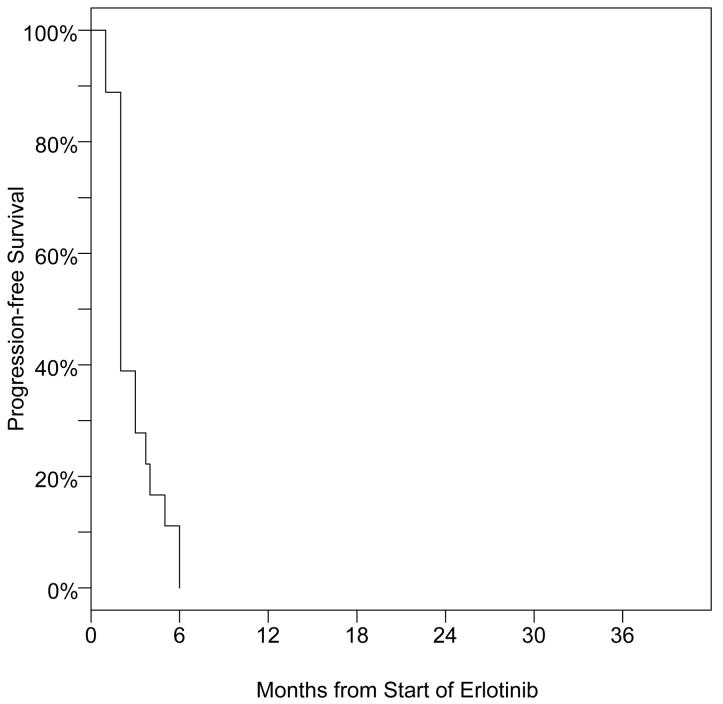
Results: Most patients (14 of 18) responded to gefitinib with median progression-free survival of 11 months (95% confidence interval, 4-16). After gefitinib resistance (de novo or acquired), 78% (14 of 18) of these patients displayed progressive disease while on erlotinib with progression-free survival of 2 months (95% confidence interval, 2-3). Six of 7 resampled patients acquired the T790M mutation, and 0 of 3 had MET amplification. Only 1 gefitinib-resistant patient with the acquired L858R-L747S EGFR, which in vitro is sensitive to achievable serum concentrations of erlotinib 150 mg/d, achieved a partial response to erlotinib.
Conclusions: In EGFR mutated tumors resistant to gefitinib 250 mg/d, a switch to erlotinib 150 mg/d does not lead to responses in most patients. These findings are consistent with preclinical models, because the common mechanisms of TKI resistance (T790M and MET amplification) in vitro are not inhibited by clinically achievable doses of gefitinib or erlotinib. Alternative strategies to overcome TKI resistance must be evaluated.
Figures

References
-
- Jemal A, Siegel R, Ward E, et al. Cancer statistics, 2008. CA Cancer J Clin. 2008;58:71–96. - PubMed
-
- Ardizzoni A, Boni L, Tiseo M, et al. Cisplatin- versus carboplatin-based chemotherapy in first-line treatment of advanced non-small-cell lung cancer: an individual patient data meta-analysis. J Natl Cancer Inst. 2007;99:847–57. - PubMed
-
- Schiller JH, Harrington D, Belani CP, et al. Comparison of four chemotherapy regimens for advanced non-small-cell lung cancer. N Engl J Med. 2002;346:92–8. - PubMed
-
- Sandler A, Gray R, Perry MC, et al. Paclitaxel-carboplatin alone or with bevacizumab for non-small-cell lung cancer. N Engl J Med. 2006;355:2542–50. - PubMed
-
- Shepherd FA, Dancey J, Ramlau R, et al. Prospective randomized trial of docetaxel versus best supportive care in patients with non-small-cell lung cancer previously treated with platinum-based chemotherapy. J Clin Oncol. 2000;18:2095–103. - PubMed
Publication types
MeSH terms
Substances
Grants and funding
LinkOut - more resources
Full Text Sources
Medical
Molecular Biology Databases
Research Materials
Miscellaneous
