


Suppression of murine allergic airway disease by IL-2:anti-IL-2 monoclonal antibody-induced regulatory T cells
- PMID: 18981114
- PMCID: PMC2706157
- DOI: 10.4049/jimmunol.181.10.6942
Suppression of murine allergic airway disease by IL-2:anti-IL-2 monoclonal antibody-induced regulatory T cells
Abstract
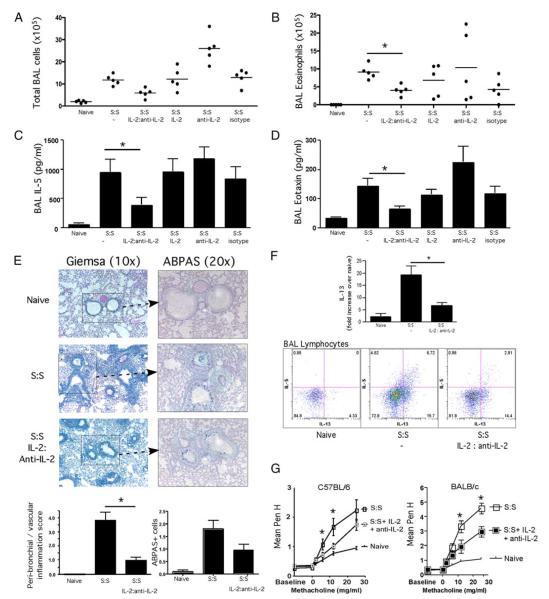
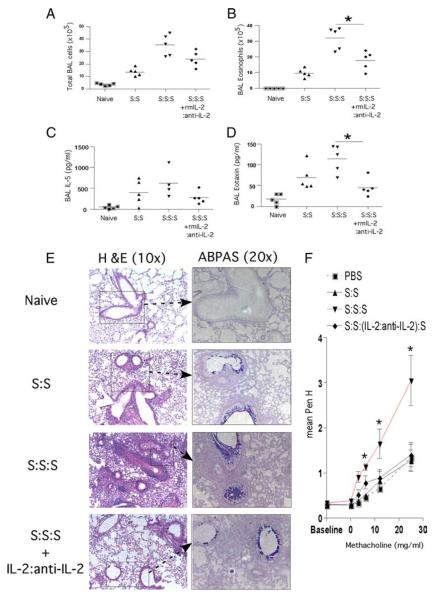
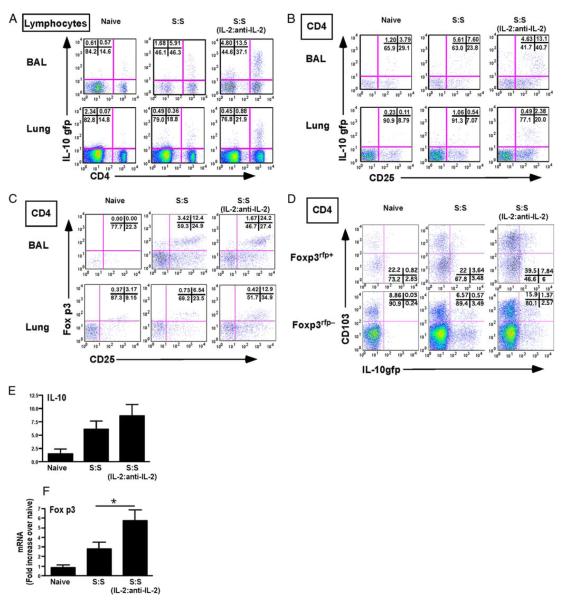
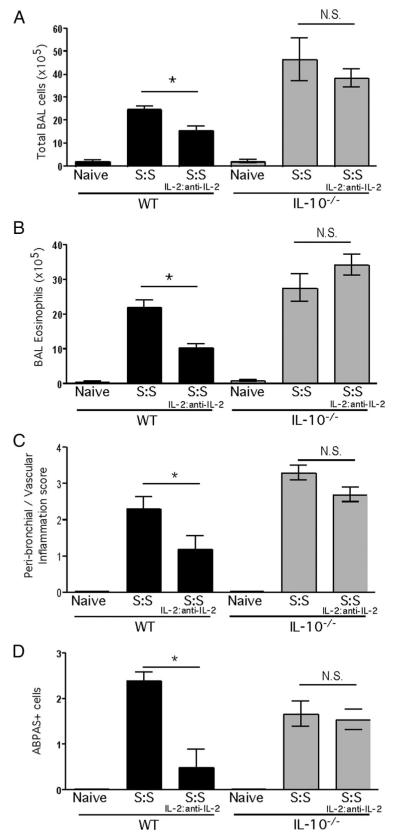
Regulatory T cells (Treg) play a decisive role in many diseases including asthma and allergen-induced lung inflammation. However, little progress has been made developing new therapeutic strategies for pulmonary disorders. In the current study we demonstrate that cytokine:antibody complexes of IL-2 and anti-IL-2 mAb reduce the severity of allergen-induced inflammation in the lung by expanding Tregs in vivo. Unlike rIL-2 or anti-IL-2 mAb treatment alone, IL-2:anti-IL-2 complexes dampened airway inflammation and eosinophilia while suppressing IL-5 and eotaxin-1 production. Mucus production, airway hyperresponsiveness to methacholine, and parenchymal tissue inflammation were also dramatically reduced following IL-2:anti-IL-2 treatment. The suppression in allergic airway disease was associated with a marked expansion of Tregs (IL-10(+)CD4(+)CD25(+) and Foxp3(+)CD4(+)CD25(+)) in the tissues, with a corresponding decrease in effector T cell responses. The ability of IL-2:anti-IL-2 complexes to suppress airway inflammation was dependent on Treg-derived IL-10, as IL-10(+/+), but not IL-10(-/-) Tregs, were capable of mediating the suppression. Furthermore, a therapeutic protocol using a model of established airway allergy highlighted the ability of IL-2:anti-IL-2 complexes to expand Tregs and prevent successive airway inflammation and airway hyperresponsiveness. This study suggests that endogenous Treg therapy may be a useful tool to combat the rising incidence of allergic airway disease.
Figures



References
-
- Kelchtermans H, De Klerck B, Mitera T, Van Balen M, Bullens D, Billiau A, Leclercq G, Matthys P. Defective CD4+CD25+ regulatory T cell functioning in collagen-induced arthritis: an important factor in pathogenesis, counter-regulated by endogenous IFN-γ. Arthritis Res. Ther. 2005;7:R402–R415. - PMC - PubMed
-
- Marazuela M, Garcia-Lopez MA, Figueroa-Vega N, de la Fuente H, Alvarado-Sanchez B, Monsivais-Urenda A, Sanchez-Madrid F, Gonzalez-Amaro R. Regulatory T cells in human autoimmune thyroid disease. J. Clin. Endocrinol. Metab. 2006;91:3639–3646. - PubMed
-
- Suri-Payer E, Amar AZ, Thornton AM, Shevach EM. CD4+CD25+ T cells inhibit both the induction and effector function of autoreactive T cells and represent a unique lineage of immunoregulatory cells. J. Immunol. 1998;160:1212–1218. - PubMed
-
- Hawrylowicz CM, O’Garra A. Potential role of interleukin-10-secreting regulatory T cells in allergy and asthma. Nat. Rev. Immunol. 2005;5:271–283. - PubMed
-
- Ling EM, Smith T, Nguyen XD, Pridgeon C, Dallman M, Arbery J, Carr VA, Robinson DS. Relation of CD4+CD25+ regulatory T-cell suppression of allergen-driven T-cell activation to atopic status and expression of allergic disease. Lancet. 2004;363:608–615. - PubMed
Publication types
MeSH terms
Substances
Grants and funding
LinkOut - more resources
Full Text Sources
Other Literature Sources
Research Materials
