. 2009 Jan;77(1):152-61.
doi: 10.1128/IAI.01113-08. Epub 2008 Nov 3.

Identification of an essential Francisella tularensis subsp. tularensis virulence factor

Affiliations

Identification of an essential Francisella tularensis subsp. tularensis virulence factor

Aiping Qin et al. Infect Immun. 2009 Jan.

Abstract

Francisella tularensis, the highly virulent etiologic agent of tularemia, is a low-dose intracellular pathogen that is able to escape from the phagosome and replicate in the cytosol. Although there has been progress in identifying loci involved in the pathogenicity of this organism, analysis of the genome sequence has revealed few obvious virulence factors. We previously reported isolation of an F. tularensis subsp. tularensis strain Schu S4 transposon insertion mutant with a mutation in a predicted hypothetical lipoprotein, FTT1103, that was deficient in intracellular replication in HepG2 cells. In this study, a mutant with a defined nonpolar deletion in FTT1103 was created, and its phenotype, virulence, and vaccine potential were characterized. A phagosomal integrity assay and lysosome-associated membrane protein 1 colocalization revealed that DeltaFTT1103 mutant bacteria were defective in phagosomal escape. FTT1103 mutant bacteria were maximally attenuated in the mouse model; mice survived, without visible signs of illness, challenge by more than 10(10) CFU when the intranasal route was used and challenge by 10(6) CFU when the intraperitoneal, subcutaneous, or intravenous route was used. The FTT1103 mutant bacteria exhibited dissemination defects. Mice that were infected by the intranasal route had low levels of bacteria in their livers and spleens, and these bacteria were cleared by 3 days postinfection. Mutant bacteria inoculated by the subcutaneous route failed to disseminate to the lungs. BALB/c or C57BL/6 mice that were intranasally vaccinated with 10(8) CFU of FTT1103 mutant bacteria were protected against subsequent challenge with wild-type strain Schu S4. These experiments identified the FTT1103 protein as an essential virulence factor and also demonstrated the feasibility of creating defined attenuated vaccines based on a type A strain.


Figures
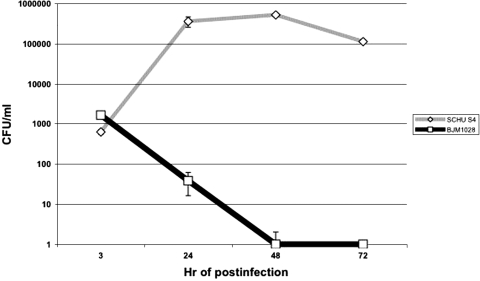
FIG. 1.
FIG. 1.
BJM1028 (Tn::FTT1103) was defective in intracellular survival in HepG2 cells. Bacteria were incubated with HepG2 cells at an MOI of 100:1. After 1 h fresh medium that contained 50 μg/ml of gentamicin was added the wells. At the indicated time points the HepG2 cells were lysed and dilutions of the lysate were plated on MHAC plates.
FIG. 2.
FIG. 2.
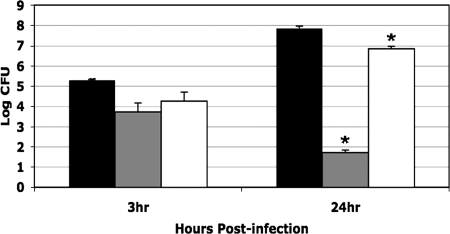
BJM1031 (ΔFTT1103) was defective in intracellular survival in macrophagelike cell line J774A.1. Bacteria were incubated with J774A.1 cells at an MOI of 50:1. After 1 h fresh medium that contained 50 μg/ml of gentamicin was added the wells. At the indicated time points cells were lysed and dilutions of the lysate were plated on MHAC plates. Black bars, Schu S4; gray bars, BJM1031 (ΔFTT1103); open bars, BJM1035 (BJM1031/pAQ38 [FTT1103+]). Asterisks indicate values that are statistically different (P ≤ 0.0004) from the value for Schu S4 based on a two-tailed Student's t test.
FIG. 3.
FIG. 3.
FTT1103 was required for efficient escape from the phagosome. Bacteria were incubated with J774A.1 cells at an MOI of 50:1. A phagosomal integrity assay was performed as described in Materials and Methods and by Checroun et al. (3). Briefly, the plasma membrane was first permeabilized with digitonin, and then cells were incubated with rabbit anti-Francisella antibody. Next, the cells were fixed and then treated with saponin, which permeabilized the entire membrane component of the cells. Finally, the cells were treated with mouse anti-Schu S4 and rat anti-LAMP-1 antisera, washed, and then incubated with goat anti-rat Alexa 488, goat anti-rabbit Alexa 546, and goat anti-mouse Alexa 633. Samples were viewed with a Zeiss LSM 510 laser scanning confocal microscopy. A minimum of 100 bacteria were counted for each sample, and experiments were performed in triplicate. Asterisks indicate values that were statistically different from the value for Schu S4 (P ≤ 0.03) as determined by a two-tailed Student's t test. (A) Percentage of phagosomal bacteria. Bars 1, heat-killed Schu S4; bars 2, LVS; bars 3, Schu S4; bars 4, BJM1031; bars 5, BJM1035. (B) Representative merged confocal images from the phagosomal escape assay. In the merged image cytoplasmic bacteria are red and phagosomal bacteria are blue. HK-Schu S4, heat-killed Schu S4. (C) Percentages of bacteria that colocalized with LAMP-1. Bars 1, heat-killed Schu S4; bars 2, Schu S4; bars 3, BJM1031; bars 4, BJM1035. (D) Colocalization with LAMP-1. Bacteria were detected using mouse anti-Schu S4 and goat anti-mouse Alexa 546 antibodies (green pseudocolor), and LAMP-1 was detected using rat anti-LAMP-1 and goat anti-rat Alexa 488 (red pseudocolor). H-K Schu S4, heat-killed Schu S4.
FIG. 4.
FIG. 4.
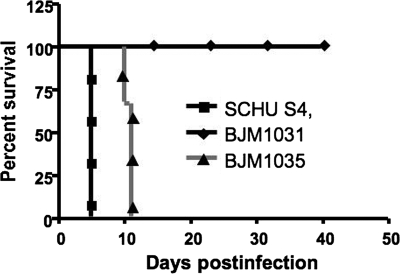
BJM1031 is avirulent in mice. C57BL/6 mice (three mice per group) were intranasally inoculated with 20 μl of BJM1031 (1.8 × 10¹⁰ CFU), BJM1035 (6 × 10⁴ CFU), or Schu S4 (100 CFU). Mice were monitored daily. More than 12 mice survived challenge with >1010 CFU of BJM1031 in three separate experiments.
FIG. 5.
FIG. 5.
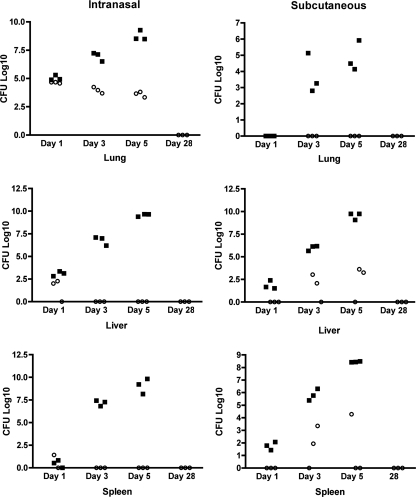
BJM1031 was defective in dissemination. C57BL/6 mice were intranasally or subcutaneously infected with either 200 CFU of Schu S4 or 5.8 × 10¹¹ CFU of BJM1031. On the indicated days three mice from each group were euthanized. The lungs, livers, and spleens were harvested, homogenized with a tissue grinder, and then serially diluted, and the serial dilutions were plated on MHAC plates. For presentation log10 transformation was performed on the data.
FIG. 6.
FIG. 6.
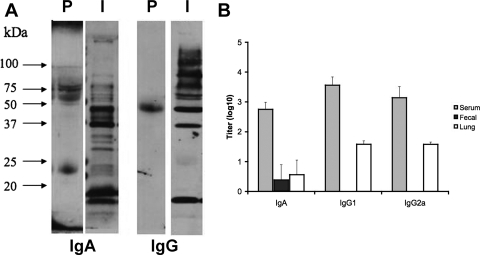
Intranasal immunization with BJM1031 elicited specific systemic and mucosal antibody responses. (A) Western blots of whole-cell lysates of Schu S4 were incubated with pooled preimmune sera (lane P) or immune sera (lane I) from mice intranasally immunized with BJM1031 and then with secondary antibodies that were specific for IgA or IgG heavy chains. Reactive proteins were visualized by chemiluminescence. (B) Sera were collected from three mice 28 days after infection with 5.8 × 10¹¹ CFU of BJM1031. Antibody isotype titers were determined by isotype-specific enzyme-linked immunosorbent assays. Endpoint antibody titers were calculated by linear regression analysis and were expressed as log10 of the reciprocal of the highest dilution that gave an OD450 greater than the cutoff value, which was defined as the average OD450 for the PBS-immunized mice plus 2.0 standard deviations. Assays were performed in duplicate.

References

    1. Anthony, L. D., R. D. Burke, and F. E. Nano. 1991. Growth of Francisella spp. in rodent macrophages. Infect. Immun. 593291-3296. - PMC - PubMed
    1. Bakshi, C. S., M. Malik, M. Mahawar, G. S. Kirimanjeswara, K. R. Hazlett, L. E. Palmer, M. B. Furie, R. Singh, J. A. Melendez, T. J. Sellati, and D. W. Metzger. 2008. An improved vaccine for prevention of respiratory tularemia caused by Francisella tularensis SchuS4 strain. Vaccine 265276-5288. - PMC - PubMed
    1. Checroun, C., T. D. Wehrly, E. R. Fischer, S. F. Hayes, and J. Celli. 2006. Autophagy-mediated reentry of Francisella tularensis into the endocytic compartment after cytoplasmic replication. Proc. Natl. Acad. Sci. USA 10314578-14583. - PMC - PubMed
    1. Clemens, D. L., B. Y. Lee, and M. A. Horwitz. 2004. Virulent and avirulent strains of Francisella tularensis prevent acidification and maturation of their phagosomes and escape into the cytoplasm in human macrophages. Infect. Immun. 723204-3217. - PMC - PubMed
    1. Cole, L. E., A. Santiago, E. Barry, T. J. Kang, K. A. Shirey, Z. J. Roberts, K. L. Elkins, A. S. Cross, and S. N. Vogel. 2008. Macrophage proinflammatory response to Francisella tularensis live vaccine strain requires coordination of multiple signaling pathways. J. Immunol. 1806885-6891. - PMC - PubMed

Publication types

MeSH terms