


Discovering modes of an image population through mixture modeling
- PMID: 18982628
- PMCID: PMC2671151
- DOI: 10.1007/978-3-540-85990-1_46
Discovering modes of an image population through mixture modeling
Abstract
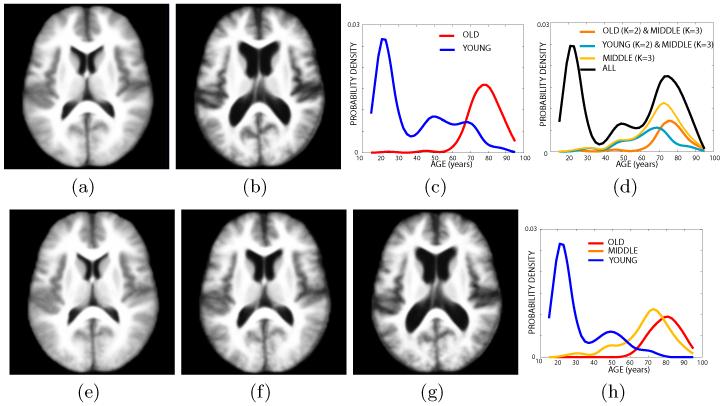
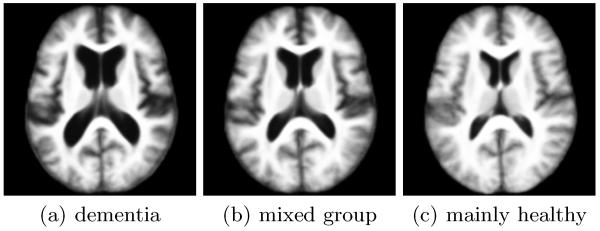
We present iCluster, a fast and efficient algorithm that clusters a set of images while co-registering them using a parameterized, nonlinear transformation model. The output is a small number of template images that represent different modes in a population. This is in contrast with traditional approaches that assume a single template to construct atlases. We validate and explore the algorithm in two experiments. First, we employ iCluster to partition a data set of 416 whole brain MR volumes of subjects aged 18-96 years into three sub-groups, which mainly correspond to age groups. The templates reveal significant structural differences across these age groups that confirm previous findings in aging research. In the second experiment, we run iCluster on a group of 30 patients with dementia and 30 age-matched healthy controls. The algorithm produced three modes that mainly corresponded to a sub-population of healthy controls, a sub-population of patients with dementia and a mixture group that contained both types. These results suggest that the algorithm can be used to discover sub-populations that correspond to interesting structural or functional "modes".
Figures
References
-
- Allassonniere A, Amit Y, Trouve A. Towards a coherent statistical framework for dense deformable template estimation. J.R. Statist. Soc.B. 2007;69:3–29.
-
- Ashburner J, Neelin P, Collins DL, Evans A, Friston K. Incorporating prior knowledge into image registration. Neuro Image. 1997;6(4):344–352. - PubMed
-
- Collins DL, et al. Automatic 3D intersubject registration of MR volumetric data in standardized Talairach space. J. comput. assist. tomogr. 1994;18(2):192–205. - PubMed
-
- De Craene M, et al. LNCS . Multi-subject registration for unbiased statistical atlas construction. In: Barillot C, Haynor DR, Hellier P, editors. MICCAI 2004. Vol. 3216. Springer; Heidelberg: 2004. pp. 655–662.
Publication types
MeSH terms
Grants and funding
LinkOut - more resources
Full Text Sources
Other Literature Sources
Medical