


Lipophilicity is a critical parameter that dominates the efficacy of metalloporphyrins in blocking the development of morphine antinociceptive tolerance through peroxynitrite-mediated pathways
- PMID: 18983908
- PMCID: PMC2656771
- DOI: 10.1016/j.freeradbiomed.2008.09.037
Lipophilicity is a critical parameter that dominates the efficacy of metalloporphyrins in blocking the development of morphine antinociceptive tolerance through peroxynitrite-mediated pathways
Abstract
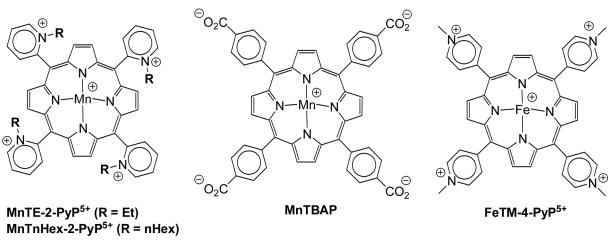
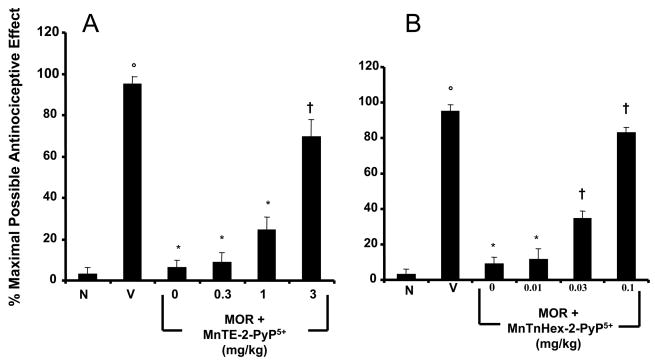
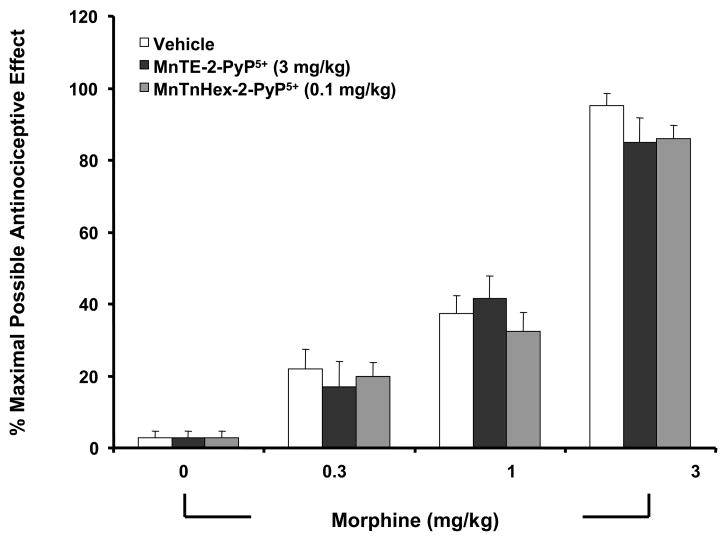
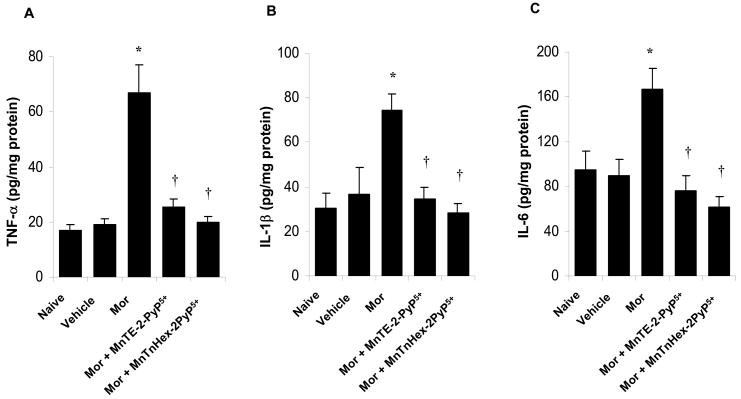
Severe pain syndromes reduce the quality of life of patients with inflammatory and neoplastic diseases, partly because reduced analgesic effectiveness with chronic opiate therapy (i.e., tolerance) leads to escalating doses and distressing side effects. Peroxynitrite-mediated nitroxidative stress in the dorsal horn of the spinal cord plays a critical role in the induction and development of antinociceptive tolerance to morphine. This provides a valid pharmacological basis for developing peroxynitrite scavengers as potent adjuncts to opiates in the management of pain. The cationic Mn(III) ortho-N-alkylpyridylporphyrins MnTE-2-PyP(5+) and MnTnHex-2-PyP(5+) are among the most potent peroxynitrite scavengers, with nearly identical scavenging rate constants (approximately 10(7) M(-1) s(-1)). Yet, MnTnHex-2-PyP(5+) is significantly more lipophilic and more bioavailable and, in turn, was 30-fold more effective in blocking the development of morphine antinociceptive tolerance than MnTE-2-PyP(5+) using the hot-plate test in a well-characterized murine model. The hydrophilic MnTE-2-PyP(5+) and the lipophilic MnTnHex-2-PyP(5+) were 10- and 300-fold, respectively, more effective in inhibiting morphine tolerance than the hydrophilic Fe(III) porphyrin FeTM-4-PyP(5+). Both Mn porphyrins decreased levels of TNF-alpha, IL-1 beta, and IL-6 to normal values. Neither of them affected acute morphine antinociceptive effects nor caused motor function impairment. Also neither was able to reverse already established morphine tolerance. We have recently shown that the anionic porphyrin Mn(III) tetrakis(4-carboxylatophenyl)porphyrin is selective in removing ONOO(-) over O(2)(-), but at approximately 2 orders of magnitude lower efficacy than MnTE-2-PyP(5+) and MnTnHex-2-PyP(5+), which in turn parallels up to 100-fold lower ability to reverse morphine tolerance. These data (1) support the role of peroxynitrite rather than superoxide as a major mechanism in blocking the development of morphine tolerance and (2) show that lipophilicity is a critical parameter in enhancing the potency of such novel peroxynitrite scavengers.
Figures
References
-
- Renfrey S, Downton C, Featherstone J. The painful reality. Nat Rev Drug Discov. 2003;2:175–176. - PubMed
-
- Arner S, Rawal N, Gustafsson LL. Clinical experience of long-term treatment with epidural and intrathecal opioids – a nationwide survey. Acta Anaesthesiol Scand. 1988;32:253–259. - PubMed
-
- Mao J, Price DD, Mayer DJ. Mechanisms of hyperalgesia and morphine tolerance: a current view of their possible interactions. Pain. 1995;62:259–274. - PubMed
-
- Ossipov MH, Lai J, King T, Vanderah TW, Malan TP, Jr, Hruby VJ, Porreca F. Antinociceptive and nociceptive actions of opioids. J Neurobiol. 2004;61:126–148. - PubMed
-
- Foley KM. Misconceptions and controversies regarding the use of opioids in cancer pain. Anticancer Drugs. 1995;6(Suppl 3):4–13. - PubMed
Publication types
MeSH terms
Substances
Grants and funding
LinkOut - more resources
Full Text Sources
Medical
Miscellaneous
