. 2009 Jan;37(Database issue):D93-7.
doi: 10.1093/nar/gkn787. Epub 2008 Nov 4.

GtRNAdb: a database of transfer RNA genes detected in genomic sequence

Affiliations

GtRNAdb: a database of transfer RNA genes detected in genomic sequence

Patricia P Chan et al. Nucleic Acids Res. 2009 Jan.

Abstract

Transfer RNAs (tRNAs) represent the single largest, best-understood class of non-protein coding RNA genes found in all living organisms. By far, the major source of new tRNAs is computational identification of genes within newly sequenced genomes. To organize the rapidly growing collection and enable systematic analyses, we created the Genomic tRNA Database (GtRNAdb), currently including over 74,000 tRNA genes predicted from 740 species. The web resource provides overview statistics of tRNA genes within each analyzed genome, including information by isotype and genetic locus, easily downloadable primary sequences, graphical secondary structures and multiple sequence alignments. Direct links for each gene to UCSC eukaryotic and microbial genome browsers provide graphical display of tRNA genes in the context of all other local genetic information. The database can be searched by primary sequence similarity, tRNA characteristics or phylogenetic group. The database is publicly available at http://gtrnadb.ucsc.edu.


Figures
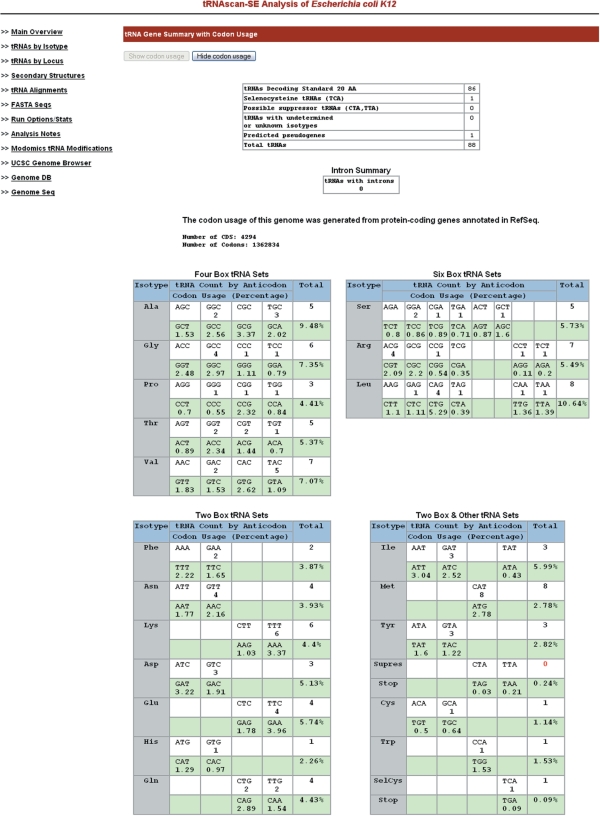
Figure 1.
Figure 1.
tRNA summary statistics with codon usage for Escherichia coli K12. Number of total tRNA genes and genes by isotypes and anticodons were provided by tRNAscan-SE (1) identification results. Protein-coding genes annotated in RefSeq (8) were used to compute codon usage of the genome. Side menus include links to detailed information for tRNA genes and external databases for gene analysis.
Figure 2.
Figure 2.
Secondary structure prediction of tRNA-GluCTC in chromosome III of Caenorhabditis elegans. (A) Linear string representation of secondary structure prediction generated within tRNAscan-SE by COVE (4). (B) Graphic representation of secondary structure prediction rendered by NAVIEW (14).
Figure 3.
Figure 3.
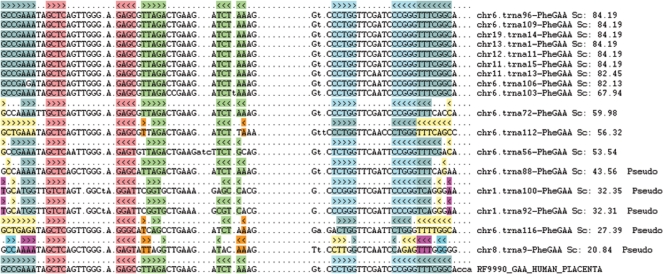
Multiple sequence alignments of tRNA-PheGAA in Homo sapiens. Sequence alignments are grouped by identical secondary structures with the linear string representation listed on top of each block. Each color in the alignments codes for the base pairing of each stem loop in the secondary structure. The tRNA genes marked as ‘pseudo’ were identified as pseudogenes. The last tRNA RF9990_GAA_HUMAN_PLACENTA was retrieved from the Sprinzl tRNA database (10).

References

    1. Lowe TM, Eddy SR. tRNAscan-SE: a program for improved detection of transfer RNA genes in genomic sequence. Nucleic Acids Res. 1997;25:955–964. - PMC - PubMed
    1. Fichant GA, Burks C. Identifying potential tRNA genes in genomic DNA sequences. J. Mol. Biol. 1991;220:659–671. - PubMed
    1. Pavesi A, Conterio F, Bolchi A, Dieci G, Ottonello S. Identification of new eukaryotic tRNA genes in genomic DNA databases by a multistep weight matrix analysis of transcriptional control regions. Nucleic Acids Res. 1994;22:1247–1256. - PMC - PubMed
    1. Eddy SR, Durbin R. RNA sequence analysis using covariance models. Nucleic Acids Res. 1994;22:2079–2088. - PMC - PubMed
    1. Karolchik D, Kuhn RM, Baertsch R, Barber GP, Clawson H, Diekhans M, Giardine B, Harte RA, Hinrichs AS, Hsu F, et al. The UCSC Genome Browser Database: 2008 update. Nucleic Acids Res. 2008;36:D773–D779. - PMC - PubMed