


The Arabidopsis GRAS protein SCL14 interacts with class II TGA transcription factors and is essential for the activation of stress-inducible promoters
- PMID: 18984675
- PMCID: PMC2613660
- DOI: 10.1105/tpc.108.058974
The Arabidopsis GRAS protein SCL14 interacts with class II TGA transcription factors and is essential for the activation of stress-inducible promoters
Abstract
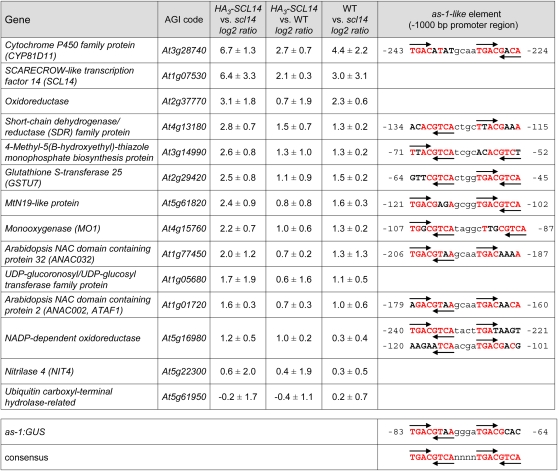
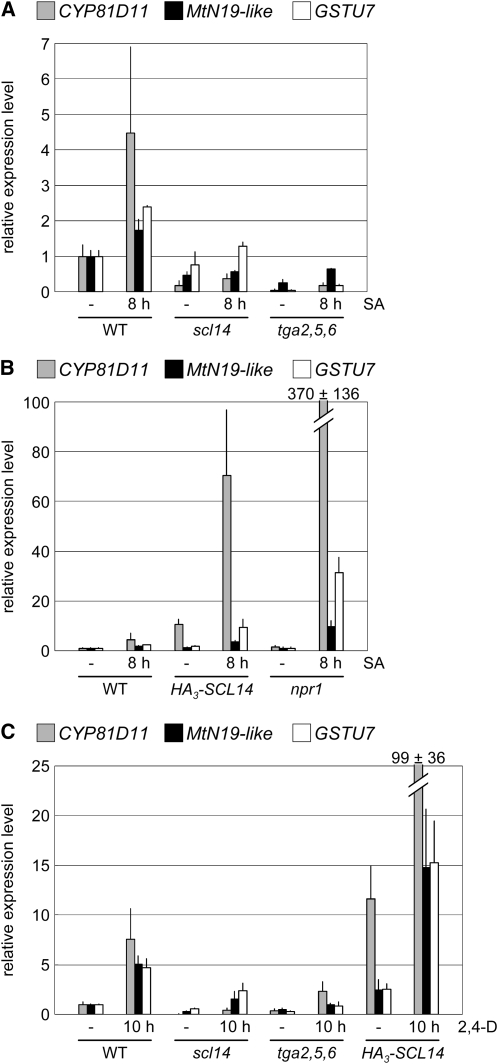
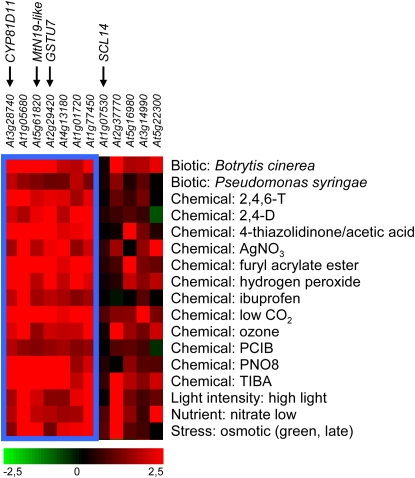
The plant signaling molecule salicylic acid (SA) and/or xenobiotic chemicals like the auxin mimic 2,4-D induce transcriptional activation of defense- and stress-related genes that contain activation sequence-1 (as-1)-like cis-elements in their promoters. as-1-like sequences are recognized by basic/leucine zipper transcription factors of the TGA family. Expression of genes related to the SA-dependent defense program systemic acquired resistance requires the TGA-interacting protein NPR1. However, a number of as-1-containing promoters can be activated independently from NPR1. Here, we report the identification of Arabidopsis thaliana SCARECROW-like 14 (SCL14), a member of the GRAS family of regulatory proteins, as a TGA-interacting protein that is required for the activation of TGA-dependent but NPR1-independent SA- and 2,4-D-inducible promoters. Chromatin immunoprecipitation experiments revealed that class II TGA factors TGA2, TGA5, and/or TGA6 are needed to recruit SCL14 to promoters of selected SCL14 target genes identified by whole-genome transcript profiling experiments. The coding regions and the expression profiles of the SCL14-dependent genes imply that they might be involved in the detoxification of xenobiotics and possibly endogenous harmful metabolites. Consistently, plants ectopically expressing SCL14 showed increased tolerance to toxic doses of the chemicals isonicotinic acid and 2,4,6-triiodobenzoic acid, whereas the scl14 and the tga2 tga5 tga6 mutants were more susceptible. Hence, the TGA/SCL14 complex seems to be involved in the activation of a general broad-spectrum detoxification network upon challenge of plants with xenobiotics.
Figures





References
-
- Apel, K., and Hirt, H. (2004). Reactive oxygen species: Metabolism, oxidative stress, and signal transduction. Annu. Rev. Plant Biol. 55 373–399. - PubMed
-
- Baerson, S.R., Sanchez-Moreiras, A., Pedrol-Bonjoch, N., Schulz, M., Kagan, I.A., Agarwal, A.K., Reigosa, M.J., and Duke, S.O. (2005). Detoxification and transcriptome response in Arabidopsis seedlings exposed to the allelochemical benzoxazolin-2(3H)-one. J. Biol. Chem. 280 21867–21881. - PubMed
-
- Bensmihen, S., To, A., Lambert, G., Kroj, T., Giraudat, J., and Parcy, F. (2004). Analysis of an activated ABI5 allele using a new selection method for transgenic Arabidopsis seeds. FEBS Lett. 561 127–131. - PubMed
-
- Blanco, F., Garreton, V., Frey, N., Dominguez, C., Perez-Acle, T., Van der Straeten, D., Jordana, X., and Holuigue, L. (2005). Identification of NPR1-dependent and independent genes early induced by salicylic acid treatment in Arabidopsis. Plant Mol. Biol. 59 927–944. - PubMed
-
- Bolle, C. (2004). The role of GRAS proteins in plant signal transduction and development. Planta 218 683–692. - PubMed
Publication types
MeSH terms
Substances
LinkOut - more resources
Full Text Sources
Molecular Biology Databases
Miscellaneous
