Effect of combined folic acid, vitamin B6, and vitamin B12 on cancer risk in women: a randomized trial
- PMID: 18984888
- PMCID: PMC2593624
- DOI: 10.1001/jama.2008.555
Effect of combined folic acid, vitamin B6, and vitamin B12 on cancer risk in women: a randomized trial
Abstract
Context: Folate, vitamin B(6), and vitamin B(12) are thought to play an important role in cancer prevention.
Objective: To evaluate the effect of combined folic acid, vitamin B(6), and vitamin B(12) treatment on cancer risk in women at high risk for cardiovascular disease.
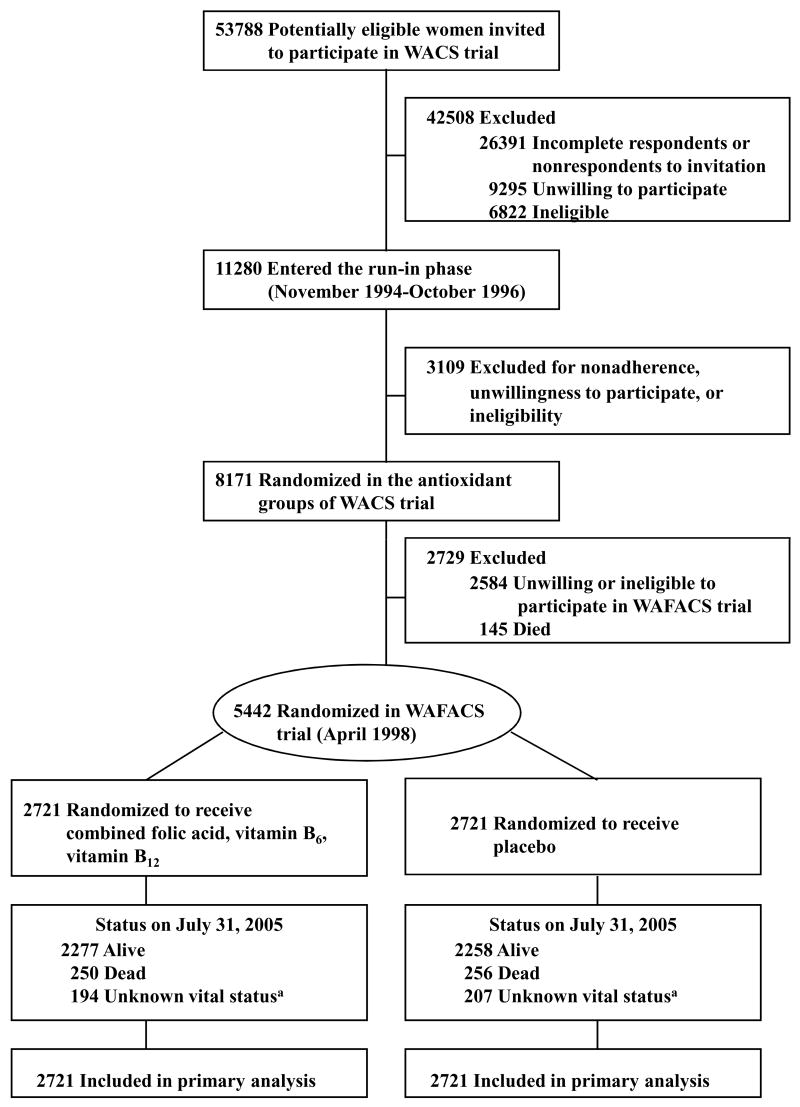
Design, setting, and participants: In the Women's Antioxidant and Folic Acid Cardiovascular Study, 5442 US female health professionals aged 42 years or older, with preexisting cardiovascular disease or 3 or more coronary risk factors, were randomly assigned to receive either a daily combination of folic acid, vitamin B(6), and vitamin B(12) or a matching placebo. They were treated for 7.3 years from April 1998 through July 31, 2005.
Intervention: Daily supplementation of a combination of 2.5 mg of folic acid, 50 mg of vitamin B(6), and 1 mg of vitamin B(12) (n = 2721) or placebo (n = 2721).
Main outcome measures: Confirmed newly diagnosed total invasive cancer or breast cancer.
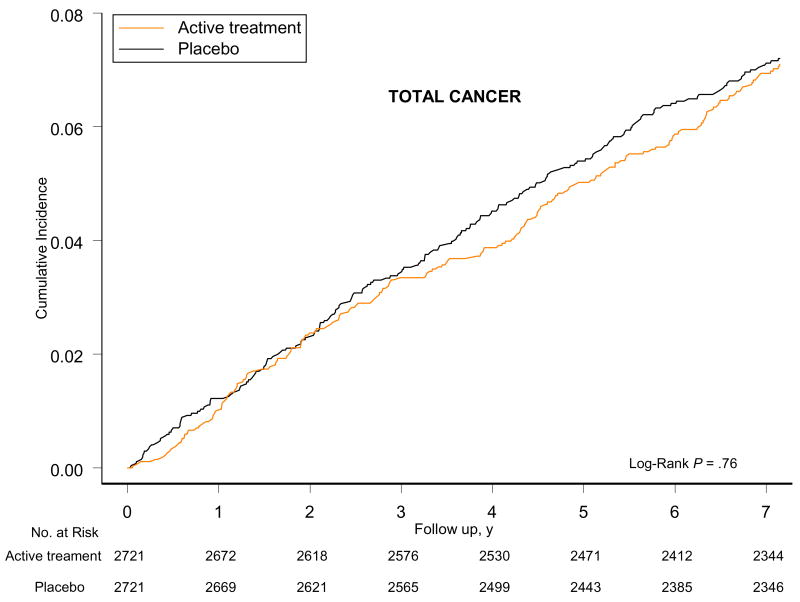
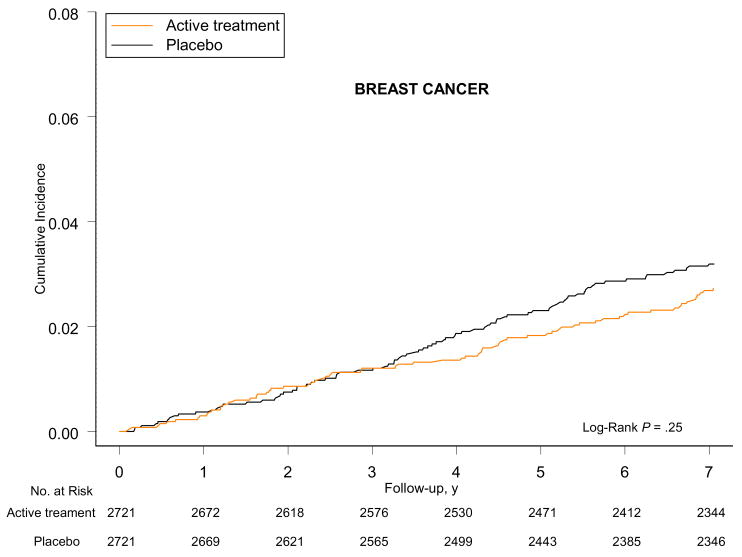
Results: A total of 379 women developed invasive cancer (187 in the active treatment group and 192 in the placebo group). Compared with placebo, women receiving the active treatment had similar risk of developing total invasive cancer (101.1/10,000 person-years for the active treatment group vs 104.3/10,000 person-years for placebo group; hazard ratio [HR], 0.97; 95% confidence interval [CI], 0.79-1.18; P = .75), breast cancer (37.8/10,000 person-years vs 45.6/10,000 person-years, respectively; HR, 0.83; 95% CI, 0.60-1.14; P = .24), or any cancer death (24.6/10,000 person-years vs 30.1/10,000 person-years, respectively; HR, 0.82; 95% CI, 0.56-1.21; P = .32).
Conclusion: Combined folic acid, vitamin B(6), and vitamin B(12) treatment had no significant effect on overall risk of total invasive cancer or breast cancer among women during the folic acid fortification era.
Trial registration: clinicaltrials.gov Identifier: NCT00000541.
Figures
Comment in
-
ACP Journal Club. Combined therapy with folic acid and vitamins B6 and B12 did not affect cancer risk in women at high risk for CV disease.Ann Intern Med. 2009 Mar 17;150(6):JC3-9. doi: 10.7326/0003-4819-150-6-200903170-02009. Ann Intern Med. 2009. PMID: 19306491 No abstract available.
References
-
- Mason JB, Levesque T. Folate: effects on carcinogenesis and the potential for cancer chemoprevention. Oncology (Williston Park) 1996;10(11):1727–1736. 1742–1743. discussion 1743–1744. - PubMed
-
- Ames BN. DNA damage from micronutrient deficiencies is likely to be a major cause of cancer. Mutat Res. 2001;475(1–2):7–20. - PubMed
-
- Jacques PF, Selhub J, Bostom AG, Wilson PW, Rosenberg IH. The effect of folic acid fortification on plasma folate and total homocysteine concentrations. N Engl J Med. 1999;340(19):1449–1454. - PubMed
-
- Radimer K, Bindewald B, Hughes J, Ervin B, Swanson C, Picciano MF. Dietary supplement use by US adults: data from the National Health and Nutrition Examination Survey, 1999–2000. Am J Epidemiol. 2004;160(4):339–349. - PubMed
-
- Giovannucci E. Epidemiologic studies of folate and colorectal neoplasia: a review. J Nutr. 2002;132(8 Suppl):2350S–2355S. - PubMed
Publication types
MeSH terms
Substances
Associated data
Grants and funding
LinkOut - more resources
Full Text Sources
Other Literature Sources
Medical
Miscellaneous