


Learning fears by observing others: the neural systems of social fear transmission
- PMID: 18985115
- PMCID: PMC2555428
- DOI: 10.1093/scan/nsm005
Learning fears by observing others: the neural systems of social fear transmission
Abstract
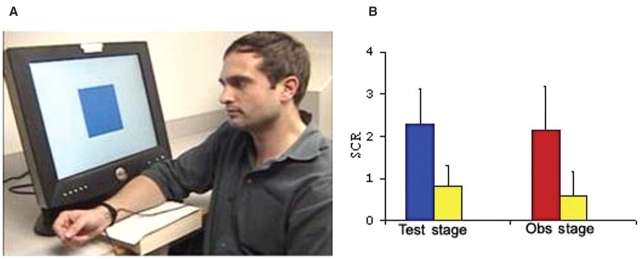
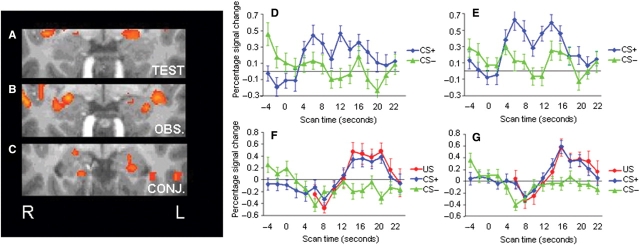
Classical fear conditioning has been used as a model paradigm to explain fear learning across species. In this paradigm, the amygdala is known to play a critical role. However, classical fear conditioning requires first-hand experience with an aversive event, which may not be how most fears are acquired in humans. It remains to be determined whether the conditioning model can be extended to indirect forms of learning more common in humans. Here we show that fear acquired indirectly through social observation, with no personal experience of the aversive event, engages similar neural mechanisms as fear conditioning. The amygdala was recruited both when subjects observed someone else being submitted to an aversive event, knowing that the same treatment awaited themselves, and when subjects were subsequently placed in an analogous situation. These findings confirm the central role of the amygdala in the acquisition and expression of observational fear learning, and validate the extension of cross-species models of fear conditioning to learning in a human sociocultural context. Our findings also provides new insights into the relationship between learning from, and empathizing with, fearful others. This study suggests that indirectly attained fears may be as powerful as fears originating from direct experiences.
Figures
Comment in
-
Learning to fear what others have feared before.Soc Cogn Affect Neurosci. 2007 Mar;2(1):1-2. doi: 10.1093/scan/nsm007. Soc Cogn Affect Neurosci. 2007. PMID: 20336855 Free PMC article. No abstract available.
References
-
- Adolphs R. Cognitive neuroscience of human social behavior. Nature Neuroscience. 2003;4:165–78. - PubMed
-
- Amodio DM, Frith CD. Meeting of minds: the medial frontal cortex and social cognition. Nature Reviews Neuroscience. 2006;7:268–77. - PubMed
-
- Bandura A. Social Learning Theory. New York: General Learning Press; 1977.
-
- Berger S. Conditioning through vicarious instigation. Psychological Review. 1962;69:450–66. - PubMed
-
- Botvinick M, Jha AP, Bylsma LM, Fabian SA, Solomon PE, Prkachin KM. Viewing facial expressions of pain engages cortical areas involved in the direct experience of pain. Neuroimage. 2005;25:312–19. - PubMed
Publication types
MeSH terms
Grants and funding
LinkOut - more resources
Full Text Sources
