. 2008 Dec;99(6):503-16.
doi: 10.1007/s00422-008-0258-5. Epub 2008 Nov 5.

Motion control of musculoskeletal systems with redundancy

Affiliations

Motion control of musculoskeletal systems with redundancy

Hyunjoo Park et al. Biol Cybern. 2008 Dec.

Abstract

Motion control of musculoskeletal systems for functional electrical stimulation (FES) is a challenging problem due to the inherent complexity of the systems. These include being highly nonlinear, strongly coupled, time-varying, time-delayed, and redundant. The redundancy in particular makes it difficult to find an inverse model of the system for control purposes. We have developed a control system for multiple input multiple output (MIMO) redundant musculoskeletal systems with little prior information. The proposed method separates the steady-state properties from the dynamic properties. The dynamic control uses a steady-state inverse model and is implemented with both a PID controller for disturbance rejection and an artificial neural network (ANN) feedforward controller for fast trajectory tracking. A mechanism to control the sum of the muscle excitation levels is also included. To test the performance of the proposed control system, a two degree of freedom ankle-subtalar joint model with eight muscles was used. The simulation results show that separation of steady-state and dynamic control allow small output tracking errors for different reference trajectories such as pseudo-step, sinusoidal and filtered random signals. The proposed control method also demonstrated robustness against system parameter and controller parameter variations. A possible application of this control algorithm is FES control using multiple contact cuff electrodes where mathematical modeling is not feasible and the redundancy makes the control of dynamic movement difficult.


Figures
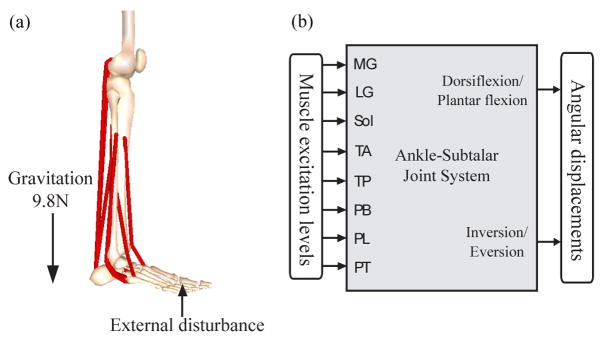
Fig. 1
Fig. 1
Ankle-subtalar joint model with eight muscles and two DOF joint angles. (a) There are eight muscles around ankle-subtalar joints: MG, LG, Sol, TA, TP, PB, PL and PT. The knee joint is fixed and the gravitational direction is parallel to the shank direction. (b) System inputs are muscle excitation levels between 0 and 1. System outputs are angular displacements of ankle joint (dorsiflexion/plantar flexion) and subtalar joint (inversion/eversion).
Fig. 2
Fig. 2
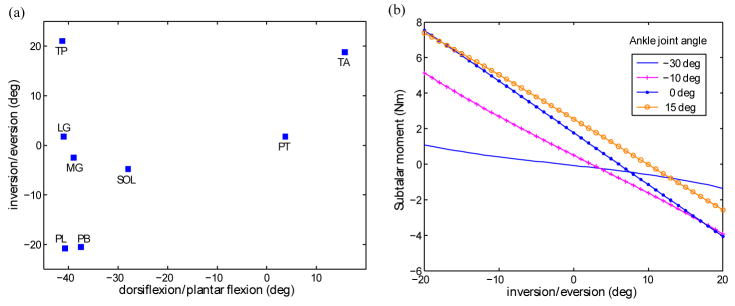
Model analysis. (a) The steady state output joint angles when each of eight muscles is fully activated. (b) An example of strong coupling and nonlinearity properties of the ankle-subtlar joint system. The subtalar joint moments generated by the maximum MG activation with respect to subtalar joint angle variations were calculated for four different ankle joint angles from −30° to 15°. The magnitudes and the direction of the subtalar joint moment depend on the ankle joint angle as well as the subtalar joint angle.
Fig. 3
Fig. 3
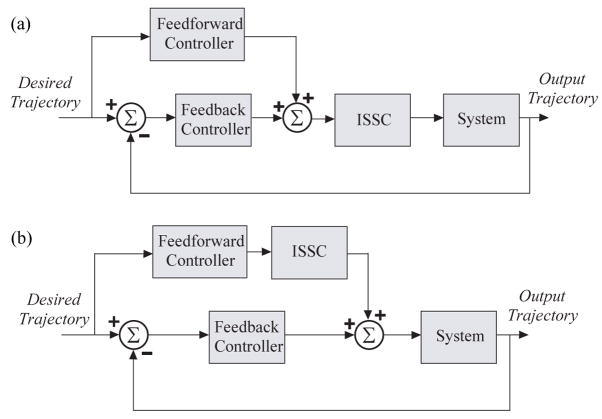
Proposed controller structure. The system stands for the ankle-subtalar joint musculoskeletal model. ISSC is the inverse steady state controller. The Feedforward controller is a multilayer perceptron network (MLP) and feedback controller is PID controller. (a) type I controller structure: Both the feedforward and the feedback control are applied through ISSC. (b) type II controller structure: the feedforward control is applied through ISSC and feedback control is applied directly to the system.
Fig. 4
Fig. 4
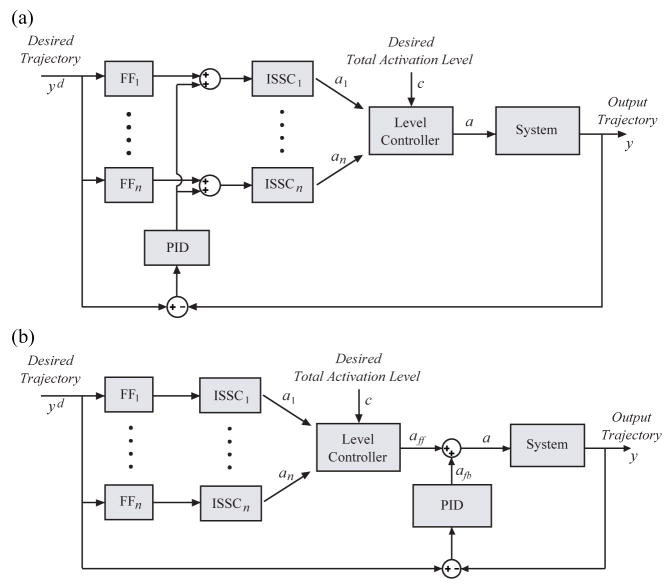
Control structure with desired coactivation level input. ISSCn is n-th inverse steady state controller. Each ISSC is built with different coactivation level. FFn is feedforward controller for ISSCn. The coactivation controller interpolates the output of ISSCs based on the desired coactivation reference trajectory. (a) type I controller. The sum of feedback controller output and FFn output is the input to ISSCn. (b) type II controller. Only feedforward controller output is fed through ISSC and feedback control is directly applied to the system.
Fig. 5
Fig. 5
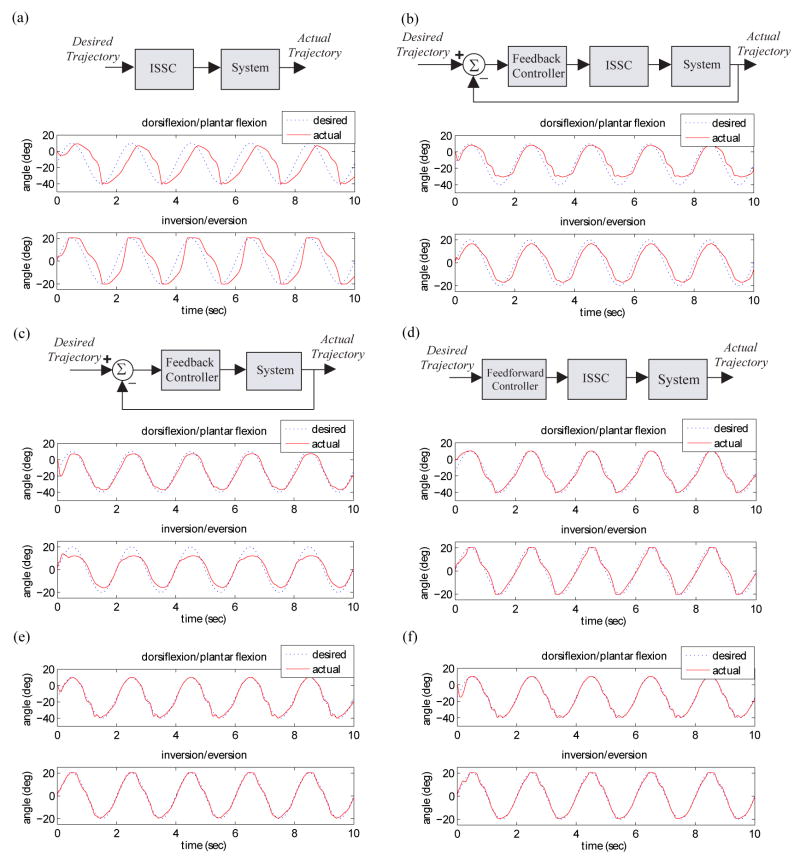
System output for the sinusoidal reference trajectories with coactivation level 0.25. (a) ISSC only (b) feedback + ISSC (type I feedback) (c) direct feedback (type II feedback) (d) feedforward + ISSC (e) type I control (f) type II control. The incorporation of feedback and feedforward control with ISSC in type I and type II control performs better than feedback and feedforward control is used separately.
Fig. 6
Fig. 6
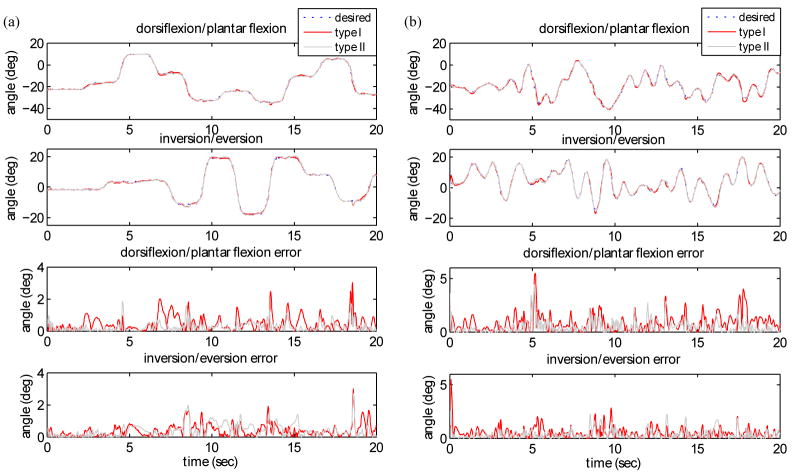
Results of type I and type II control with the total activation level 0.25 for (a) pseudo-step reference trajectories and (b) pseudo-random trajectories. E1 and E2 stand for ankle and subtalar joint RMS errors in degrees respectively. (a) Type I E1: 0.7°(1.4%) E2: 0.6° (1.5%), type II E1: 0.4° (0.8%) E2: 0.6° (1.5%) (b) type I E1: 1.2° (2.4%) E2: 0.8° (2.0%), type II E1: 0.8° (1.6%) E2: 0.6° (1.5%).
Fig. 7
Fig. 7
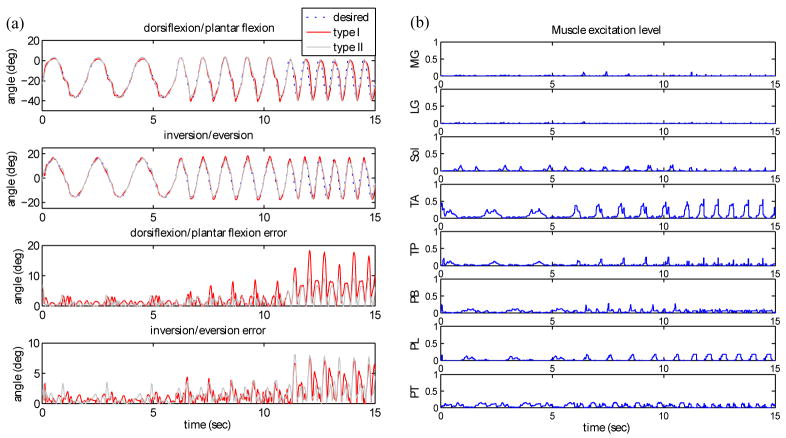
Results of type I and type II control with for in-phase sinusoidal reference trajectories with the total activation level 0.25. (a) The output angles and errors of each joint. E1 and E2 stand for ankle and subtalar joint RMS errors in degrees respectively. Type I control E1: 1.4° (2.8%) for 0.5Hz, 3.0° (4.5%) for 1.0Hz, 8.3° (16.6%) for 1.5Hz, E2: 0.8° (2.0%) for 0.5Hz, 1.6° (4.0%) for 1.0Hz, 3.8° (9.5%) for 1.5Hz, Type II control E1: 1.0° (2.0%) for 0.5Hz, 1.9° (3.8%) for 1.0Hz, 5.0° (10.0%) for 1.5Hz, E2: 1.0° (2.5%) for 0.5Hz, 1.8° (4.5%) for 1.0Hz, 3.5° (8.8%) for 1.5Hz. As the frequency increases, the error increases as well. (b) The corresponding muscle excitation levels generated by type I controller. Muscle excitation levels increase for fast movement
Fig. 8
Fig. 8
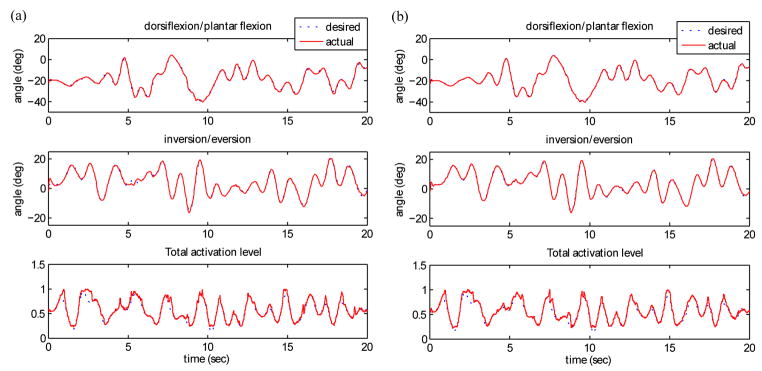
Tracking performance of (a) type I and (b) type II controller while maintaining the desired total activation level. The RMS output errors of type I control are 0.8° (1.6%)and 0.8° (2.0%) for ankle and subtalar joint respectively, and the RMS output errors of type II control are 0.6° (1.2%) and 0.5° (1.3%) for ankle and subtalar joint respectively.
Fig. 9
Fig. 9
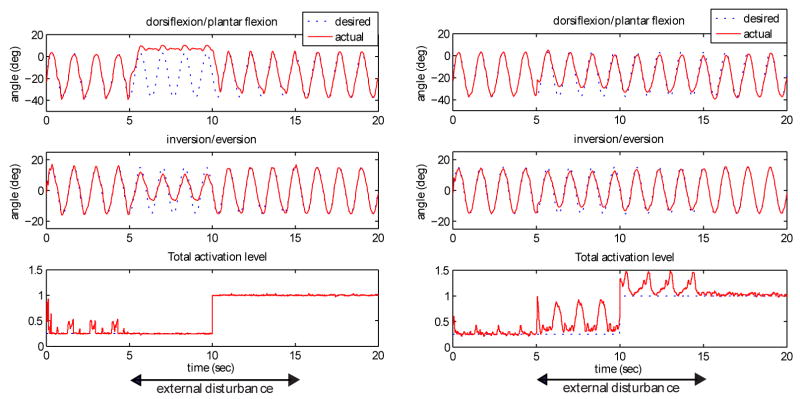
Tracking performance of (a) type I and (b) type II controller in the presence of external disturbance. The external disturbance with the magnitude of 50N is applied at a point 20 cm from the subtalar joint along the foot as shown in Fig. 1 between 5 seconds and 15 seconds. As the total activation level increases from low level (0.25) to high level (1.00), the effect of external disturbance on the output error is reduced. Type II controller is more robust against external disturbance because the output of feedback is not restricted to the subspace of ISSCs.
Fig. 10
Fig. 10
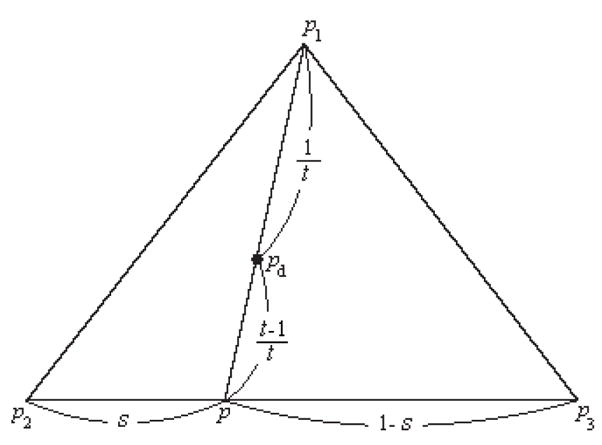
Illustration of the method for finding muscle excitation levels at the desired point pd using linear interpolation of p1, p2 and p3.

References

    1. Abbas JJ, Triolo RJ. Experimental evaluation of an adaptive feedforward controller for use in functional neuromuscular stimulation systems. IEEE Transactions on Rehabilitation Engineering. 1997;5:12–22. - PubMed
    1. Adamczyk MM, Crago PE. Simulated feedforward neural network coordiantion of hand grasp and wrist angle in a neuroprosthesis. IEEE Transactions on Rehabilitation Engineering. 2000;8:297–304. - PubMed
    1. Anderson FC, Pandy MG. Static and dynamic optimization solutions for gait are practically equivalent. Journal of Biomechanics. 2001;34:153–161. - PubMed
    1. Chang G-C, Lub J-J, Liao G-D, Lai J-S, Cheng C-K, Kuo B-L, Kuo T-S. A neuro-control system for the knee joint position control with quadriceps stimulation. Rehabilitation Engineering, IEEE Transactions on. 1997;5:2–11. - PubMed
    1. Crago PE, Peckham PH, Thrope GB. Modulation of muscle force by recruitment during intramuscular stimulation. Ieee Transactions on Biomedical Engineering. 1980;27:679–684. - PubMed

Publication types