


Cyclic changes in gene expression induced by Peg-interferon alfa-2b plus ribavirin in peripheral blood monocytes (PBMC) of hepatitis C patients during the first 10 weeks of treatment
- PMID: 18986530
- PMCID: PMC2613871
- DOI: 10.1186/1479-5876-6-66
Cyclic changes in gene expression induced by Peg-interferon alfa-2b plus ribavirin in peripheral blood monocytes (PBMC) of hepatitis C patients during the first 10 weeks of treatment
Abstract
Background and aims: This study determined the kinetics of gene expression during the first 10 weeks of therapy with Pegylated-interferon-alfa2b (PegIntron) and ribavirin (administered by weight) in HCV patients and compared it with the recently completed Virahep C study 12 in which Peginterferon-alfa2a (Pegasys) and ribavirin were administered.
Methods: RNA was isolated from peripheral blood monocytes (PBMC) from twenty treatment-naïve patients just before treatment (day 1) and at days 3, 6, 10, 13, 27, 42 and 70 days after treatment. Gene expression at each time was measured using Affymetrix microarrays and compared to that of day 1.
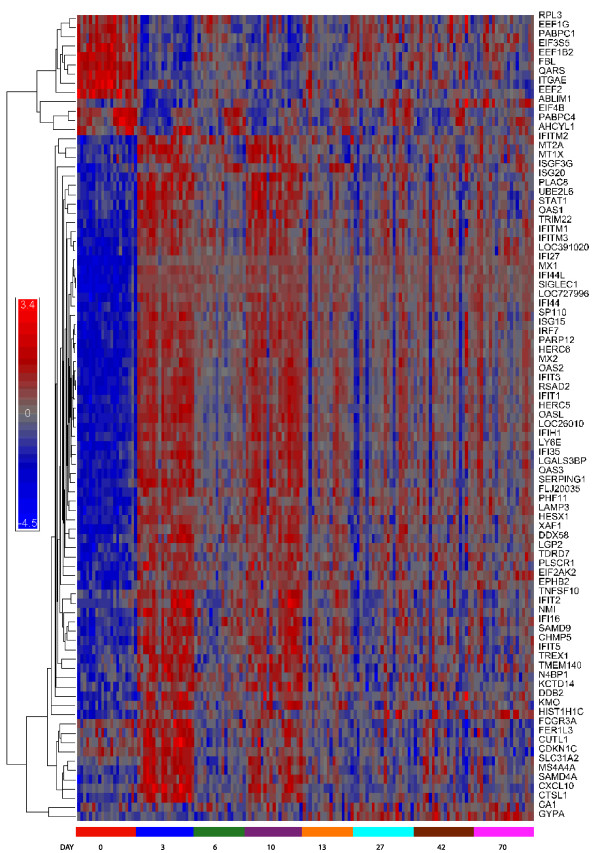
Results: The expression of many genes differed significantly (p <or= 0.001 and changed at least 1.5-fold) at days 3 (290 probes) and 10 (255 probes), but the number dropped at days 6 (165) and 13 (142). Most genes continued to be up regulated throughout the trial period. A second group of genes, including CXCL10, CMKLR1 (chemokine receptor 1), TRAIL, IL1Ralpha and genes associated with complement and lipid metabolism, was transiently induced early in treatment. CDKN1C (cyclin kinase inhibitor 1) was induced early but repressed at later times. Genes induced at later times were mostly related to blood chemistry and oxygen transport. By week 10, 11 of the patients demonstrated a positive response to therapy, and the final sustained viral response (SVR) was 35%. The levels of gene induction or decrease was very similar to that previously reported with Pegasys/ribavirin treatment.
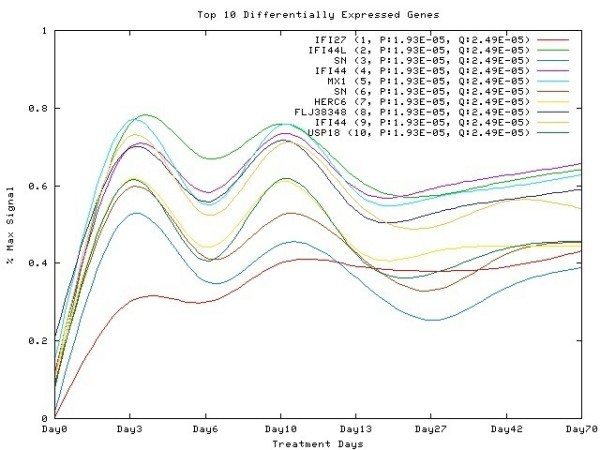
Conclusion: The response to Pegintron/ribavirin was similar to that reported for Pegasys/ribavirin despite some differences in the amount administered. We did not detect major differences at the genomic level between patients responding to treatment or non-responders, perhaps because of limited power. Gene induction occurred in a cyclic fashion, peaking right after administration of interferon and declining between administrations of the drug. Our data suggest that more than once a week dosing might be desirable early during treatment to maintain high levels of response as measured by gene expression.
Figures

References
-
- Conjeevaram HS, Fried MW, Jeffers LJ, Terrault NA, Wiley-Lucas TE, Afdhal N, Brown RS, Belle SH, Hoofnagle JH, Kleiner DE, Howell CD. Peginterferon and ribavirin treatment in African American and Caucasian American patients with hepatitis C genotype 1. Gastroenterology. 2006;131:470–477. - PubMed
-
- Taylor MW, Tsukahara T, Brodsky L, Schaley J, Sanda C, Stephens MJ, McClintick JN, Edenberg HJ, Li L, Tavis JE, et al. Changes in gene expression during pegylated interferon and ribavirin therapy of chronic hepatitis C virus distinguish responders from nonresponders to antiviral therapy. J Virol. 2007;81:3391–3401. - PMC - PubMed
-
- Fried MW, Shiffman ML, Reddy KR, Smith C, Marinos G, Goncales FL, Jr, Haussinger D, Diago M, Carosi G, Dhumeaux D, et al. Peginterferon alfa-2a plus ribavirin for chronic hepatitis C virus infection. N Engl J Med. 2002;347:975–982. - PubMed
-
- Kozlowski A, Charles SA, Harris JM. Development of pegylated interferons for the treatment of chronic hepatitis C. BioDrugs. 2001;15:419–429. - PubMed
Publication types
MeSH terms
Substances
LinkOut - more resources
Full Text Sources
Other Literature Sources
Medical
Molecular Biology Databases
