Review
. 2009 Jan;32(1):56-67.
doi: 10.1016/j.tins.2008.09.009. Epub 2008 Nov 3.

The hidden island of addiction: the insula

Affiliations
Review

The hidden island of addiction: the insula

Nasir H Naqvi et al. Trends Neurosci. 2009 Jan.

Abstract

Most prior research on the neurobiology of addiction has focused on the role of subcortical systems, such as the amygdala, the ventral striatum and mesolimbic dopamine system, in promoting the motivation to seek drugs. Recent evidence indicates that a largely overlooked structure, the insula, plays a crucial part in conscious urges to take drugs. The insula has been highlighted as a region that integrates interoceptive (i.e. bodily) states into conscious feelings and into decision-making processes that involve uncertain risk and reward. Here, we propose a model in which the processing of the interoceptive effects of drug use by the insula contributes to conscious drug urges and to decision-making processes that precipitate relapse.


Figures
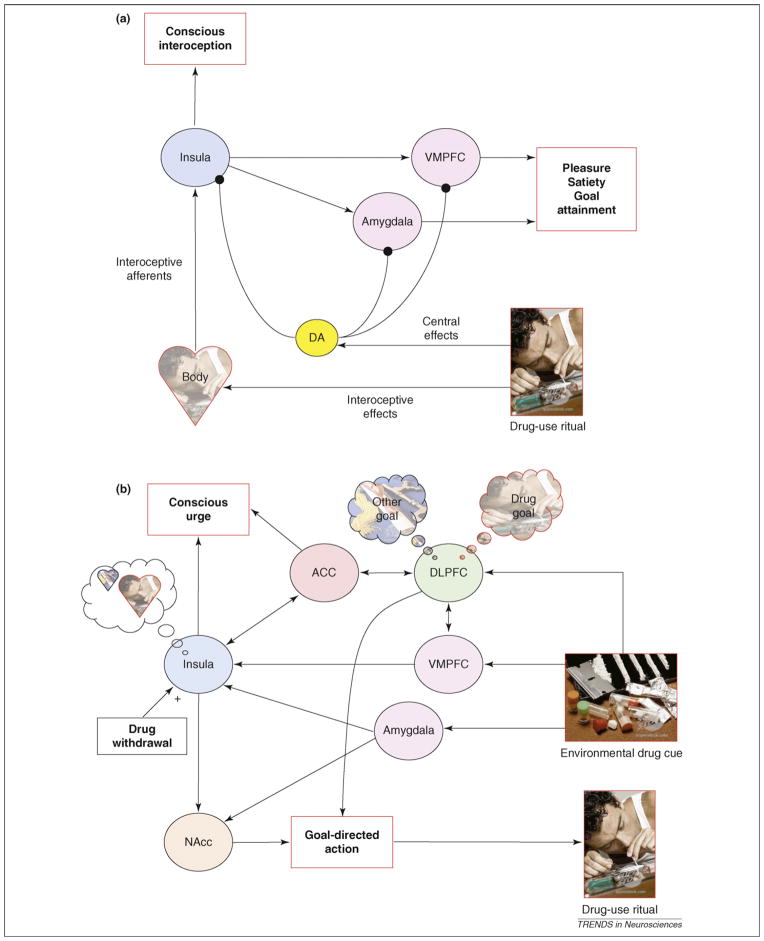
Figure 1
Figure 1
A schematic model of how the interoceptive functions of the insula contribute to the motivation to use drugs. (a) The insula represents the interoceptive effects of drug-use rituals. This gives rise to a specific subjective quality of the drug-use ritual, which includes conscious appreciation of interoceptive effects in addition to pleasure and satiety (i.e. reward). Dopamine (DA) release, stimulated by the central effects of the drug, might modulate the reward derived from the interoceptive effects of drug use and also drives the learning process by which these effects become both pleasurable and desirable. (b) Exposure to environmental cues (e.g. the sight of drug paraphernalia) reactivates representations of the interoceptive effects of the drug-use ritual via the VMPFC and the amygdala. This gives rise to a subjective feeling of conscious urge that is rooted in a memory for these the interoceptive effects. This representation feeds into the nucleus accumbens (NAcc), which plays a part in initiating and invigorating motivated actions or reward seeking. In concert with the dorsolateral prefrontal cortex (DLPFC), which focuses attention and holds representations of specific goals in mind, this process gives rise to a goal-directed action to initiate the specific drug-use ritual, the interoceptive effects of which are currently represented within the insula. The anterior cingulate cortex (ACC) plays a part in conscious feelings of urge both by integrating representations of interoceptive states within the insula with representations of objects in the environment that triggered these states and by monitoring conflict between drug use and other, competing goals. Physiological signals related to drug withdrawal might also modulate these processes via the insula.

References

    1. Peto R, et al. Mortality from tobacco in developed countries: indirect estimation from national vital statistics. Lancet. 1992;339:1268–1278. - PubMed
    1. American Psychiatric Association. Diagnostic and Statistical Manual of Mental Disorders. 4. American Psychiatric Association; 2001.
    1. Everitt BJ, Robbins TW. Neural systems of reinforcement for drug addiction: from actions to habits to compulsion. Nat Neurosci. 2005;8:1481–1489. - PubMed
    1. Robinson T, Berridge KC. Incentive-sensitization and addicition. Addiction. 2001;96:106–114. - PubMed
    1. Tiffany ST. Is craving the source of compulsive drug use? J Psychopharmacol. 1998;12:23–30. - PubMed

Publication types