Review
. 2009 Jan 27;364(1514):229-38.
doi: 10.1098/rstb.2008.0243.

Review. Peering into an ATPase ion pump with single-channel recordings

Affiliations
Review

Review. Peering into an ATPase ion pump with single-channel recordings

David C Gadsby et al. Philos Trans R Soc Lond B Biol Sci. .

Abstract

In principle, an ion channel needs no more than a single gate, but a pump requires at least two gates that open and close alternately to allow ion access from only one side of the membrane at a time. In the Na+,K+-ATPase pump, this alternating gating effects outward transport of three Na+ ions and inward transport of two K+ ions, for each ATP hydrolysed, up to a hundred times per second, generating a measurable current if assayed in millions of pumps. Under these assay conditions, voltage jumps elicit brief charge movements, consistent with displacement of ions along the ion pathway while one gate is open but the other closed. Binding of the marine toxin, palytoxin, to the Na+,K+-ATPase uncouples the two gates, so that although each gate still responds to its physiological ligand they are no longer constrained to open and close alternately, and the Na+,K+-ATPase is transformed into a gated cation channel. Millions of Na+ or K+ ions per second flow through such an open pump-channel, permitting assay of single molecules and allowing unprecedented access to the ion transport pathway through the Na+,K+-ATPase. Use of variously charged small hydrophilic thiol-specific reagents to probe cysteine targets introduced throughout the pump's transmembrane segments allows mapping and characterization of the route traversed by transported ions.


Figures
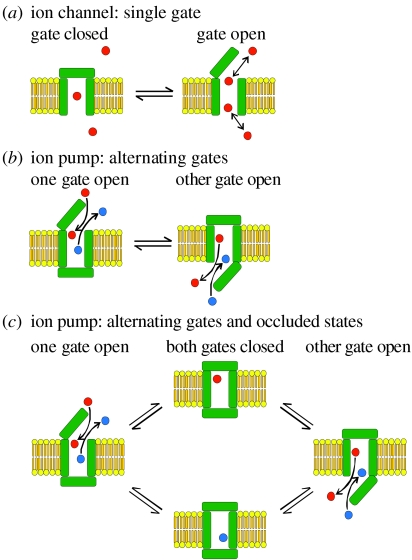
Figure 1
Figure 1
Ion channels versus ion pumps. (a) Representation of minimal ion channel as transmembrane pore with single gate. (b) Representation of minimal ion pump, or transporter, as transmembrane pore with two gates that open and close alternately. An unspecified source of energy is harnessed to make the apparent binding affinity higher for red than blue ions in the left-hand state, and higher for blue than red ions in the right-hand state. (c) The introduction of occluded states, with both gates closed around a bound ion, precludes the possibility of the second gate opening before the first gate has fully closed, which would allow ions to flow down their electrochemical potential gradient at rates several orders of magnitude higher than those at which the pump or transporter can move them against their electrochemical potential gradient. This is because ion movement through pumps or transporters is limited by gating rates, which are much slower than electrodiffusive ion flow.
Figure 2
Figure 2
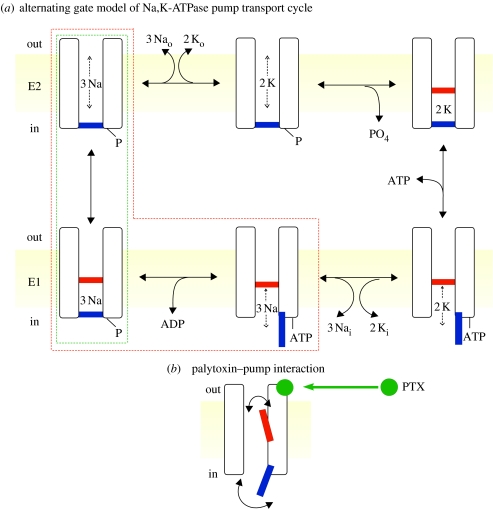
(a) Alternating-gate model of the Post–Albers (Post et al. 1965; Albers 1967) transport cycle of the Na+,K+-ATPase pump represented in cartoon form as an ion channel with two gates, an extracellular-side (labelled out) gate (red) and cytoplasmic-side (in) gate (blue), that open alternately, but are never simultaneously open. Also indicated are E2 (upper row; extracellular-side gate may open) and E1 (lower row; cytoplasmic-side gate may open) states. Occluded states, with both gates shut, follow binding of two external K+ (top right) and of three internal Na+ and subsequent phosphorylation (bottom left). ATP acts with low affinity to speed up the opening of the cytoplasmic-side gate and concomitant K+ deocclusion, and acts with high affinity to phosphorylate the pump. The states enclosed by the red dashed box are occupied in the presence of ATP and Na+ ions, but in the absence of K+ ions. The states within the green dashed box are occupied in the presence of ATP and Na+ ions, but in the absence of ADP and K+ ions, and yield voltage-jump-induced charge movements, associated with deocclusion and release to the exterior of the three transported Na+ ions (Holmgren et al. 2000). (b) Cartoon of channel-like Na+,K+ pump with bound palytoxin (PTX; green ball), which allows the pump's two gates sometimes to be open at the same time. (Modified from Artigas & Gadsby 2003.)
Figure 3
Figure 3
Palytoxin (PTX) transforms Na+,K+-ATPase pumps into channels, one Na+,K+-ATPase pump at a time. (a,b) Macroscopic currents induced by the application of 100 nM PTX to outside-out patches excised from guinea-pig ventricular myocytes, bathed in approximately 160 mM Na+ solutions, and held at −40 mV, (a) with 5 mM MgATP or (b) with no ATP present in the internal solution; note very different current scales in (a) versus (b). (c,d) Representative palytoxin-induced single-channel recordings from outside-out myocyte patches, held at −70 mV and bathed in approximately 160 mM Na+ solutions; dashed lines marked C and O indicate closed and open current levels, respectively. (c) A patch with 5 mM MgATP in the pipette was exposed to 50 pM PTX, which was quickly removed (at second arrow) once the channel opened; long open bursts characterized the gating behaviour of the channel, which remained active for approximately 2 hours. (d) Trace from a patch without pipette ATP, showing gating behaviour shortly after the removal of unbound PTX: open bursts were of shorter duration than seen in the presence of MgATP, and longer closed periods were more frequent. (Adapted from Artigas & Gadsby 2002.)
Figure 4
Figure 4
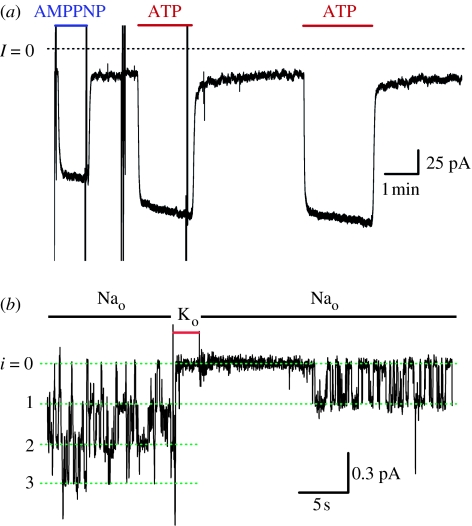
Gating of palytoxin-bound pump–channels by the pump's physiological ligands. (a) Augmentation of macroscopic palytoxin-bound pump–channel current by applications of 1 mM AMPPNP or 1 mM ATP, as indicated, to an inside-out patch from a HEK 293 cell, with 100 nM PTX dissolved in the Na solution inside the pipette. Holding potential, −10 mV; vertical deflections reflect 100 ms step changes in voltage. (b) Single palytoxin-bound pump–channel currents in outside-out patch from a guinea-pig ventricular myocyte, with Na internal solution without ATP. 100 pM palytoxin was applied for approximately 30 s, 1 min before the beginning of the trace. Holding potential, −50 mV. The 150 mM Na+ in the external solution was replaced by 150 mM K+ for the 2 s period indicated by the red line; the trace during those 2 s has been corrected for an instantaneous 1.8 pA change of seal current, also seen before palytoxin application.
Figure 5
Figure 5
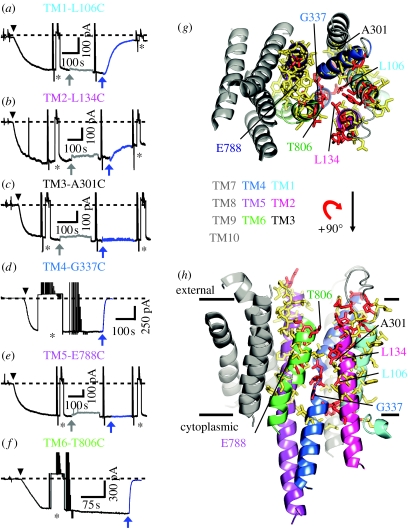
Characteristics of the ion pathway through the palytoxin-bound Na+,K+-ATPase as revealed by a combination of cysteine scanning and homology modelling. (a–f) Effects of MTSET+ on current through palytoxin-bound Na+,K+ pump–channels with single target cysteines introduced at representative positions in TM1 (a, L106), TM2 (b, L134), TM3 (c, A301), TM4 (d, G337), TM5 (e, E788) or TM6 (f, T806). Application of 50 nM palytoxin (black arrowheads) generated inward (negative) current, Ipalytoxin (dashed line marks zero total membrane current) in outside-out patches exposed to symmetrical Na+ concentrations. Temporary substitution (asterisk) of less permeant tetramethylammonium (TMA+) for external Na+ monitored patch integrity. Application of 10 mM dithiothreitol (grey arrows, grey traces) caused a small, reversible, poorly understood current decrease. Then 1 mM MTSET+ (blue arrows, blue traces) was applied until the current became steady. (g, h) MTSET+-reactive (red sticks; Ipalytoxin altered >10% by 1 mM MTSET+) and non-responsive (yellow sticks) residues were mapped onto a homology model of the Na+,K+-ATPase transmembrane domain based on the SERCA E2·BeF3 structure, shown viewed from (g) the extracellular surface or (h) the membrane plane. Representative residues featured in (af) are labelled and helices are coloured pale blue (TM1), magenta (TM2), dark grey (TM3), blue (TM4), purple (TM5), green (TM6) and the rest (TM7–TM10) grey. Reaction rate constants for MTSET+ decreased from 104 M−1 s−1 or more for superficial positions to 10 M−1 s−1 or more for deep positions. (Modified from Takeuchi et al. 2008.)

References

    1. Albers R.W. Biochemical aspects of active transport. Annu. Rev. Biochem. 1967;36:727–756. doi:10.1146/annurev.bi.36.070167.003455 - DOI - PubMed
    1. Artigas P., Gadsby D.C. Ion channel-like properties of the Na+/K+-pump. Ann. NY Acad. Sci. 2002;976:31–40. - PubMed
    1. Artigas P., Gadsby D.C. Na+/K+-pump ligands modulate gating of palytoxin-induced ion channels. Proc. Natl Acad. Sci. USA. 2003;100:501–505. doi:10.1073/pnas.0135849100 - DOI - PMC - PubMed
    1. Artigas P., Gadsby D.C. Large diameter of palytoxin-induced Na/K pump-channels and modulation of palytoxin interaction by Na/K pump ligands. J. Gen. Physiol. 2004;123:357–376. doi:10.1085/jgp.200308964 - DOI - PMC - PubMed
    1. Artigas P., Gadsby D. Oubain affinity determining residues lie close to the Na/K pump ion pathway. Proc. Natl Acad. Sci. USA. 2006;103:12 613–12 618. doi:10.1073/pnas.0602720103 - DOI - PMC - PubMed

Publication types

MeSH terms