


Increased cognitive functioning in symptomatic Huntington's disease as revealed by behavioral and event-related potential indices of auditory sensory memory and attention
- PMID: 18987205
- PMCID: PMC6671311
- DOI: 10.1523/JNEUROSCI.2659-08.2008
Increased cognitive functioning in symptomatic Huntington's disease as revealed by behavioral and event-related potential indices of auditory sensory memory and attention
Abstract
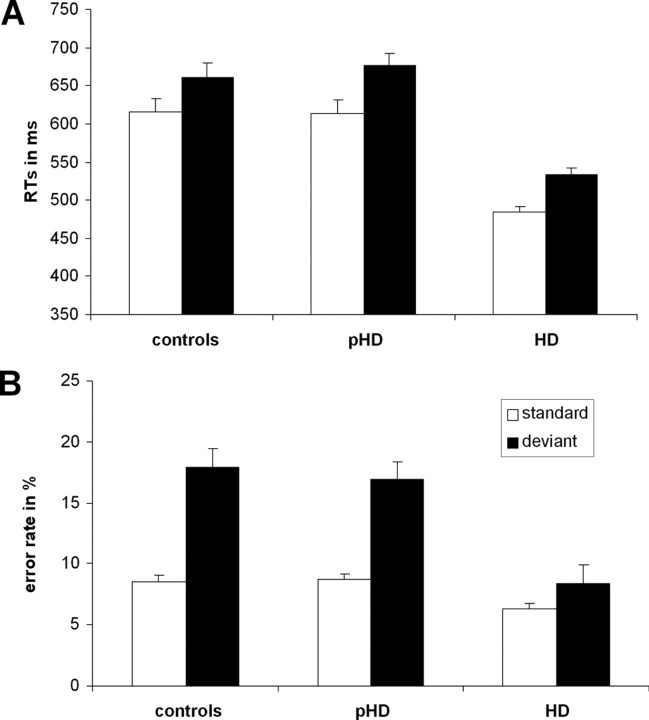
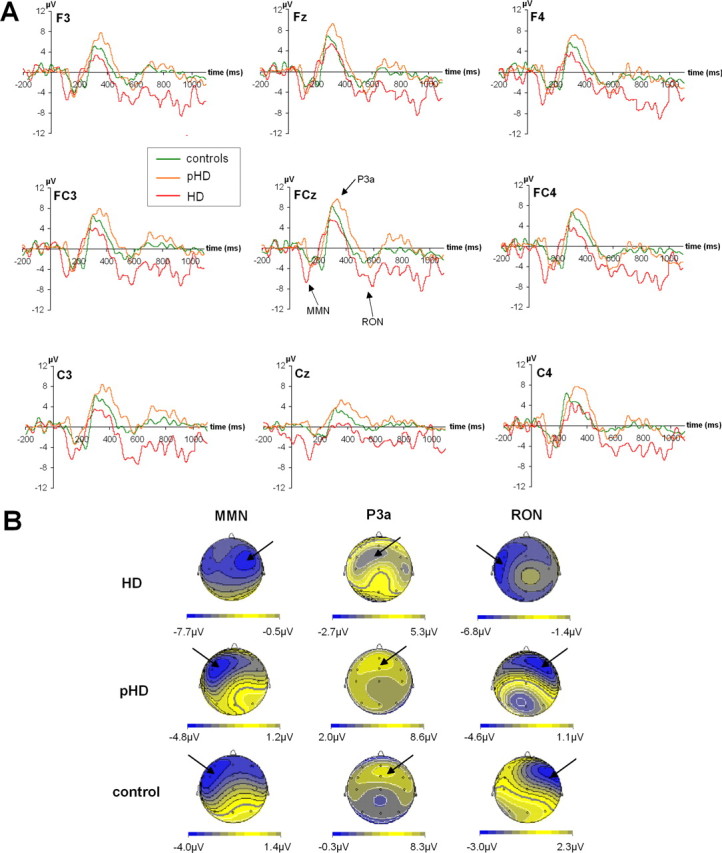
Cognitive functions are thought to deteriorate globally in late stages of various neurodegenerative disorders. Here we describe that this general assumption is not justified and fails in Huntington's disease (HD). Presymptomatic gene mutation carriers (pHDs) and healthy controls performed worse compared with symptomatic HDs in an auditory signal detection task. During task performance, behavioral data and event-related potentials (ERPs) [i.e., MMN (mismatch negativity), P3a, and RON (reorienting negativity)] were recorded. Not only behavioral performance but also neurophysiological correlates of auditory sensory memory and attentional reorientation indicate enhanced performance occurring primal in late stages of a neurodegenerative disorder. Increased activity of the NMDA-receptor system, an assumed pathogenic mechanism in HD, might facilitate signal propagation at striatal level that enables more efficient task execution through a winner-take-all process. The results challenge the view that late stage neurodegeneration is necessarily related to a global decline in cognitive abilities in HD. In contrast, selectively enhanced cognitive functioning can emerge together with otherwise impaired cognitive functioning.
Figures
References
-
- Ahveninen J, Jääskeläinen IP, Osipova D, Huttunen MO, Ilmoniemi RJ, Kaprio J, Lönnqvist J, Manninen M, Pakarinen S, Therman S, Näätänen R, Cannon TD. Inherited auditory-cortical dysfunction in twin pairs discordant for schizophrenia. Biol Psychiatry. 2006;60:612–620. - PubMed
-
- Arning L, Kraus PH, Valentin S, Saft C, Andrich J, Epplen JT. NR2A and NR2B receptor gene variations modify age at onset in Huntington's disease. Neurogenetics. 2005;6:25–28. - PubMed
-
- Aron AR, Watkins L, Sahakian BJ, Monsell S, Barker RA, Robbins TW. Task-set switching deficits in early-stage Huntington's disease: implications for basal ganglia function. J Cogn Neurosi. 2003;15:629–642. - PubMed
-
- Beal MF, Ferrante RJ. Experimental therapeutics in transgenic mouse models of Huntington's disease. Nat Rev Neurosci. 2004;5:373–384. - PubMed
-
- Berti S, Schröger E. A comparison of auditory and visual distraction effects: behavioral and event-related indices. Brain Res Cogn Brain Res. 2001;10:265–273. - PubMed
Publication types
MeSH terms
LinkOut - more resources
Full Text Sources
Other Literature Sources
Medical
