Clinical Trial
. 2009 Feb 3;72(5):396-401.
doi: 10.1212/01.wnl.0000327341.89587.76. Epub 2008 Nov 5.

Immunologic, clinical, and radiologic status 14 months after cessation of natalizumab therapy

Affiliations
Clinical Trial

Immunologic, clinical, and radiologic status 14 months after cessation of natalizumab therapy

O Stüve et al. Neurology. .

Abstract

Objective: Natalizumab is a humanized recombinant monoclonal antibody against very late activation antigen-4 approved for the treatment of patients with multiple sclerosis (MS). A phase II study failed to demonstrate a difference between natalizumab treatment groups and the placebo group with regard to gadolinium enhancing lesions on MRI 3 months after discontinuation of therapy. The objective of this study was to assess clinical MS disease activity, surrogate disease markers on MRI, immunologic parameters in peripheral blood and CSF, as well as safety in patients with MS after discontinuation of natalizumab therapy.

Methods: This study is a longitudinal and serial cross-sectional assessment, in which 23 patients who were treated with natalizumab in the context of two phase III clinical trials were originally enrolled. A subgroup of patients was followed over 14 months. The annual relapse rate, neurologic disease progression assessed by the Expanded Disability Status Scale, disease surrogate markers on MRI, cellular and humoral immune markers in peripheral blood and CSF, and adverse events of the drug were monitored.

Results: With regard to clinical disease activity, neuroimaging, and immune responses, the majority of patients in our cohort were stable. Decreased lymphocyte cell numbers and altered cell ratios returned to normal 14 months after cessation of natalizumab. No infectious complications were observed.

Conclusion: This is the first long-term follow-up of patients who discontinued natalizumab. We did not observe a clinical, radiographic, or immunologic rebound phenomenon after discontinuation of natalizumab therapy.


Figures
None
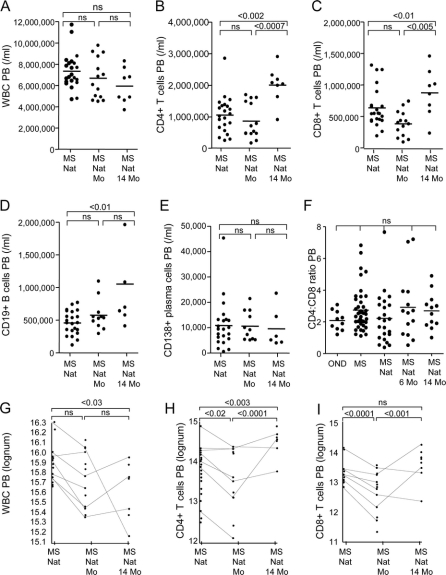
Figure 1 Analysis of leukocyte and lymphocyte cell numbers in peripheral blood (PB) Serial cross-sectional analysis showed that the total numbers of white blood cells (WBC) in the PB of natalizumab-treated patients with multiple sclerosis (MS) at study entry (MS Nat) were within normal limits (A). There was a nonsignificant (ns) decrease in WBC numbers between the entry time point, 6 months (MS Nat 6 months), and 14 months (MS Nat 14 months) after cessation of natalizumab therapy (A). The number of CD4+ T cells (B), CD8+ T cells (C), and CD19+ B cells (D) significantly increased 14 months after discontinuation of natalizumab therapy, whereas the number of CD138+ plasma cells did not change (E). CD4:CD8 T cell ratios in the PB were normal at all three time points (F). Longitudinal analysis of leukocyte and lymphocyte cell numbers showed a significant decrease of WBC between study entry and month 14 (G). After an initial decrease at 6 months after cessation of natalizumab, there was an increase of CD4+ T cells in the PB 14 months after study entry (H). The number of CD8+ T cells did not change over the 14-month study period, but there was an initial significant decrease 6 months after cessation of natalizumab (I).
None
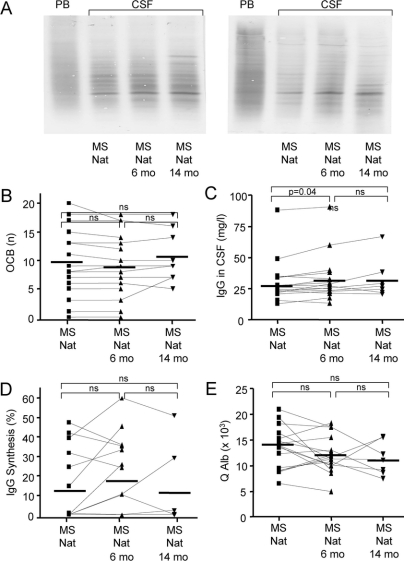
Figure 2 Humoral immune parameters in CSF Oligoclonal bands (OCBs) were assessed in all patient samples. Two examples of the OCBs detection assay are shown (A). The number of OCBs (B), the amount of IgG synthesis (D), and the CSF/serum albumin quotient (E) did not differ between patients on natalizumab [MS (Nat)] and 6 months (MS Nat 6 months) or 14 months (MS Nat 14 months) after cessation of the drug. The total amount of intrathecal IgG increased significantly 6 months after cessation of natalizumab, and remained stable over the next 8 months (C).
None
Figure 3 Measurement of disease activity Longitudinal analysis of the annual relapse rate was assessed in 21 patients with multiple sclerosis (MS) for the 12-month period prior to enrollment into the AFFIRM and SENTINEL trials (MS pre Nat), for the trial period of the AFFIRM and SENTINEL trials (MS Nat), and for the 14-month period after cessation of natalizumab (MS Nat 14 months) (A). In addition, neurologic disability assessed by the Expanded Disability Status Scale (EDSS) was recorded in 17 patients prior to enrollment into the AFFIRM and SENTINEL trial (MS pre Nat), at the time of cessation of natalizumab therapy (MS Nat), and 14 months after cessation of natalizumab (MS Nat 14 months) (B). There was a significant decrease in the annual relapse rate in patients with MS on natalizumab during the AFFIRM and SENTINEL trials compared to the pretrial period (A). There was also a significant decrease in the annual relapse rate in the 14-month period after cessation of therapy compared to the pretrial period (A). In contrast, there was no significant difference in the annual relapse rate between patients on natalizumab during the AFFIRM and SENTINEL trials and during the 14-month period after cessation of natalizumab therapy (A). There was no significant difference with regard to neurologic disability as assessed by the EDSS scale among the three time points in this patient cohort (B). The number of new gadolinium-enhancing (Gd+) lesions on T1-weighted MRI (C), the total lesion volume on T2-weighted (D) and FLAIR-weighted images (E) was assessed while patients received natalizumab, and 14 months after discontinuation of therapy. There was no significant difference with regard to Gd+ lesions on T1-weighted images (C) and the total lesion volume on T2-weighted (D) and FLAIR weighted images (E).

Comment in

  • Natalizumab: bound to rebound?
    Schiess N, Calabresi PA. Schiess N, et al. Neurology. 2009 Feb 3;72(5):392-3. doi: 10.1212/01.wnl.0000341783.33962.5b. Neurology. 2009. PMID: 19188569 No abstract available.

References

    1. Stuve O, Bennett JL. Pharmacological properties, toxicology and scientific rationale for the use of natalizumab (Tysabri) in inflammatory diseases. CNS Drug Rev 2007;13:79–95. - PMC - PubMed
    1. Rudick RA, Stuart WH, Calabresi PA, et al. Natalizumab plus interferon beta-1a for relapsing multiple sclerosis. N Engl J Med 2006;354:911–923. - PubMed
    1. Polman CH, O’Connor PW, Havrdova E, et al. A randomized, placebo-controlled trial of natalizumab for relapsing multiple sclerosis. N Engl J Med 2006;354:899–910. - PubMed
    1. Kleinschmidt-Demasters BK, Tyler KL. Progressive multifocal leukoencephalopathy complicating treatment with natalizumab and interferon beta-1a for multiple sclerosis. N Engl J Med 2005;353:369–374. - PubMed
    1. Langer-Gould A, Atlas SW, Green AJ, Bollen AW, Pelletier D. Progressive multifocal leukoencephalopathy in a patient treated with natalizumab. N Engl J Med 2005;353:375–381. - PubMed

Publication types

MeSH terms