Comparative Study
. 2009 Mar;150(3):1485-94.
doi: 10.1210/en.2008-1459. Epub 2008 Nov 6.

Strain-specific differences in the mechanisms of progesterone regulation of murine mammary gland development

Affiliations
Comparative Study

Strain-specific differences in the mechanisms of progesterone regulation of murine mammary gland development

Mark D Aupperlee et al. Endocrinology. 2009 Mar.

Abstract

Progesterone (P) is required for normal mammary gland development, and is implicated in the etiology of mammary cancer in rodents and humans. We analyzed mammary gland developmental responses to P and estrogen (E) in two strains of mice (BALB/c and C57BL/6) that exhibit differences in ductal development at sexual maturity and alveologenesis during pregnancy. C57BL/6 mice exhibited reduced proliferative and morphological responses to P. Analysis of known mediators of sidebranching and alveologenesis revealed that reduced P-induced expression of P receptor isoform B and receptor activator of nuclear factor-kappaB ligand (RANKL), as well as altered expression and regulation of cyclin D1, CCAAT/enhancer binding protein beta, and the downstream effectors of RANKL, nuclear Id2 and p21, contribute significantly to the reduced P responsiveness of the C57BL/6 mammary gland. In contrast, E responsiveness was greater in C57BL/6 than in BALB/c glands. E may play a compensatory role in C57BL/6 alveologenesis through its effect on the induction and activation of signal transducer and activator of transcription 5a, a known regulator of RANKL. These observations suggest that in human populations with heterogeneous genetic backgrounds, individuals may respond differentially to the same hormone. Thus, genetic diversity may have a role in determining the effects of P in normal mammary development and tumorigenesis.


Figures
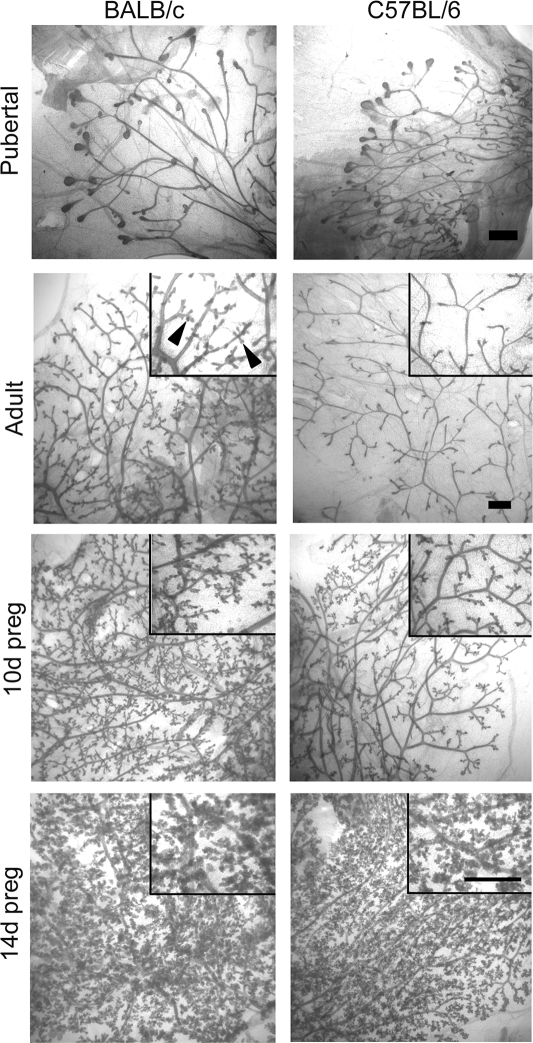
Figure 1
Figure 1
Mammary gland development in BALB/c and C57BL/6 mice. Mammary gland whole mounts were prepared from 6-wk-old immature, 20-wk-old adult, and 10 and 14 d pregnant (preg) BALB/c and C57BL/6 mice as described in Materials and Methods. Lower magnification images with higher magnification insets are shown for adult and pregnant mammary glands. Black arrowheads indicate sidebranching in the adult BALB/c mouse. Scale bar, 1 mm.
Figure 2
Figure 2
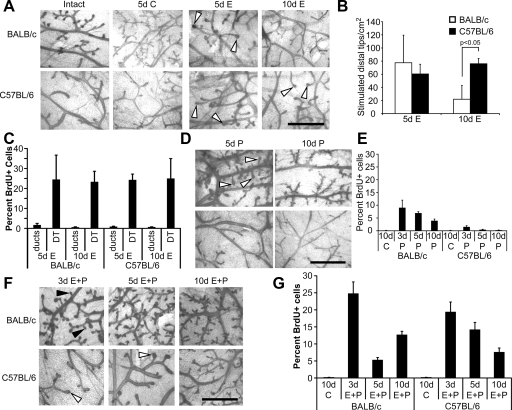
Effects of E or P treatment on morphology and proliferation. Panels A, D, and F, Representative mammary gland whole mounts from intact and ovariectomized 3, 5, and 10 d control (C)-, E-, P-, or E plus P-treated BALB/c and C57BL/6 mice. White arrowheads indicate enlargement of distal tips of ducts (panels A and F), sidebranches (panel D), and black arrowheads indicate side branches (panel F). Scale bar, 1 mm. B, Quantitation of enlarged distal tips of ducts. The number of enlarged distal tips (area > 0.003 mm2, which represents the area of an unstimulated duct end) per cm2 for ovariectomized adult BALB/c and C57BL/6 mice treated for 5 or 10 d with E. After 10 d E, the number of enlarged distal tips in the BALB/c was less than in the C57BL/6 (P < 0.05). Panels C, E, and G, Quantitation of proliferating luminal epithelial cells in ducts and distal tips (DT) after E (panel C), P (panel E), or E plus P (panel G) treatment as described in Materials and Methods. The values represent the mean ± sem.
Figure 3
Figure 3
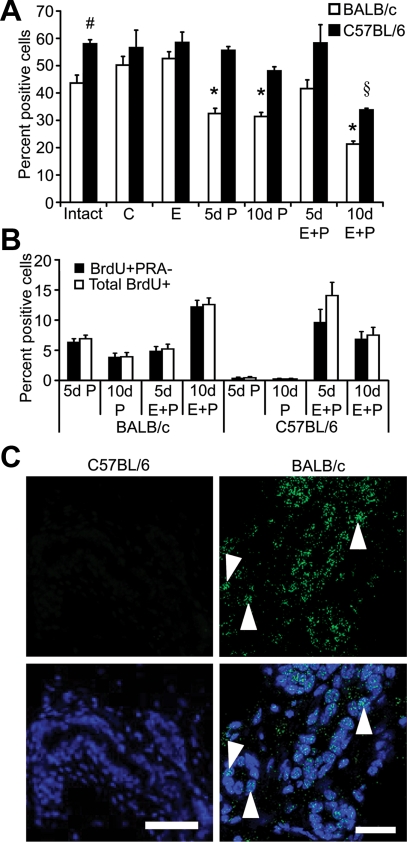
Hormonal regulation of PRA and PRB expression. PRA- or PRB-expressing cells were detected by immunofluorescence as described in Materials and Methods. Panel A, Quantitation of the PRA+ luminal epithelial cells in adult intact or ovariectomized BALB/c and C57BL/6 mice treated for 5 or 10 d with control (C), E, P, or E plus P. *, PRA+ cells were less abundant in 5 and 10 d P and 10 d E plus P-treated glands than in intact, control, E, and 5 d E plus P-treated glands in BALB/c mice (P < 0.05); #, PRA+ cells were more abundant in intact C57BL/6 than in intact BALB/c glands (P < 0.05); §, PRA+ cells were less abundant in 10 d E plus P-treated C57BL/6 glands than in all other C57BL/6 treatments (P < 0.05). Panel B, Quantitation of BrdU+ and BrdU+/PRA− luminal epithelial cells. Dual-immunofluorescent detection of PRA and BrdU in glands of ovariectomized adult BALB/c and C57BL/6 mice treated for 5 or 10 d with P or E plus P. The values (A and B) represent the mean ± sem. Panel C, Immunofluorescent detection of PRB. PRB staining (green nuclei, white arrowheads) in 10 d E plus P-treated C57BL/6 and BALB/c mammary glands. Nuclei (blue) were counterstained with DAPI. Scale bar, 25 μm.
Figure 4
Figure 4
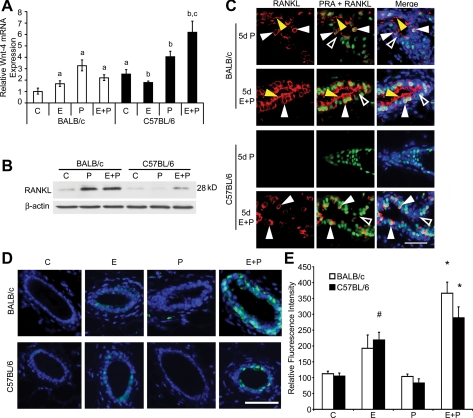
Expression and hormonal regulation of Wnt-4, RANKL, and Stat5a. Panel A, RT-PCR detection of Wnt-4 mRNA expressed as fold change relative to ovariectomized control (C) levels in the BALB/c mammary gland. a, P < 0.05 E, P, or E plus P increased Wnt-4 in the BALB/c gland; ovariectomized C57BL/6 control gland expressed more Wnt-4 than BALB/c control gland. b, P < 0.05 E decreased Wnt-4 in C57BL/6 gland; P and E plus P increased Wnt-4 relative to ovariectomized controls. c, P < 0.05 E plus P increased Wnt-4 in C57BL/6 more than in BALB/c gland. Panel B, Immunoblot analysis of RANKL in ovariectomized adult BALB/c and C57BL/6 glands after 5 d control, P, or E plus P. Cytoplasmic extracts from mammary gland were subjected to SDS-PAGE, and RANKL was detected in immunoblot as described in Materials and Methods. Panel C, Dual-immunofluorescent detection of RANKL (red) and PRA (green) in mammary glands of ovariectomized adult BALB/c and C57BL/6 mice after 5 d with P or E plus P; nuclei (blue) were counterstained with DAPI. White arrowheads indicate PRA+/RANKL+ cells; yellow arrowheads indicate RANKL staining in the ductal lumen associated with the apical plasma membranes of RANKL− cells. Open arrowheads indicate PRA−/RANKL− cells. Scale bar, 25 μm. Panel D, Merged Immunofluorescence images of Stat5a (teal) in mammary gland sections from ovariectomized adult BALB/c and C57BL/6 mice after 3 d control, E, P, or E plus P; nuclei (blue) counterstained with DAPI. Scale bar, 25 μm. Panel E, Quantitation of Stat5a immunofluorescence intensity. Values represent the mean ± sem pixel intensity in nuclear Stat5a-positive cells. *, Stat5a intensity after 3 d E plus P in BALB/c and C57BL/6 mammary glands is greater than controls (P < 0.05); #, Stat5a intensity after 3 d E in C57BL/6 mammary glands is greater than control (P < 0.05).
Figure 5
Figure 5
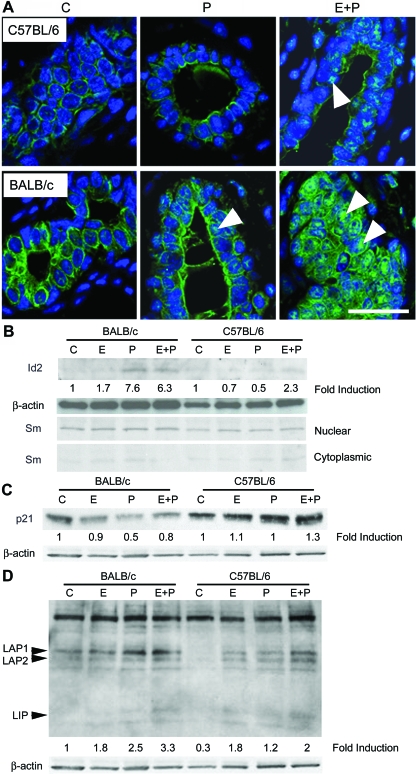
Hormonal regulation of nuclear Id2, p21, and C/EBPβ. Panel A, Immunofluorescent detection of Id2 in mammary glands of ovariectomized adult BALB/c and C57BL/ mice after 5 d control (C), P, or E plus P. Nuclear Id2 was detected (green nuclei, white arrowheads); nuclei (blue) were counterstained with To-PRO. Scale bar, 25 μm. Panels B–D, Immunoblot analysis of Id2 (panel B), p21 (panel C), and C/EBPβ (panel D) in nuclear extracts of whole mammary glands from ovariectomized adult BALB/c and C57BL/6 mice after 5 d control, E, P, or E plus P. Nuclear extracts were subjected to SDS-PAGE, and Id2, p21, and C/EBPβ were detected in immunoblots as described in Materials and Methods. The 33-kDa Sm nuclear antigen, detected to evaluate the quality of cellular fractionation, was more abundant in nuclear than cytoplasmic extracts, indicating successful fractionation.
Figure 6
Figure 6
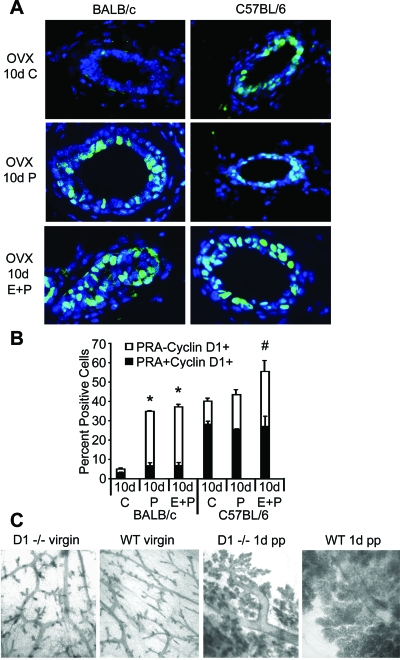
Hormonal regulation of D1. Panel A, Dual-immunofluorescent detection of PRA and D1 was determined for ovariectomized adult BALB/c and C57BL/6 mice after 10 d control (C), P, or E plus P. Nuclear expression of D1 was detected (green nuclei); nuclei (blue) were counterstained with DAPI. Scale bar, 25 μm. Panel B, Quantitation of D1+ PRA− and PRA+D1+ luminal epithelial cell nuclei. *, Total nuclear D1+ cells after 10 d P and E plus P is greater than in 10 d control in BALB/c glands (P < 0.05); #, total nuclear D1+ cells after 10 d E plus P is greater than after 10 d control or P in C57BL/6 glands (P < 0.05). The values represent the mean ± sem. Panel C, Whole mounts from virgin adult and 1 d postpartum (pp) D1−/− and wild-type (WT) BALB/c mice.

References

    1. Aupperlee MD, Haslam SZ 2007 Differential hormonal regulation and function of progesterone receptor isoforms in normal adult mouse mammary gland. Endocrinology 148:2290–2300 - PubMed
    1. Fendrick JL, Raafat AM, Haslam SZ 1998 Mammary gland growth and development from the postnatal period to postmenopause: ovarian steroid receptor ontogeny and regulation in the mouse. J Mammary Gland Biol Neoplasia 3:7–22 - PubMed
    1. Hofseth LJ, Raafat AM, Osuch JR, Pathak DR, Slomski CA, Haslam SZ 1999 Hormone replacement therapy with estrogen or estrogen plus medroxyprogesterone acetate is associated with increased epithelial proliferation in the normal postmenopausal breast. J Clin Endocrinol Metab 84:4559–4565 - PubMed
    1. Graham JD, Yager ML, Hill HD, Byth K, O'Neill GM, Clarke CL 2005 Altered progesterone receptor isoform expression remodels progestin responsiveness of breast cancer cells. Mol Endocrinol 19:2713–2735 - PubMed
    1. Graham JD, Yeates C, Balleine RL, Harvey SS, Milliken JS, Bilous AM, Clarke CL 1996 Progesterone receptor A and B protein expression in human breast cancer. J Steroid Biochem Mol Biol 56:93–98 - PubMed

Publication types

MeSH terms