. 2008 Nov 7;322(5903):957-60.
doi: 10.1126/science.1162011.

Fat metabolism links germline stem cells and longevity in C. elegans

Affiliations

Fat metabolism links germline stem cells and longevity in C. elegans

Meng C Wang et al. Science. .

Abstract

Fat metabolism, reproduction, and aging are intertwined regulatory axes; however, the mechanism by which they are coupled remains poorly understood. We found that germline stem cells (GSCs) actively modulate lipid hydrolysis in Caenorhabditis elegans, which in turn regulates longevity. GSC arrest promotes systemic lipolysis via induction of a specific fat lipase. Subsequently, fat mobilization is promoted and life span is prolonged. Constitutive expression of this lipase in fat storage tissue generates lean and long-lived animals. This lipase is a key factor in the lipid hydrolysis and increased longevity that are induced by decreased insulin signaling. These results suggest a link between C. elegans fat metabolism and longevity.


Figures
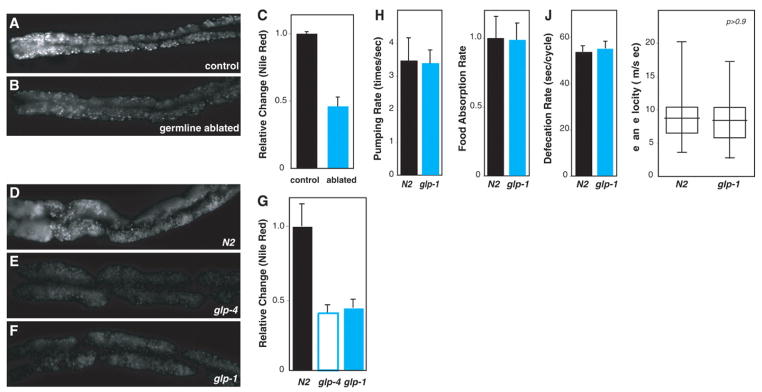
Fig. 1
Fig. 1. Influence of reproductive activity on fat metabolism
(A to C) Ablation of germline precursor cells resulted in a 50% reduction in adult fat storage (P < 0.0001) (n = 15). (D to G) The same degree of reduction was observed in glp-4(bn2) and glp-1(e2141) mutants defective in germline proliferation (P < 0.0001) (N2 and glp-4, n = 15; glp-1, n = 18). (H to J) Decreased fat in glp-1 was not due to less food intake (measured as pharyngeal pumping and food absorption rates) or food retention time (measured as defecation rate) (P > 0.5 for each) (pumping rate, N2, n = 12; glp-1, n = 18; food absorption rate, N2 and glp-1, n = 5; defecation rate, N2 and glp-1, n = 7). (K) Comparison of locomotory behavior showed that physical activity does not change in glp-1. Experiments were performed at the restrictive temperature (25°C) for both wild-type (N2) and glp mutants (n = 21 for each).
Fig. 2
Fig. 2. Regulation of fat metabolism by GSC proliferation
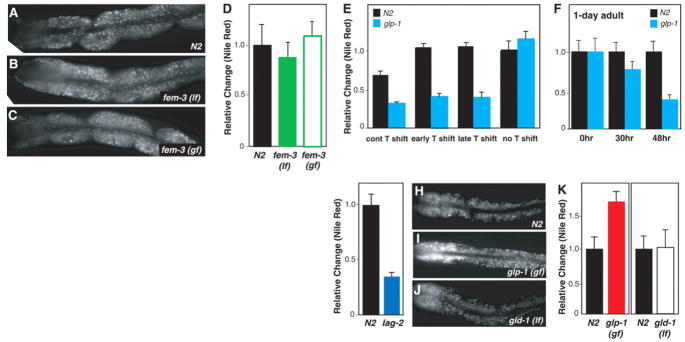
(A to D) fem-3(e2006) loss-of-function mutants (lf) producing only oocytes or fem-3(q20) gain-of-function mutants (gf) generating only sperm showed the same fat storage as in the wild type (P > 0.1) (n = 15 for each). (E) Shift to 25°C during early or late larval development did not affect fat storage in the wild type (P > 0.1) but caused a 50% decrease in glp-1(e2141) mutants (P < 0.0001) (n = 15 for each genotype and treatment). (F) GSC arrest, caused by temperature shifting of 1-day-old glp-1 adults, caused a decrease in fat storage (0 hours, P > 0.5; 30 hours, P < 0.005; 48 hours, P < 0.0001)(n = 17 for each genotype and treatment). (G) lag-2(q420) showed reduced fat (P < 0.0001) (N2, n = 12; lag-2, n = 15). (H to K) GSC overproliferation in the glp-1(ar202) gain-of-function mutant causes increased fat (P < 0.0001). In contrast, the loss-of-function mutant of gld-1(q485), in which early-phase meiotic germ cells overproliferate, did not change fat storage (P > 0.1) (N2, n = 12; glp-1, n = 15; gld-1, n = 13).
Fig. 3
Fig. 3. A role for triglyceride lipase in lipid hydrolysis and longevity
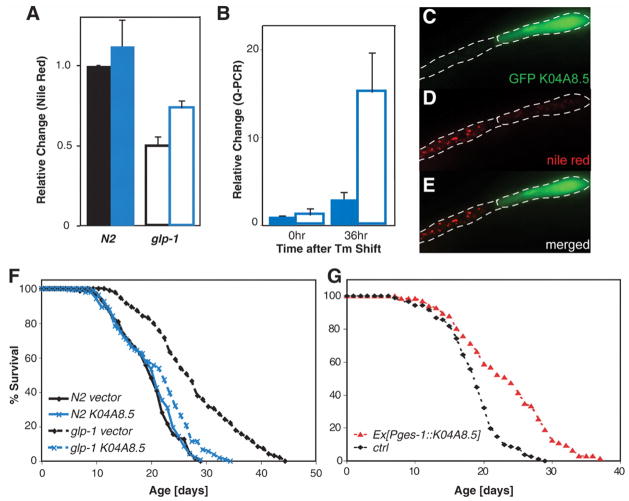
(A) K04A8.5 RNAi partially restored fat storage in glp-1(e2141) (open bars, P < 0.001) but had a marginal effect in the wild type (solid bars, 10% increase in fat storage, P > 0.1)(n = 20 for each genotype and RNAi feeding). Blue, K04A8.5 RNAi; black, vector control. (B) K04A8.5 expression was up-regulated in glp-1 (P < 0.0001; solid bars, N2; open bars, glp-1). (C to E) Genetic mosaic analysis shows that the number and intensity of lipid droplets both decreased in the cell constitutively expressing K04A8.5, marked by GFP, relative to its sister cell. (F) K04A8.5 RNAi had no effect on the life span of wild-type animals (P > 0.01) but suppressed the increased longevity of glp-1 (P < 0.0001; 24% reduction in mean life span). (G) Constitutive expression of K04A8.5 in the intestine extended life span (P < 0.0001; 24% mean life-span extension).
Fig. 4
Fig. 4. Synergistic regulation of fat metabolism by GSC proliferation and insulin signaling
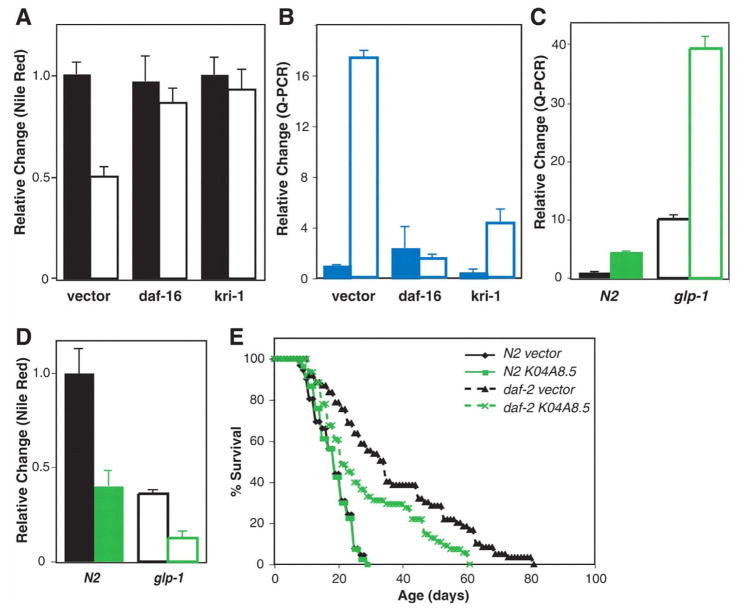
(A) Either daf-16 or kri-1 RNAi restored lipid accumulation in glp-1 (P < 0.0001); neither of them affected fat storage in the wild type (P > 0.05) (n = 17 for each genotype and RNAi feeding). Solid bars, N2; open bars, glp-1. (B) daf-16 and kri-1 were required to up-regulate K04A8.5 upon GSC arrest. daf-16 or kri-1 RNAi suppressed K04A8.5 induction in glp-1 (P < 0.001) (n = 15 for each genotype and RNAi feeding). Solid bars, N2; open bars, glp-1. (C) K04A8.5 was induced in animals subjected to daf-2 RNAi only at adulthood (P < 0.0001). This induction by daf-2 RNAi was enhanced in the glp-1 mutant (P < 0.0001). Green, daf-2 RNAi; black, vector control. Solid bars, N2; open bars, glp-1. (D) Adult-specific daf-2 RNAi decreased fat storage by 50% in the wild type (P < 0.0001). Loss of the germ line and reduction of daf-2 activity were synergistic in reducing fat storage (P < 0.0001). Green, daf-2 RNAi; black, vector control. Solid bars, N2; open bars, glp-1. (E) K04A8.5 RNAi partially suppressed the longevity of daf-2(e1370) mutants (P < 0.005; 24% decrease in mean life span) but had no effect on the life span of the wild type (P > 0.01).

Comment in

References

    1. Zechner R, Strauss JG, Haemmerle G, Lass A, Zimmermann R. Curr Opin Lipidol. 2005;16:333. - PubMed
    1. Tissenbaum HA, Ruvkun G. Genetics. 1998;148:703. - PMC - PubMed
    1. Burks DJ, et al. Nature. 2000;407:377. - PubMed
    1. Carr MC. J Clin Endocrinol Metab. 2003;88:2404. - PubMed
    1. Blüher M, Kahn BB, Kahn CR. Science. 2003;299:572. - PubMed

Publication types

MeSH terms