. 2009 Apr 16;113(16):3792-800.
doi: 10.1182/blood-2008-08-173195. Epub 2008 Nov 6.

A protease-resistant immunotoxin against CD22 with greatly increased activity against CLL and diminished animal toxicity

Affiliations

A protease-resistant immunotoxin against CD22 with greatly increased activity against CLL and diminished animal toxicity

John E Weldon et al. Blood. .

Abstract

Immunotoxins based on Pseudomonas exotoxin A (PE) are promising anticancer agents that combine a variable fragment (Fv) from an antibody to a tumor-associated antigen with a 38-kDa fragment of PE (PE38). The intoxication pathway of PE immunotoxins involves receptor-mediated internalization and trafficking through endosomes/lysosomes, during which the immunotoxin undergoes important proteolytic processing steps but must otherwise remain intact for eventual transport to the cytosol. We have investigated the proteolytic susceptibility of PE38 immunotoxins to lysosomal proteases and found that cleavage clusters within a limited segment of PE38. We subsequently generated mutants containing deletions in this region using HA22, an anti-CD22 Fv-PE38 immunotoxin currently undergoing clinical trials for B-cell malignancies. One mutant, HA22-LR, lacks all identified cleavage sites, is resistant to lysosomal degradation, and retains excellent biologic activity. HA22-LR killed chronic lymphocytic leukemia cells more potently and uniformly than HA22, suggesting that lysosomal protease digestion may limit immunotoxin efficacy unless the susceptible domain is eliminated. Remarkably, mice tolerated doses of HA22-LR at least 10-fold higher than lethal doses of HA22, and these higher doses exhibited markedly enhanced antitumor activity. We conclude that HA22-LR advances the therapeutic efficacy of HA22 by using an approach that may be applicable to other PE-based immunotoxins.


Figures
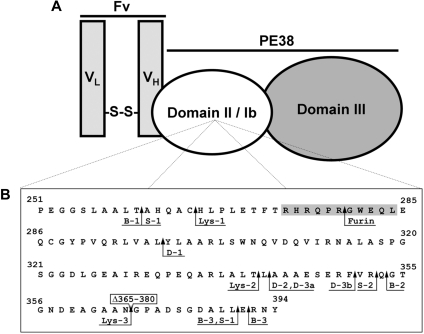
Figure 1
Figure 1
PE-based immunotoxins. (A) The 2-chain disulfide-linked Fv of an antibody targeting a tumor-associated antigen is combined with the PE38 fragment of native PE to create an immunotoxin. (B) PE38 domains II and Ib. The sequences of domain II (residues 251-364) and domain Ib (residues 365-394) from PE38 are shown. Residue numbering is based on the amino acid sequence of native PE. Residues 365 to 380 from native PE (boxed) were deleted in the generation of PE38. Lysosomal protease cleavage sites, determined by N-terminal sequencing of fragments from B3(dsFv)-PE38 digests, are indicated by arrows adjacent to the designation of their corresponding band from SDS-PAGE analysis (Figure 2). Lysosomal protease cleavage sites occur between residues 260-261, 265-266, 297-298, 341-342, 342-343, 351-352, 352-353, 353-354, 364-381, 390-391, and 391-392. The furin cleavage site (279-280) is also indicated. The 11-residue furin-sensitive sequence in domain II from HA22-LR is shaded.
Figure 2
Figure 2
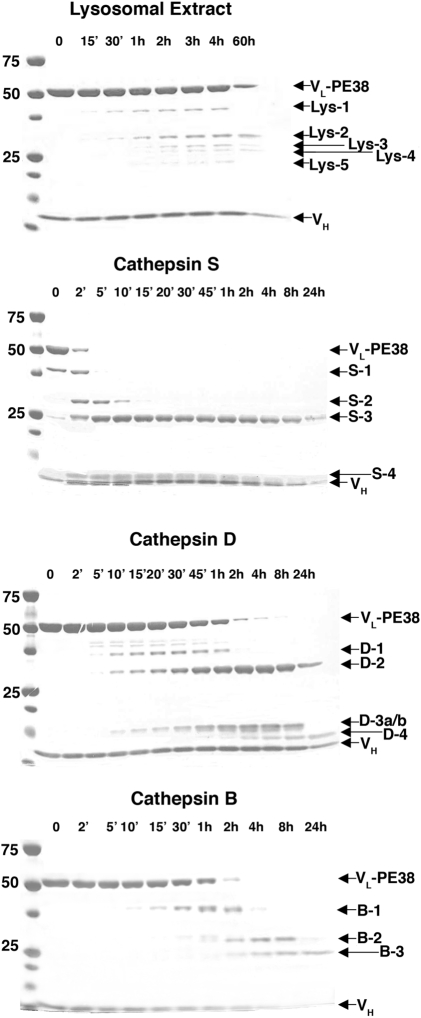
Cleavage of immunotoxins by lysosomal proteases. The immunotoxin B3(dsFv)-PE38 was incubated with lysosomal extract from Raji cells or with one of the purified lysosomal proteases cathepsin B, cathepsin D, or cathepsin S. Samples of the reaction were removed immediately after the addition of enzyme (0) and at various time intervals up to 60 hours after the start of the incubation, then analyzed by reducing SDS-PAGE. Arrows indicate the VH and VL-PE38 polypeptides that compose the mature immunotoxin and the lysosomal protease cleavage fragments sequenced by Edman degradation.
Figure 3
Figure 3
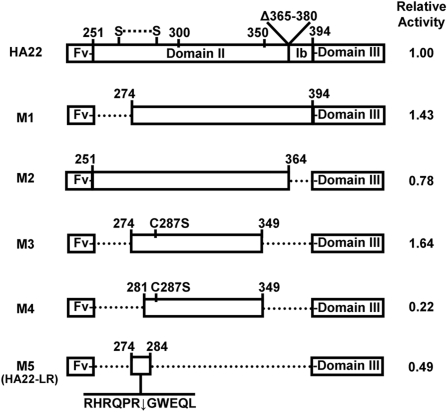
HA22 mutants. A series of deletions within domains II and Ib were introduced into the PE38 component of HA22 to eliminate lysosomal protease cleavage sites. These 5 mutant proteins (M1, M2, M3, M4, and M5) are illustrated using an expanded view of domains II and Ib of PE38 to show the extent of the deletions (dotted lines) and the presence of the C287S point mutation. Residue numbering is based on the location of amino acids in native PE. The proteins were subsequently purified and compared with HA22 using an in vitro cytotoxicity assay on Raji cells. The M5 protein was renamed HA22-LR for further analysis. The IC50 (ng/mL) of each mutant relative to the IC50 of HA22 is presented as a mean of at least 3 separate experiments.
Figure 4
Figure 4
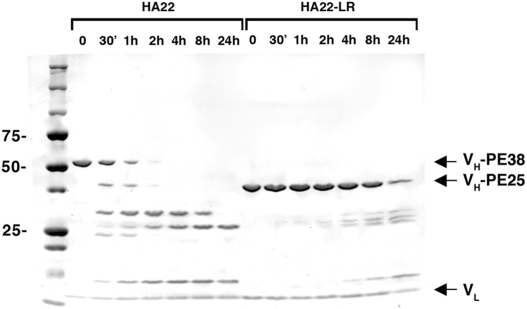
HA22-LR is resistant to digestion with lysosomal extracts. HA22 and HA22-LR were incubated with lysosomal extracts of Raji cells under identical conditions. After the addition of lysosomal extract, samples were removed immediately (0), after 30 minutes, and after 1, 2, 4, 8, and 24 hours, then analyzed by reducing SDS-PAGE. Arrows indicate the VL, VH-PE38 (HA22), and VH-PE25 (HA22-LR) bands that comprise the mature immunotoxins.
Figure 5
Figure 5
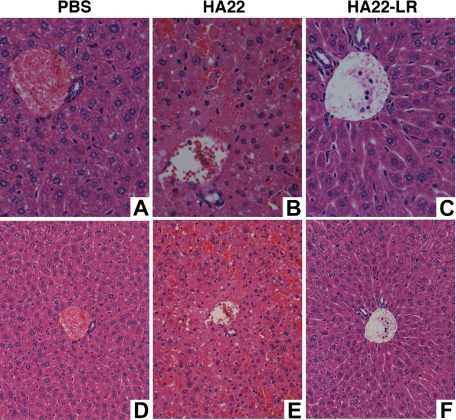
Liver sections. Nude mice were treated intravenously with PBS, 2 mg/kg of HA22, or 20 mg/kg of HA22-LR. After 30 hours, livers were removed, fixed in formalin, sectioned, and stained with hematoxylin and eosin. Panel A (original magnification ×400) and panel D (original magnification ×200) show a representative section of the PBS-treated mouse. Panel B (original magnification ×400) and panel E (original magnification ×200) show a representative section of the HA22-treated mouse. There are many individual necrotic hepatocytes in various stages of cell death as well as the loss of hepatocytes and replacement with blood in sinusoids. Panel C (original magnification ×400) and panel F (original magnification ×200) show a representative section of the HA22-LR-treated mouse. Slides were viewed with an Olympus BX41 microscope. Images were acquired using an Olympus DP41 camera with its own Olympus DP Controller software. Photoshop CS3 was used to produce the composite.
Figure 6
Figure 6
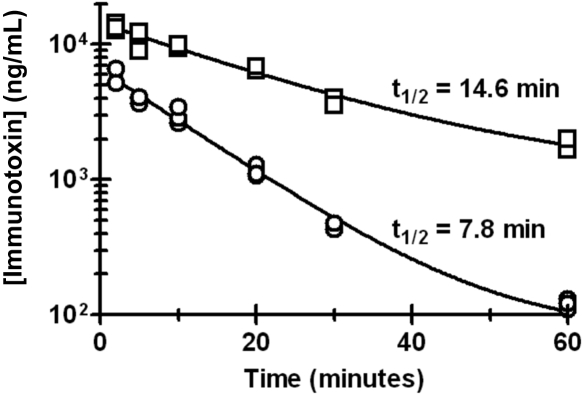
Pharmacokinetics of HA22-LR. Balb/c mice were injected intravenously with 10 μg of either HA22 (□) or HA22-LR (○) and bled at several intervals between 2 and 60 minutes from the time of injection. The concentration of immunotoxin in the serum at the various intervals was determined by ELISA and fit to a single exponential decay function. The corresponding half-life (t1/2) is indicated. Each point is the concentration of immunotoxin in the serum of one mouse, and the concentration at each time interval was determined from at least 2 different mice.
Figure 7
Figure 7
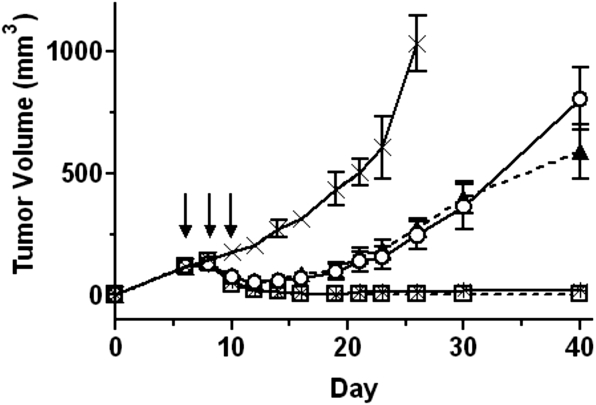
HA22-LR has potent antitumor activity. SCID mice with CA46 xenograft tumors were treated every other day 3 times (on days 6, 8, and 10) intravenously with PBS (×; solid line), 0.3 mg/kg HA22 (○; solid line), or HA22-LR at 1.0 (▲; dashed line), 1.75 (□; solid line), or 2.5 (*; dashed line) mg/kg. Arrows indicate days when treatment was administered. Tumor size was measured over the course of 40 days. Points represent the mean tumor size of all mice in the treatment group. Error bars show the 95% confidence interval of each mean value.

References

    1. Zhang Q, Chen G, Liu X, et al. Monoclonal antibodies as therapeutic agents in oncology and antibody gene therapy. Cell Res. 2007;17:89–99. - PubMed
    1. Pastan I, Hassan R, Fitzgerald DJ, et al. Immunotoxin therapy of cancer. Nat Rev Cancer. 2006;6:559–565. - PubMed
    1. Pastan I, Hassan R, FitzGerald DJ, et al. Immunotoxin treatment of cancer. Annu Rev Med. 2007;58:221–237. - PubMed
    1. Kreitman RJ, Squires DR, Stetler-Stevenson M, et al. Phase I trial of recombinant immunotoxin RFB4(dsFv)-PE38 (BL22) in patients with B-cell malignancies. J Clin Oncol. 2005;23:6719–6729. - PubMed
    1. Hassan R, Bullock S, Premkumar A, et al. Phase I study of SS1P, a recombinant anti-mesothelin immunotoxin given as a bolus I. V. infusion to patients with mesothelin-expressing mesothelioma, ovarian, and pancreatic cancers. Clin Cancer Res. 2007;13:5144–5149. - PubMed

Publication types

MeSH terms