


Alterations in candidate genes PHF2, FANCC, PTCH1 and XPA at chromosomal 9q22.3 region: pathological significance in early- and late-onset breast carcinoma
- PMID: 18990233
- PMCID: PMC2633285
- DOI: 10.1186/1476-4598-7-84
Alterations in candidate genes PHF2, FANCC, PTCH1 and XPA at chromosomal 9q22.3 region: pathological significance in early- and late-onset breast carcinoma
Expression of concern in
-
Editorial Expression of Concern: Alterations in candidate genes PHF2, FANCC, PTCH1 and XPA at chromosomal 9q22.3 region: Pathological significance in early- and late-onset breast carcinoma.Mol Cancer. 2025 Apr 5;24(1):108. doi: 10.1186/s12943-024-02181-x. Mol Cancer. 2025. PMID: 40188063 Free PMC article. No abstract available.
Abstract
Introduction: Younger women with breast carcinoma (BC) exhibits more aggressive pathologic features compared to older women; young age could be an independent predictor of adverse prognosis. To find any existing differences in the molecular pathogenesis of BC in both younger and older women, alterations at chromosomal (chr.) 9q22.32-22.33 region were studied owing to its association in wide variety of tumors. Present work focuses on comparative analysis of alterations of four candidate genes; PHF2, FANCC, PTCH1 and XPA located within 4.4 Mb region of the afore-said locus in two age groups of BC, as well as the interrelation and prognostic significance of alterations of these genes.
Methods: Deletion analysis of PHF2, FANCC, PTCH1 and XPA were examined in a subset of 47 early-onset (group-A: < or = 40 years) and 59 late-onset (group-B: > 40 years) breast carcinomas using both microsatellite and exonic markers. Methylation Sensitive Restriction analysis (MSRA) was done to check for promoter methylation. Quantitative real-time polymerase chain reaction (Q-PCR) and immunohistochemisty (IHC) was done in some genes to see their relative mRNA and protein expressions respectively. Clinico-pathological correlation of different parameters as well as patient survival was calculated using different statistical softwares like EpiInfo 6.04b, SPSS 10.0 etc.
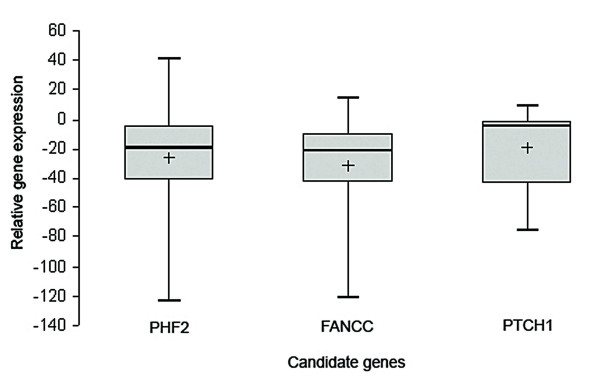
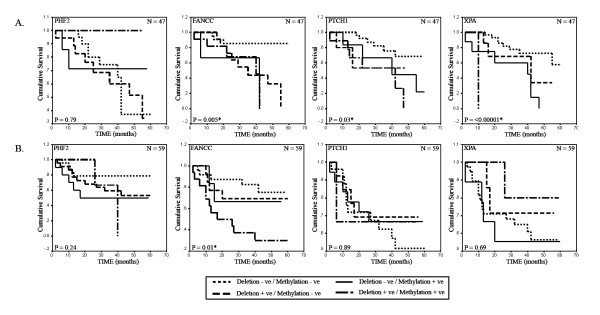
Results: Either age group exhibited high frequency of overall alterations in PHF2, FANCC and PTCH1 compared to XPA. Samples with alteration (deletion/methylation) in these genes showed reduced level of mRNA expression as seen by Q-PCR. Immunohistochemical analysis of FANCC and PTCH1 also supported this observation. Poor patient survival was noted in both age groups having alterations in FANCC. Similar result was also seen with PTCH1 and XPA alterations in group-A and PHF2 alterations in group-B. This reflected their roles as prognostic tools in the respective groups in which they were altered.
Conclusion: Overall alterations of PHF2, FANCC and PTCH1 were comparatively higher than XPA. Differential association of alterations in FANCC and PTCH1 with that of PHF2, XPA and two breast cancer susceptibility genes (BRCA1/BRCA2) in the two age groups suggests differences in their molecular pathogenesis and dysregulation of multiple DNA repair pathways as well as hedgehog dependent stem cell renewal pathway.
Figures



References
-
- Chunder N, Mandal S, Roy A, Roychoudhury S, Panda CK. Analysis of different deleted regions in chromosome 11 and their interrelations in early- and late-onset breast tumors: association with cyclin D1 amplification and survival. Diagn Mol Pathol. 2004;13:172–182. doi: 10.1097/01.pas.0000124337.49401.0b. - DOI - PubMed
Publication types
MeSH terms
Substances
LinkOut - more resources
Full Text Sources
Medical
Molecular Biology Databases
Miscellaneous
