. 2009 Jan 16;284(3):1718-24.
doi: 10.1074/jbc.M805301200. Epub 2008 Nov 6.

Caloric restriction stimulates revascularization in response to ischemia via adiponectin-mediated activation of endothelial nitric-oxide synthase

Affiliations

Caloric restriction stimulates revascularization in response to ischemia via adiponectin-mediated activation of endothelial nitric-oxide synthase

Megumi Kondo et al. J Biol Chem. .

Abstract

Caloric restriction (CR) can extend longevity and modulate the features of obesity-related metabolic and vascular diseases. However, the functional roles of CR in regulation of revascularization in response to ischemia have not been examined. Here we investigated whether CR modulates vascular response by employing a murine hindlimb ischemia model. Wild-type (WT) mice were randomly divided into two groups that were fed either ad libitum (AL) or CR (65% of the diet consumption of AL). Four weeks later, mice were subjected to unilateral hindlimb ischemic surgery. Body weight of WT mice fed CR (CR-WT) was decreased by 26% compared with WT mice fed AL (AL-WT). Revascularization of ischemic hindlimb relative to the contralateral limb was accelerated in CR-WT compared with AL-WT as evaluated by laser Doppler blood flow and capillary density analyses. CR-WT mice had significantly higher plasma levels of the fat-derived hormone adiponectin compared with AL-WT mice. In contrast to WT mice, CR did not affect the revascularization of ischemic limbs of adiponectin-deficient (APN-KO) mice. CR stimulated the phosphorylation of endothelial nitric-oxide synthase (eNOS) in the ischemic limbs of WT mice. CR increased plasma adiponectin levels in eNOS-KO mice but did not stimulate limb perfusion in this strain. CR-WT mice showed enhanced phosphorylation of AMP-activated protein kinase (AMPK) in ischemic muscle, and administration of AMPK inhibitor compound C abolished CR-induced increase in limb perfusion and eNOS phosphorylation in WT mice. Our observations indicate that CR can promote revascularization in response to tissue ischemia via an AMPK-eNOS-dependent mechanism that is mediated by adiponectin.


Figures
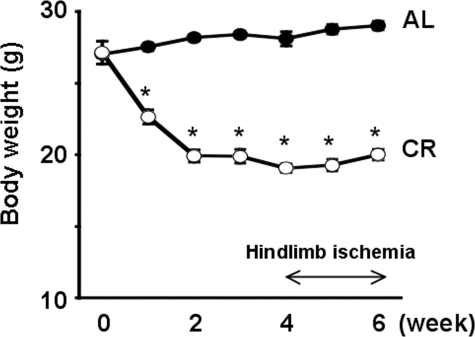
FIGURE 1.
FIGURE 1.
Effect of CR on body weight of WT mice. The CR was 65% of the AL diet fed to control. Values presented are the mean ± S.E. of six mice per group. *, p < 0.01 versus AL-WT mice.
FIGURE 2.
FIGURE 2.
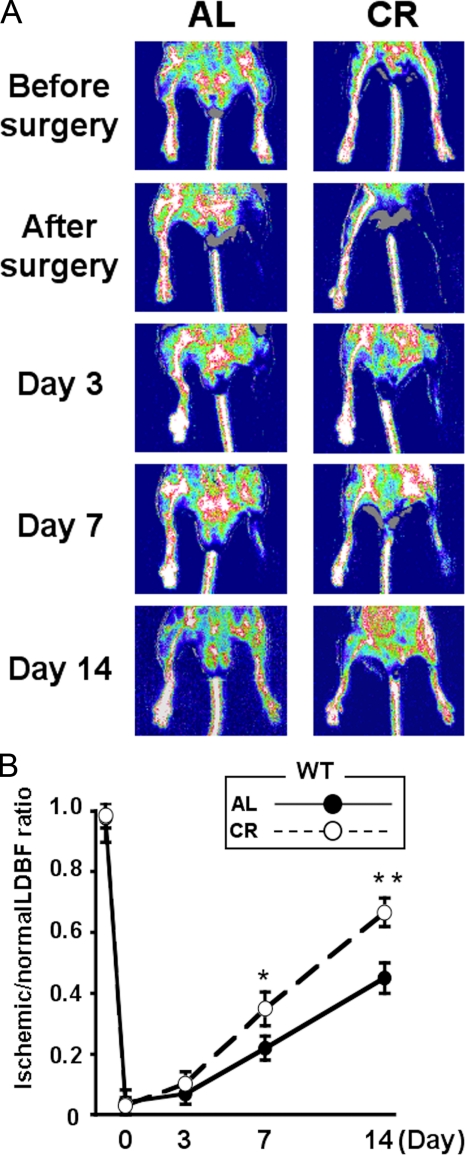
Caloric restriction improves perfusion of ischemic limbs in WT mice. A, representative LDBF images showing improved perfusion in ischemic limb of WT-fed AL or CR. A low perfusion signal (dark blue) was observed in the ischemic hindlimb of AL-WT mice, whereas a high perfusion signal (white to red) was detected in CR-WT mice on post-operative day 7 and 14. B, quantitative analysis of ischemic/nonischemic LDBF ratio in AL-WT and CR-WT mice on postoperative day 3, 7, and 14. *, p < 0.05; **, p < 0.01 versus AL-WT mice; n = 6.
FIGURE 3.
FIGURE 3.
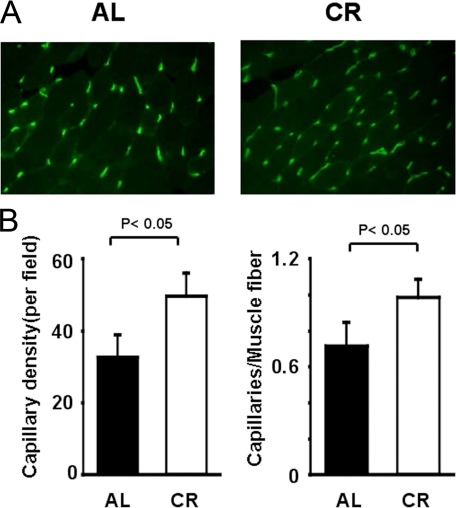
Increased capillary density in ischemic CR-WT mice. A, fluorescence staining of ischemic tissues with anti-CD31 monoclonal antibody (green) on post-operative day 14. B, quantitative analysis of capillary density in AL-WT and CR-WT mice on post-operative day 14 (n = 6 in each group). Capillary density was expressed as the number of capillaries per high power field (×400, left) and capillaries per muscle fiber (right).
FIGURE 4.
FIGURE 4.
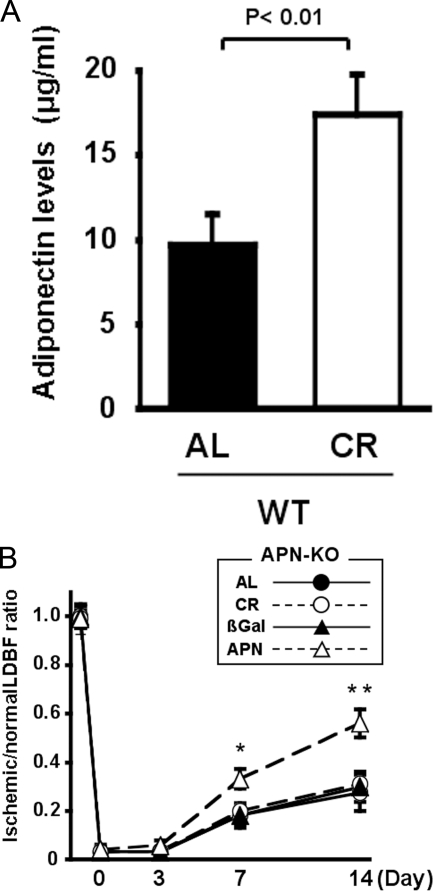
Effects of CR on ischemia-induced revascularization in APN-KO mice. A, plasma adiponectin levels in AL-WT and CR-WT mice. Blood samples were obtained from WT mice fed AL or CR for 4 weeks (n = 5). B, quantitative analysis of ischemic/nonischemic LDBF ratio in AL or CR-APN-KO mice and AL-APN-KO mice treated with Ad-APN or Ad-βgal on post-operative day 0, 3, 7, and 14 (n = 5). The adenoviral vector expressing adiponectin (Ad-APN) or Ad-βgal at 2 × 10⁸ pfu total was delivered intravenously to AL-APN-KO mice via the jugular vein 3 days before ischemic surgery (*, p < 0.05; **, p < 0.01 versus Ad-βgal).
FIGURE 5.
FIGURE 5.
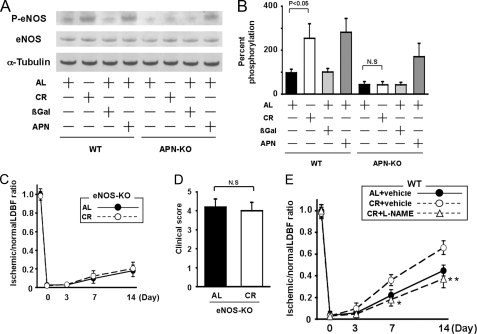
CR promotes eNOS phosphorylation in response to tissue ischemia. A, representative immunoblots for phosphorylated eNOS (P-eNOS) and eNOS in WT and APN-KO mice fed AL or CR, and AL-WT or AL-APN-KO mice treated with Ad-APN or Ad-βgal. Western immunoblots with the indicated antibodies were performed on the ischemic adductor muscle at 7 days after surgery. Ad-APN or Ad-βgal at 2 × 10⁸ pfu total was intravenously injected into AL-WT and AL-APN-KO mice 3 days before the induction of hindlimb ischemia. B, quantitative analysis of relative changes in phosphorylation of eNOS in WT and APN-KO mice fed AL or CR, and AL-WT or AL-APN-KO mice treated with Ad-APN or Ad-βgal. Phosphorylation of eNOS was normalized to the tubulin signal and expressed as percentage of the signal intensity of AL-WT mice (n = 4). C, quantitative analysis of ischemic/nonischemic LDBF ratio in AL-eNOS-KO or CR-eNOS-KO mice on post-operative day 0, 3, 7, and 14 (n = 5). D, clinical score in AL-eNOS-KO or CR-eNOS-KO mice as determined by an index of severity of limb ischemia. (0 = normal, 1 = pale foot or gait abnormalities, 2 = less than half of foot is necrotic, 3 = more than half of foot is necrotic without lower leg necrosis, 4 = more than half of foot is necrotic with some lower leg necrosis, 5 = necrosis or auto amputation of entire lower limb.) E, quantitative analysis of ischemic/nonischemic LDBF ratio in AL or CR-WT mice in the presence of l-NAME or vehicle on post-operative day 0, 3, 7, and 14 (*, p < 0.05; **, p < 0.01 versus CR+vehicle; n = 5).
FIGURE 6.
FIGURE 6.
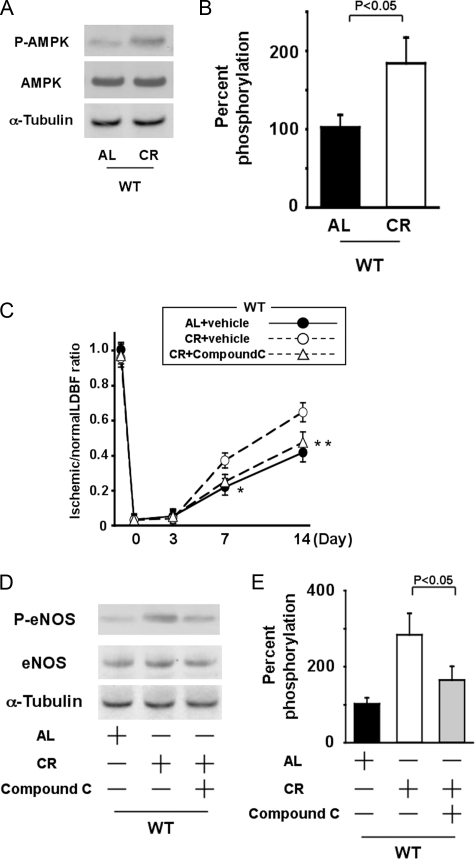
AMPK signaling is required for CR-induced revascularization and eNOS phosphorylation in response to tissue ischemia. A, representative immunoblots for phosphorylated AMPK (P-AMPK) and AMPK in AL-WT and CR-WT mice on day 7 after induction of limb ischemia. Western immunoblots with the indicated antibodies were performed on the ischemic adductor muscle. B, quantitative analysis of relative changes in phosphorylation of AMPK in AL-WT and CR-WT mice on day 7 after induction of limb ischemia. Phosphorylation of AMPK was normalized to the tubulin signal and expressed as percentage of the signal intensity of AL-WT mice (n = 4). C, quantitative analysis of ischemic/nonischemic LDBF ratio in AL or CR-WT mice in the presence of compound C or vehicle on post-operative day 0, 3, 7, and 14 (*, p < 0.05; **, p < 0.01 versus CR+vehicle; n = 5). D, representative immunoblots for phosphorylated eNOS (P-eNOS) and eNOS in AL-WT or CR-WT mice in the presence or absence of compound C on day 7 after induction of limb ischemia. E, quantitative analysis of relative changes in phosphorylation of eNOS in AL-WT or CR-WT mice in the presence or absence of compound C. Phosphorylation of eNOS was normalized to the tubulin signal and expressed as percentage of the signal intensity of AL-WT mice (n = 4).

References

    1. Reilly, M. P., and Rader, D. J. (2003) Circulation 108 1546-1551 - PubMed
    1. Yilmaz, M. B., Biyikoglu, S. F., Akin, Y., Guray, U., Kisacik, H. L., and Korkmaz, S. (2003) Int. J. Obes. Relat. Metab. Disord. 27 1541-1545 - PubMed
    1. Schiekofer, S., Galasso, G., Sato, K., Kraus, B. J., and Walsh, K. (2005) Arterioscler. Thromb. Vasc. Biol. 25 1603-1609 - PubMed
    1. Tirziu, D., Moodie, K. L., Zhuang, Z. W., Singer, K., Helisch, A., Dunn, J. F., Li, W., Singh, J., and Simons, M. (2005) Circulation 112 2501-2509 - PubMed
    1. Ingram, D. K., Anson, R. M., de Cabo, R., Mamczarz, J., Zhu, M., Mattison, J., Lane, M. A., and Roth, G. S. (2004) Ann. N. Y. Acad. Sci. 1019 412-423 - PubMed

Publication types