Review
. 2009 Jan;35(1):136-52.
doi: 10.1093/schbul/sbn153. Epub 2008 Nov 5.

CNTRICS final task selection: working memory

Affiliations
Review

CNTRICS final task selection: working memory

Deanna M Barch et al. Schizophr Bull. 2009 Jan.

Abstract

The third meeting of the Cognitive Neuroscience Treatment Research to Improve Cognition in Schizophrenia (CNTRICS) was focused on selecting promising measures for each of the cognitive constructs selected in the first CNTRICS meeting. In the domain of working memory, the 2 constructs of interest were goal maintenance and interference control. CNTRICS received 3 task nominations for each of these constructs, and the breakout group for working memory evaluated the degree to which each of these tasks met prespecified criteria. For goal maintenance, the breakout group for working memory recommended the AX-Continuous Performance Task/Dot Pattern Expectancy task for translation for use in clinical trial contexts in schizophrenia research. For interference control, the breakout group recommended the recent probes and operation/symmetry span tasks for translation for use in clinical trials. This article describes the ways in which each of these tasks met the criteria used by the breakout group to recommend tasks for further development.


Figures
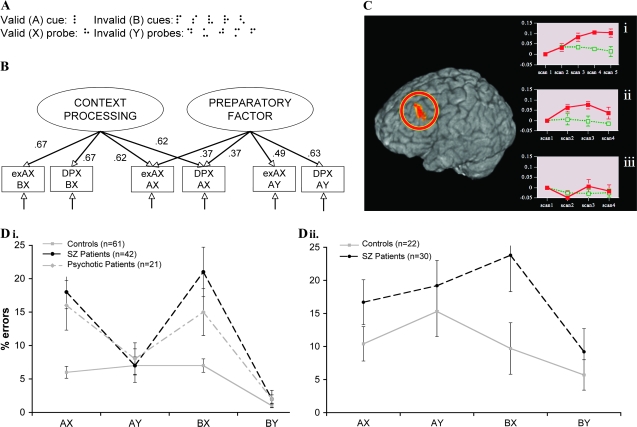
Fig. 1.
Fig. 1.
A. Stimuli for Dot Pattern Expectancy (DPX) task. B. Confirmation factor analysis of expectancy AX and DPX trial types (adapted with permission from the American Psychological Association). C. Increased activity in left dorsolateral prefrontal cortex (BA 9, x = −41, y = 18, and z = 28) following a cue to prepare to use a controlled (red) or automatic (green) response when responding to a Stroop stimulus (i) or following a “B” or “A” cue in the AX task in healthy volunteers (ii) or patients with schizophrenia (iii) (adapted with permission from the American Psychological Association). D. Patterns of impairments in patients on (i) the AX and (ii) DPX tasks.
Fig. 2.
Fig. 2.
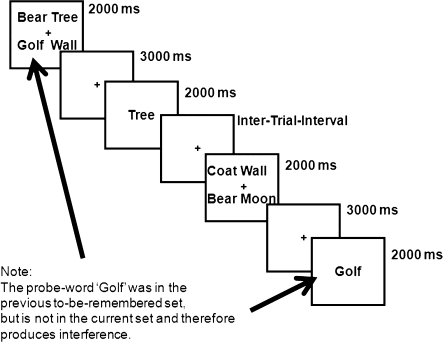
A Recent Negative Trial From the Recent-Probes Task. This figure illustrates a seqeuence to 2 trials that lead the second trial to be a recent negative trial. As can be seen in the figure, the probe on the second trial “golf” was a member of the memory set on the preceeding trial but not a member of the memory set on the current trial.
Fig. 3.
Fig. 3.
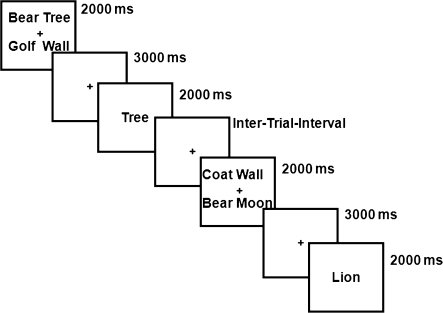
A Nonrecent Negative Trial From the Recent-Probes Task. This figure illustrates a seqeuence to 2 trials that lead the second trial to be a nonrecent negative trial. As can be seen in the figure, the probe on the second trial “lion” was not a member of the memory set on the current trial nor on the preceding trial.
Fig. 4.
Fig. 4.
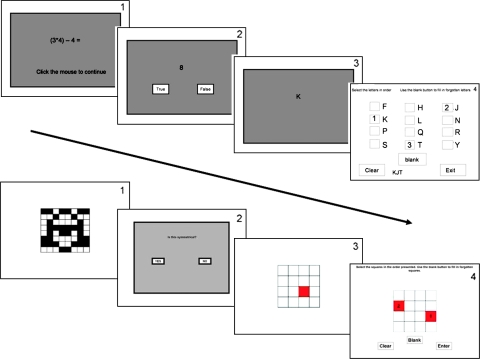
Screenshots of the Automated Operation Span (Above) and Symmetry Span (Below) Tasks. The numbers in the right-hand corner (not visible to the participants) indicate the order in which the screens are presented on a given trial. The first 3 panels illustrate the sequence of events on a single trial, and the last panel indicates the memory test that participants are given at the end of a set of trials. For the operation span, participants must remember the letter presented at the end of each individual trial across the remaining trials in that set until they are given the memory test. Similarly, for the symmetry span, participants must remember the location of the red block in the grid presented at the end of each individual trial across the remaining trials in the set until they are given the memory test.

References

    1. Park S, Holtzman PS. Schizophrenics show spatial working memory deficits. Arch Gen Psychiatry. 1992;49:975–982. - PubMed
    1. Goldman-Rakicp Cellular basis of working memory. Neuron. 1995;14:477–485. - PubMed
    1. D'Esposito M. From cognitive to neural models of working memory. Philos Trans R Soc Biol Sci. 2007;362:761–772. - PMC - PubMed
    1. Baddeley AD, Logie R, Bressi S, Della Sala S, Spinnler H. Dementia and working memory. Q J Exp Psychol. 1986;38A:603–618. - PubMed
    1. Baddeley AD. The episodic buffer: a new component of working memory? Trend Cogn Sci. 2000;4:417–423. - PubMed

Publication types