


Long-term follow-up of congenital esotropia in a population-based cohort
- PMID: 18993096
- PMCID: PMC2762934
- DOI: 10.1016/j.jaapos.2008.06.013
Long-term follow-up of congenital esotropia in a population-based cohort
Abstract
Purpose: To report the long-term outcomes of a population-based cohort of children diagnosed with congenital esotropia during a 30-year period.
Methods: The medical records of all patients diagnosed with congenital esotropia as residents of Olmsted County, MN, from January 1, 1965, through December 31, 1994, were retrospectively reviewed.
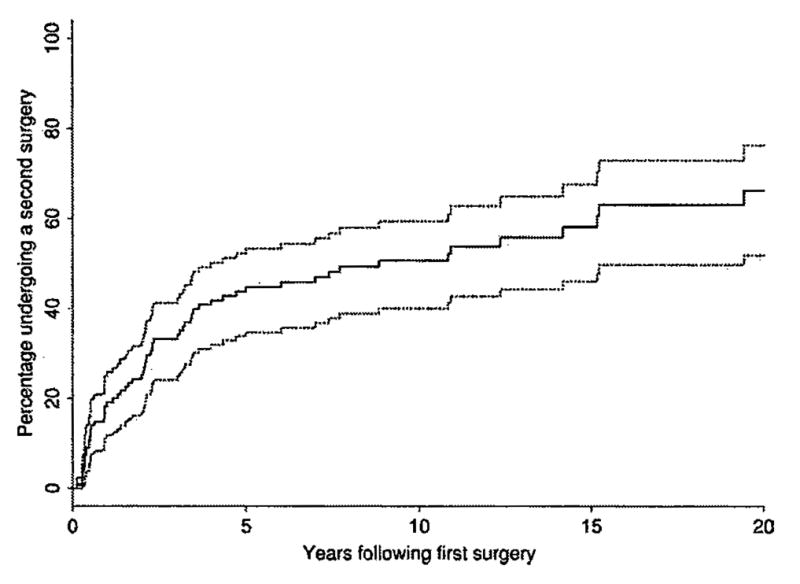
Results: A total of 130 children were diagnosed during the 30-year period at a median age of 7.4 months with a mean deviation of 30(Delta). During a median follow-up of 11.9 years, 126 patients underwent a mean of 1.8 strabismus surgeries. The risk for undergoing a second surgery was significantly greater in patients with a larger presenting angle (p = 0.017) and a younger age at first surgery (p = 0.006). The Kaplan-Meier rate of having a second surgery was 51% at 10 years and 66% at 20 years. For those with 6 weeks or more of follow-up from the final surgery, last examined at a mean age of 15.1 years, 42 of 94 (45%) were within 8(Delta) of orthotropia and 30 of 98 had some level of stereopsis (</=3000 arcsec).
Conclusions: In this population-based study of children with congenital esotropia, a second surgery was necessary in half the patients after 10 years and was more likely in those patients with a larger presenting angle and a younger age at first surgery. Approximately half of the patients were within 8(Delta) of orthotropia and one-third had measurable stereopsis after a mean of 10.9 years of follow-up.
Figures
Comment in
-
Strabismus surgery: how well do we do?J AAPOS. 2009 Feb;13(1):1-3. doi: 10.1016/j.jaapos.2009.01.001. J AAPOS. 2009. PMID: 19233012 No abstract available.
-
Long-term follow-up of congenital esotropia in a population-based study.J AAPOS. 2009 Aug;13(4):427; author reply 427. doi: 10.1016/j.jaapos.2009.04.010. J AAPOS. 2009. PMID: 19683203 No abstract available.
References
-
- Greenberg AE, Mohney BG, Diehl NN, Burke JP. Incidence and types of childhood esotropia. A population-based study. Ophthalmology. 2007;113:170–4. - PubMed
-
- Infeld D, Prior C, Ryan H, O’Day J. The long-term results of surgical correction of childhood esotropia. Aust N Z J Ophthalmol. 1993;21:23–8. - PubMed
-
- Helveston EM, Neely DF, Stidham DB, Wallace DK, Plager DA, Springer DT. Results of early alignment of congenital esotropia. Ophthalmology. 1999;106:1716–26. - PubMed
-
- Ing MR. Outcome study of surgical alignment before six months of age for congenital esotropia. Ophthalmology. 1995;102:2041–5. - PubMed
-
- Tolun H, Dikici K, Ozkiris A. Long-term results of bimedial rectus recessions in infantile esotropia. J Pediatr Ophthalmol Strabismus. 1999;36:201–15. - PubMed
Publication types
MeSH terms
Grants and funding
LinkOut - more resources
Full Text Sources
