. 2009 Jan;191(2):563-70.
doi: 10.1128/JB.01004-08. Epub 2008 Nov 7.

Small-molecule type III secretion system inhibitors block assembly of the Shigella type III secreton

Affiliations

Small-molecule type III secretion system inhibitors block assembly of the Shigella type III secreton

Andreas K J Veenendaal et al. J Bacteriol. 2009 Jan.

Abstract

Type III secretion systems (T3SSs) are essential virulence devices for many gram-negative bacteria that are pathogenic for plants, animals, and humans. They serve to translocate virulence effector proteins directly into eukaryotic host cells. T3SSs are composed of a large cytoplasmic bulb and a transmembrane region into which a needle is embedded, protruding above the bacterial surface. The emerging antibiotic resistance of bacterial pathogens urges the development of novel strategies to fight bacterial infections. Therapeutics that rather than kill bacteria only attenuate their virulence may reduce the frequency or progress of resistance emergence. Recently, a group of salicylidene acylhydrazides were identified as inhibitors of T3SSs in Yersinia, Chlamydia, and Salmonella species. Here we show that these are also effective on the T3SS of Shigella flexneri, where they block all related forms of protein secretion so far known, as well as the epithelial cell invasion and induction of macrophage apoptosis usually demonstrated by this bacterium. Furthermore, we show the first evidence for the detrimental effect of these compounds on T3SS needle assembly, as demonstrated by increased numbers of T3S apparatuses without needles or with shorter needles. Therefore, the compounds generate a phenocopy of T3SS export apparatus mutants but with incomplete penetrance. We discuss why this would be sufficient to almost completely block the later secretion of effector proteins and how this begins to narrow the search for the molecular target of these compounds.


Figures

FIG. 1.
FIG. 1.
Effect of the compounds on Shigella growth in broth culture. An overnight culture of wild-type Shigella was diluted to an OD600 of 0.1 and then grown in the presence of DMSO or 50 μM of the compounds for 8 h. The cultures were sampled at 2-h intervals for cell density measurements at 600 nm.
FIG. 2.
FIG. 2.
Inhibition of leakage and constitutive secretion of T3SS proteins. Shigella cultures were grown in the presence of DMSO or compounds, and then culture supernatants were isolated. Samples were separated by SDS-PAGE, and the 12% gels were silver stained. The gels show “leakage” of wild-type Shigella (A), constitutive secretion of the mxiH/D73A mutant, (B) and fast constitutive secretion of the ΔipaD strain (C). The positions of the abundant T3SS proteins are indicated on the right. The SepA protein, which is secreted by an autotransporter pathway, acted as a loading control.
FIG. 3.
FIG. 3.
Inhibition of CR-induced secretion. Wild-type Shigella cultures were grown in the presence of DMSO or compounds, and then culture supernatants were isolated. Samples were separated by SDS-PAGE, and the 12% gel was silver stained. The positions of the major T3SS proteins are indicated on the right.
FIG. 4.
FIG. 4.
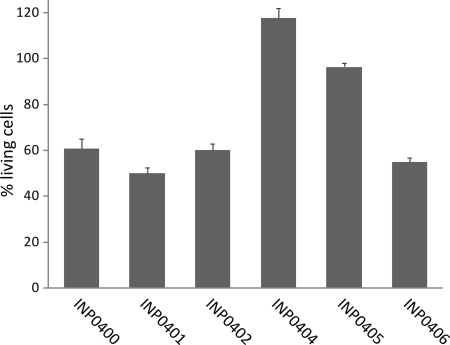
Survival of Shigella-infected macrophages. Cells of macrophage cell line J774 were infected with wild-type and plasmid-cured Shigella flexneri strain CCUG 29416 grown in the presence of the compounds. The fluorescence intensity was measured in a microplate reader (Calcein, 485/535 nm; Sytox Orange, 535/595 nm), and the relative amounts of living cells and cells with the cell membrane destroyed, respectively, were calculated. The bars show the mean values from three samples, and the standard deviations were calculated according to a Gauss formula suitable for percentage values. Cells infected by wild-type Shigella without addition showed a value of around 40% living cells. The value for uninfected cells was set to 100% living cells.
FIG. 5.
FIG. 5.
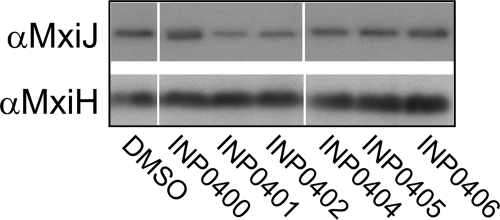
Whole-cell levels of T3SS component proteins. Wild-type Shigella cultures were grown in the presence of DMSO or compounds, and then whole-cell extracts were isolated. Samples were separated by SDS-PAGE and analyzed by Western blotting. The antibodies used for the blots are indicated on the left. Lanes were removed for consistency of display of the samples. For each blot, the same exposure was used to make the composite image, and the remaining lanes are shown in their initial loading order.
FIG. 6.
FIG. 6.
Analysis of secreton assembly. Quantification of complete secretons and needleless bases from electron micrographs of ghost cells prepared from wild-type Shigella cultures grown in the presence of DMSO or compounds is shown. Data are derived from experiments in duplicate or triplicate (n = 10 to 13 images per sample per experiment). Micrographs of the DMSO control showed ∼5 secretons/image and 19% ± 5% bases/secretons (not shown). Percentages of secretons (dark gray bars) are relative to the DMSO control (set to 100%). Percentages of bases/secretons (light gray bars) are normalized to the DMSO control for each experiment separately. The errors given are standard deviations.

References

    1. Adam, T., M. Arpin, M. C. Prevost, P. Gounon, and P. J. Sansonetti. 1995. Cytoskeletal rearrangements and the functional role of T-plastin during entry of Shigella flexneri into HeLa cells. J. Cell Biol. 129367-381. - PMC - PubMed
    1. Bahrani, F. K., P. J. Sansonetti, and C. Parsot. 1997. Secretion of Ipa proteins by Shigella flexneri: inducer molecules and kinetics of activation. Infect. Immun. 654005-4010. - PMC - PubMed
    1. Bailey, L., A. Gylfe, C. Sundin, S. Muschiol, M. Elofsson, P. Nordstrom, B. Henriques-Normark, R. Lugert, A. Waldenstrom, H. Wolf-Watz, and S. Bergstrom. 2007. Small molecule inhibitors of type III secretion in Yersinia block the Chlamydia pneumoniae infection cycle. FEBS Lett. 581587-595. - PubMed
    1. Blocker, A., P. Gounon, E. Larquet, K. Niebuhr, V. Cabiaux, C. Parsot, and P. Sansonetti. 1999. The tripartite type III secreton of Shigella flexneri inserts IpaB and IpaC into host membranes. J. Cell Biol. 147683-693. - PMC - PubMed
    1. Blocker, A., N. Jouihri, E. Larquet, P. Gounon, F. Ebel, C. Parsot, P. Sansonetti, and A. Allaoui. 2001. Structure and composition of the Shigella flexneri “needle complex,” a part of its type III secreton. Mol. Microbiol. 39652-663. - PubMed

Publication types

MeSH terms