. 2009 Jan 1;457(7225):87-91.
doi: 10.1038/nature07469. Epub 2008 Nov 9.

Immune control of an SIV challenge by a T-cell-based vaccine in rhesus monkeys

Affiliations

Immune control of an SIV challenge by a T-cell-based vaccine in rhesus monkeys

Jinyan Liu et al. Nature. .

Abstract

A recombinant adenovirus serotype 5 (rAd5) vector-based vaccine for HIV-1 has recently failed in a phase 2b efficacy study in humans. Consistent with these results, preclinical studies have demonstrated that rAd5 vectors expressing simian immunodeficiency virus (SIV) Gag failed to reduce peak or setpoint viral loads after SIV challenge of rhesus monkeys (Macaca mulatta) that lacked the protective MHC class I allele Mamu-A*01 (ref. 3). Here we show that an improved T-cell-based vaccine regimen using two serologically distinct adenovirus vectors afforded substantially improved protective efficacy in this challenge model. In particular, a heterologous rAd26 prime/rAd5 boost vaccine regimen expressing SIV Gag elicited cellular immune responses with augmented magnitude, breadth and polyfunctionality as compared with the homologous rAd5 regimen. After SIV(MAC251) challenge, monkeys vaccinated with the rAd26/rAd5 regimen showed a 1.4 log reduction of peak and a 2.4 log reduction of setpoint viral loads as well as decreased AIDS-related mortality as compared with control animals. These data demonstrate that durable partial immune control of a pathogenic SIV challenge for more than 500 days can be achieved by a T-cell-based vaccine in Mamu-A*01-negative rhesus monkeys in the absence of a homologous Env antigen. These findings have important implications for the development of next-generation T-cell-based vaccine candidates for HIV-1.


Figures
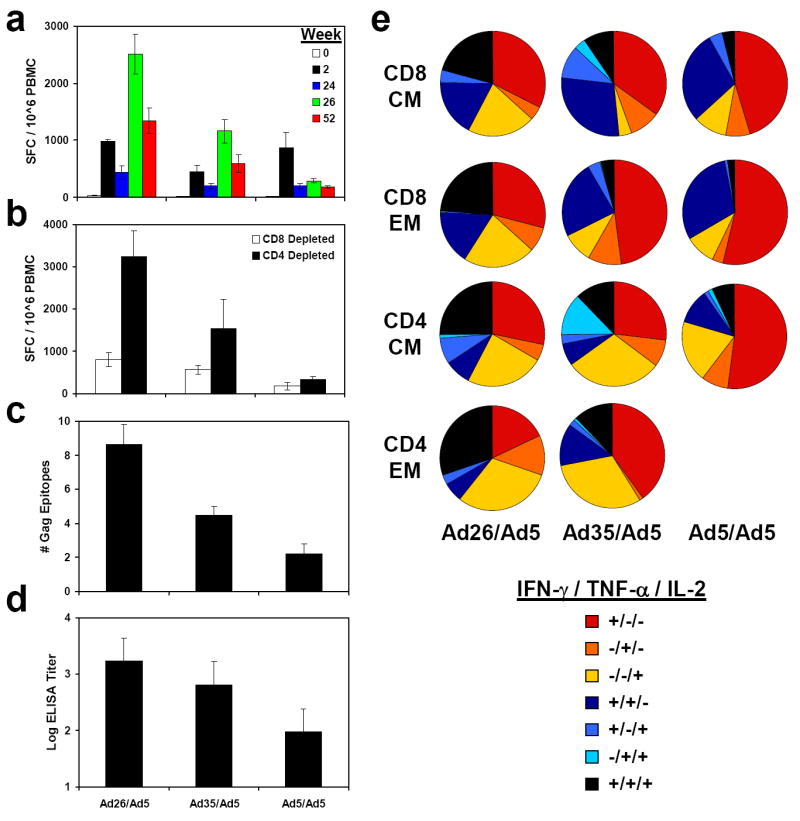
Figure 1
Figure 1. Immunogenicity of heterologous rAd prime-boost vaccine regimens
Rhesus monkeys were primed at week 0 and boosted at week 24 with rAd26/rAd5, rAd35/rAd5, or rAd5/rAd5 regimens expressing SIV Gag. a, Gag-specific IFN-γ ELISPOT assays were performed at weeks 0, 2, 24, 26, and 52 following immune priming. b, CD4+ (white bars) and CD8+ (black bars) T lymphocyte responses were evaluated at week 28 by CD8-depleted and CD4-depleted ELISPOT assays, respectively. c, Breadth of responses was determined by Gag epitope mapping at week 28. d, Gag-specific antibody responses were determined by ELISA at week 28. Mean responses with standard errors are shown (a-d). e, Functionality of Gag-specific CD8+ and CD4+ central memory (CM; CD28+CD95+) and effector memory (EM; CD28-CD95+) T lymphocyte responses were assessed by 8-color intracellular cytokine staining (ICS) assays. Proportions of IFN-γ, TNF-α, and IL-2 responses are depicted individually and in all possible combinations for each cellular subpopulation. CD4+ EM responses following rAd5/rAd5 immunization were below the detection limit of the assay.
Figure 2
Figure 2. Protective efficacy of heterologous rAd prime-boost vaccine regimens
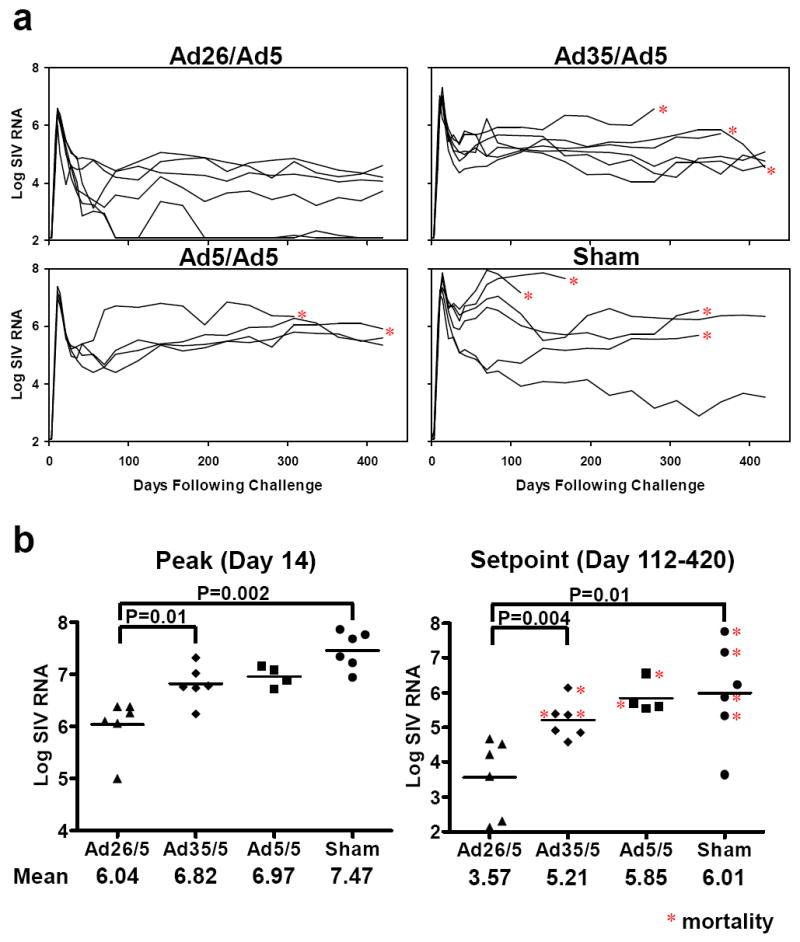
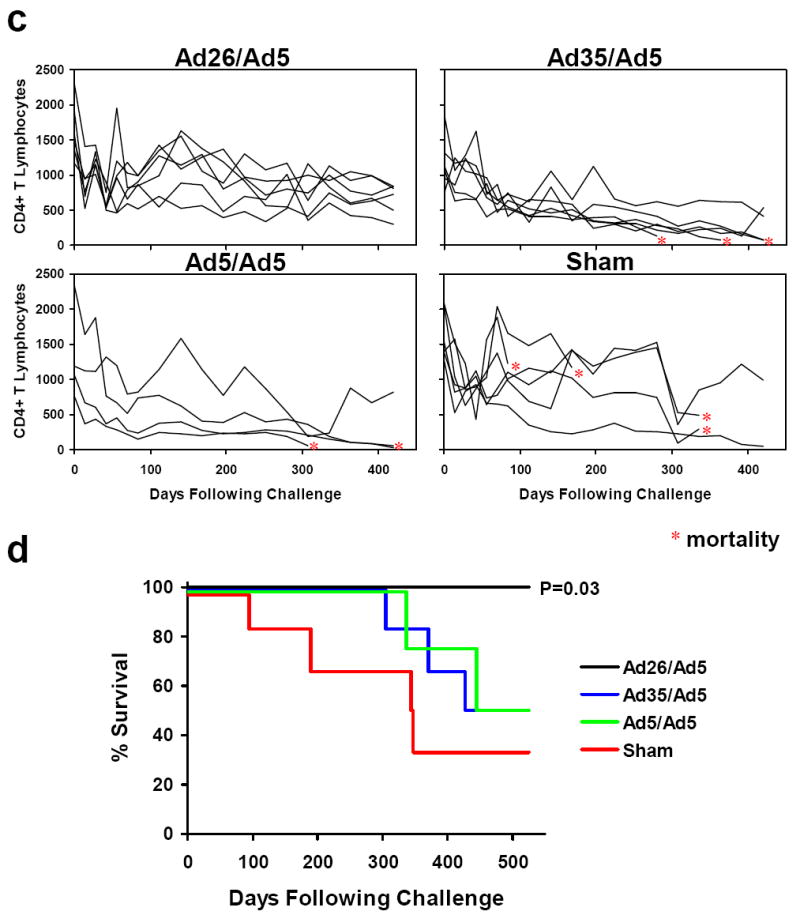
Monkeys were challenged i.v. with SIVmac251, and protective efficacy was monitored by SIV RNA levels (a, b), CD4+ T lymphocyte counts (c), and clinical disease progression and mortality (d) following challenge. Viral loads are depicted longitudinally for each group (a), and peak (day 14) and setpoint (day 112-420) viral loads are summarized for each group (b). Asterisks indicate mortality. Comparisons among groups were performed by two-sided Wilcoxon rank-sum (a, b) and Fisher’s exact (d) tests.
Figure 2
Figure 2. Protective efficacy of heterologous rAd prime-boost vaccine regimens
Monkeys were challenged i.v. with SIVmac251, and protective efficacy was monitored by SIV RNA levels (a, b), CD4+ T lymphocyte counts (c), and clinical disease progression and mortality (d) following challenge. Viral loads are depicted longitudinally for each group (a), and peak (day 14) and setpoint (day 112-420) viral loads are summarized for each group (b). Asterisks indicate mortality. Comparisons among groups were performed by two-sided Wilcoxon rank-sum (a, b) and Fisher’s exact (d) tests.
Figure 3
Figure 3. Cellular and humoral immune responses following challenge
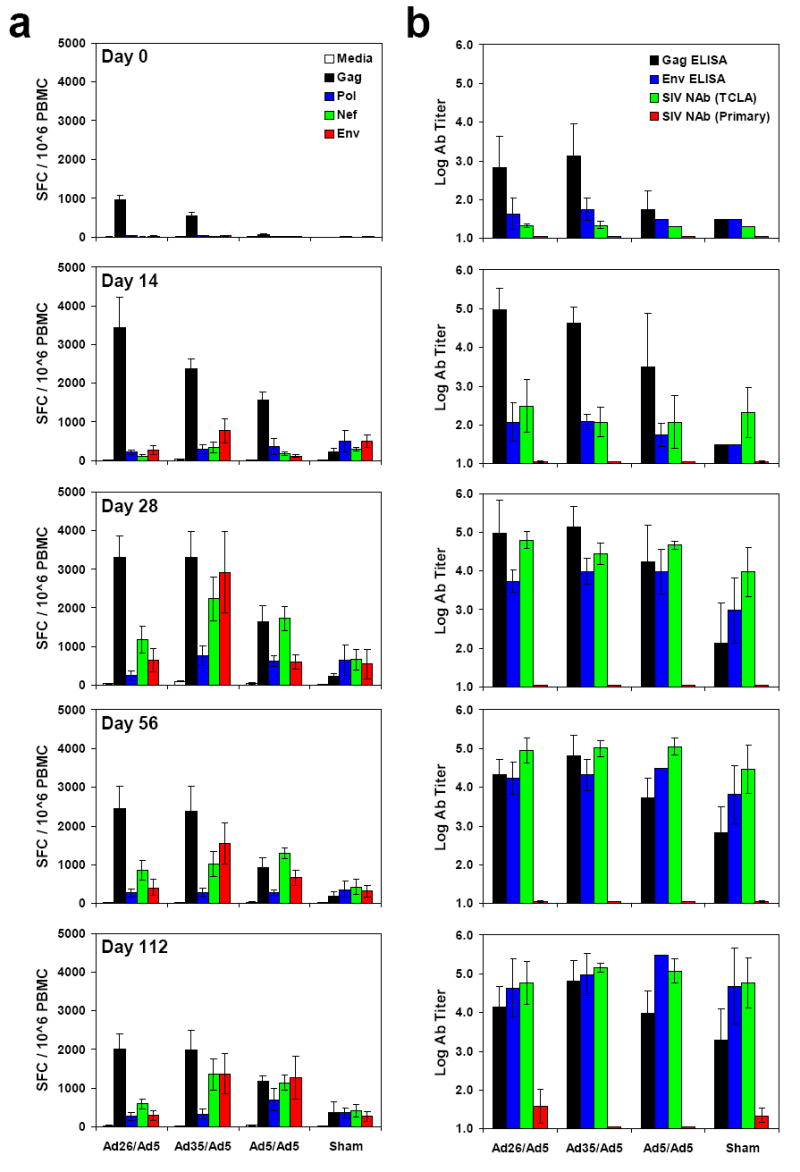
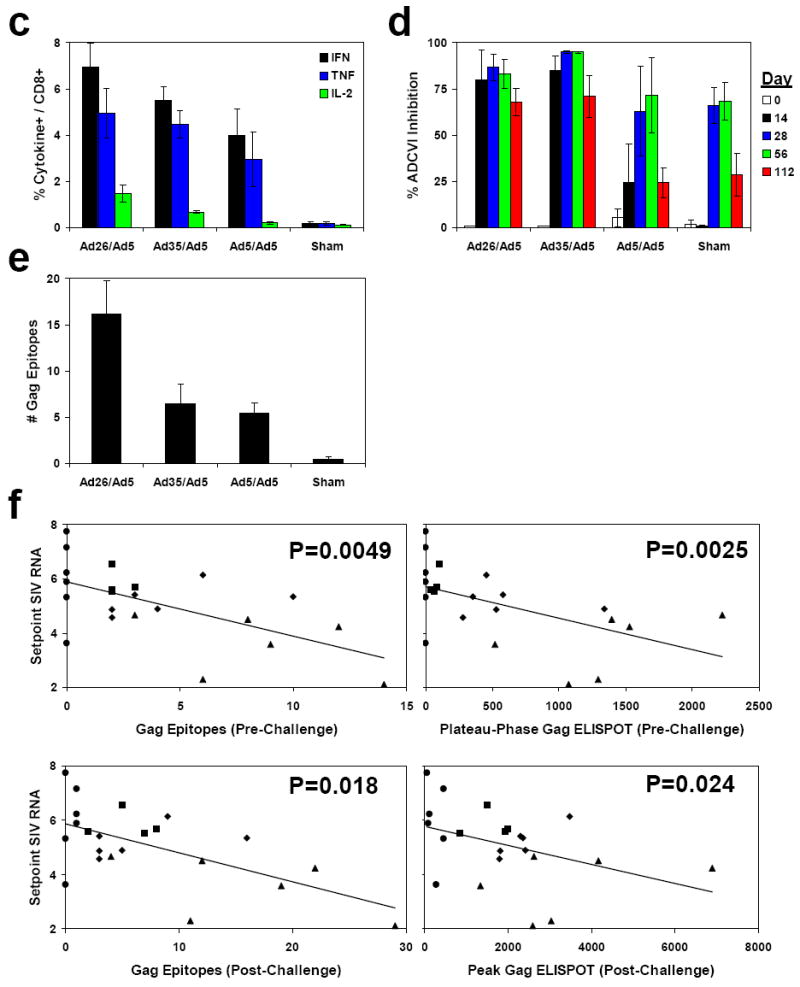
Cellular (a, c, e) and humoral (b, d) immune responses were assessed following challenge. IFN-γ ELISPOT assays (a) and ELISA and NAb assays (b) were performed on days 0, 14, 28, 56, and 112 following challenge. 8-color ICS assays on day 28 (c), ADCVI assays at 1:100 serum dilution at multiple timepoints (d), and Gag epitope mapping studies on day 28 (e) were also performed. Mean responses with standard errors are shown (a-e). f, Correlations between the breadth (left panels) or magnitude (right panels) of pre-challenge (upper panels) or post-challenge (lower panels) Gag-specific cellular immune responses and setpoint viral loads were evaluated by two-sided Spearman rank correlation tests. Monkeys immunized with rAd26/rAd5 (triangles), rAd35/rAd5 (diamonds), rAd5/rAd5 (squares), and sham (circles) vaccine regimens are depicted.
Figure 3
Figure 3. Cellular and humoral immune responses following challenge
Cellular (a, c, e) and humoral (b, d) immune responses were assessed following challenge. IFN-γ ELISPOT assays (a) and ELISA and NAb assays (b) were performed on days 0, 14, 28, 56, and 112 following challenge. 8-color ICS assays on day 28 (c), ADCVI assays at 1:100 serum dilution at multiple timepoints (d), and Gag epitope mapping studies on day 28 (e) were also performed. Mean responses with standard errors are shown (a-e). f, Correlations between the breadth (left panels) or magnitude (right panels) of pre-challenge (upper panels) or post-challenge (lower panels) Gag-specific cellular immune responses and setpoint viral loads were evaluated by two-sided Spearman rank correlation tests. Monkeys immunized with rAd26/rAd5 (triangles), rAd35/rAd5 (diamonds), rAd5/rAd5 (squares), and sham (circles) vaccine regimens are depicted.
Figure 4
Figure 4. CD4+ T lymphocyte dynamics following challenge
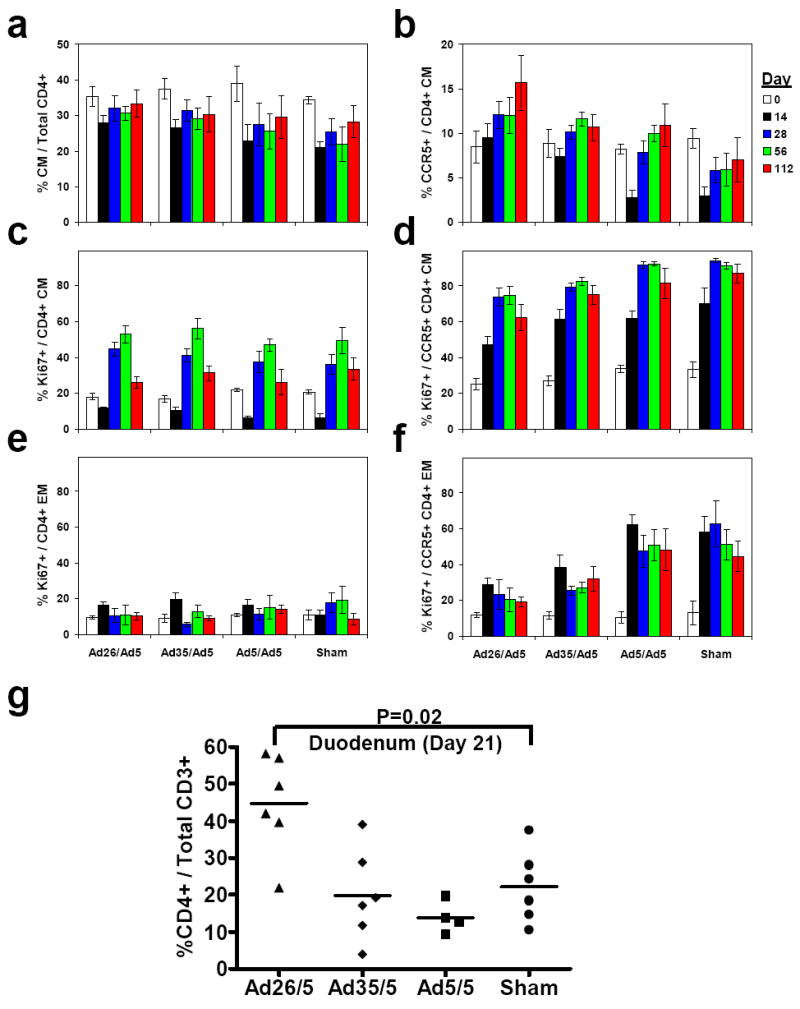
Preservation of central memory (CM; CD28+CD95+) CD4+ T lymphocytes (a) and CCR5+ central memory CD4+ T lymphocytes (b) was assessed on days 0, 14, 28, 56, and 112 following challenge. Ki67 staining of central memory CD4+ (c), CCR5+ central memory CD4+ (d), effector memory (EM; CD28-CD95+) CD4+ (e), and CCR5+ effector memory CD4+ (f) T lymphocytes was also determined. Mean responses with standard errors are shown (a-f). g, Preservation of gastrointestinal CD4+ T lymphocytes was assessed in duodenal biopsies on day 21 following challenge. Comparisons were performed by two-sided Wilcoxon rank-sum tests.

References

    1. Fauci AS. The release of new data from the HVTN 502 (STEP) HIV vaccine study. NIH News. 2007 Nov 7;
    1. Fauci AS. 25 years of HIV. Nature. 2008;453:289–90. - PubMed
    1. Casimiro DR, et al. Attenuation of simian immunodeficiency virus SIVmac239 infection by prophylactic immunization with dna and recombinant adenoviral vaccine vectors expressing Gag. J Virol. 2005;79:15547–55. - PMC - PubMed
    1. Shiver JW, et al. Replication-incompetent adenoviral vaccine vector elicits effective anti-immunodeficiency-virus immunity. Nature. 2002;415:331–5. - PubMed
    1. Shiver JW, Emini EA. Recent advances in the development of HIV-1 vaccines using replication-incompetent adenovirus vectors. Annu Rev Med. 2004;55:355–72. - PubMed

Publication types

MeSH terms