


Influence of caregiving on lifestyle and psychosocial risk factors among family members of patients hospitalized with cardiovascular disease
- PMID: 18998190
- PMCID: PMC2607516
- DOI: 10.1007/s11606-008-0852-1
Influence of caregiving on lifestyle and psychosocial risk factors among family members of patients hospitalized with cardiovascular disease
Abstract
Background: Few data have evaluated the relationship between caregiving and cardiovascular disease (CVD) risk.
Objective: The purpose of this study was to determine the prevalence and predictors of caregiver strain and to evaluate the association between caregiving and CVD lifestyle and psychosocial risk factors among family members of recently hospitalized CVD patients.
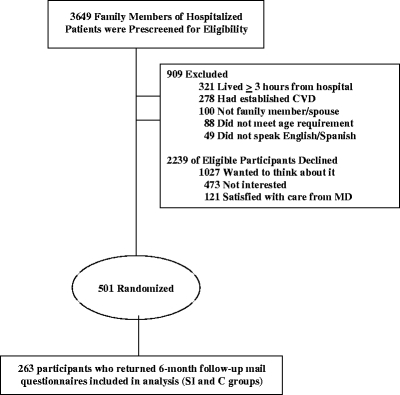
Design and participants: Participants in the NHLBI Family Intervention Trial for Heart Health (FIT Heart) who completed a 6-month follow-up were included in this analysis (n = 263; mean age 50 +/- 14 years, 67% female, 29% non-white).
Measurements: At 6 months, standardized information was collected regarding depression, social support, and caregiver strain (high caregiver strain = > or =7). Information on lifestyle risk factors, including obesity, physical activity, and diet, were also collected using standardized questionnaires. Logistic regression models on the association between caregiving and CVD risk factors were adjusted for significant confounders.
Results: The prevalence of serving as a CVD patient's primary caregiver or caring for the patient most of the time was 50% at 6 months. Caregivers (primary/most) were more likely to be women (81% vs 19%, p < .01), married/living with someone (p < .01), >50 years old (p < .01), have < or = high school education (p < .01), be unemployed (p < .01), get less physical activity (p < .01), and have a higher waist circumference (p < .01) than non-caregivers (some/occasional/none). Mean caregiver strain scores were significantly higher among those with depressive symptoms (p < .01) and low social support (p < .01) in a multivariable adjusted model.
Conclusions: Caregivers of cardiac patients may be at increased risk themselves for CVD morbidity and mortality compared to non-caregivers due to suboptimal lifestyle and psychosocial risk factors.
Figures
References
-
- American Heart Association. Heart and stroke statistical update. Retrieved March 19, 2008 from http://www.americanheart.org.
-
- {'text': '', 'ref_index': 1, 'ids': [{'type': 'DOI', 'value': '10.2105/AJPH.93.11.1939', 'is_inner': False, 'url': 'https://doi.org/10.2105/ajph.93.11.1939'}, {'type': 'PMC', 'value': 'PMC1448080', 'is_inner': False, 'url': 'https://pmc.ncbi.nlm.nih.gov/articles/PMC1448080/'}, {'type': 'PubMed', 'value': '14600070', 'is_inner': True, 'url': 'https://pubmed.ncbi.nlm.nih.gov/14600070/'}]}
- Lee S, Colditz G, Berkman L, Kawachi I. Caregiving to children and grandchildren and risk of coronary heart disease in women. Am J Public Health. 2003;93(11):1939–44. - PMC - PubMed
-
- {'text': '', 'ref_index': 1, 'ids': [{'type': 'PubMed', 'value': '12021416', 'is_inner': True, 'url': 'https://pubmed.ncbi.nlm.nih.gov/12021416/'}]}
- Vitaliano PP, Scanlan JM, Zhang J, Savage MV, Hirsch IB, Siegler IC. A path model of chronic stress, the metabolic syndrome, and coronary heart disease. Psychosom Med. 2002;64(3):418–35. - PubMed
-
- {'text': '', 'ref_index': 1, 'ids': [{'type': 'PubMed', 'value': '16259231', 'is_inner': True, 'url': 'https://pubmed.ncbi.nlm.nih.gov/16259231/'}]}
- Singh M, Cameron J. Psychosocial aspects of caregiving to stroke patients. Axone. 2005;27(1):18–24. - PubMed
-
- {'text': '', 'ref_index': 1, 'ids': [{'type': 'DOI', 'value': '10.1007/s10900-007-9059-3', 'is_inner': False, 'url': 'https://doi.org/10.1007/s10900-007-9059-3'}, {'type': 'PubMed', 'value': '17940871', 'is_inner': True, 'url': 'https://pubmed.ncbi.nlm.nih.gov/17940871/'}]}
- Harralson TL, Emig JC, Polansky M, Walker RE, Cruz JO, Garcia-Leeds C. Un Corazón Saludable: factors influencing outcomes of an exercise program designed to impact cardiac and metabolic risks among urban Latinas. J Community Health. 2007;32(6):401–12. - PubMed
Publication types
MeSH terms
Grants and funding
LinkOut - more resources
Full Text Sources
Medical
