


Blunted Akt/FOXO signalling and activation of genes controlling atrophy and fuel use in statin myopathy
- PMID: 19001041
- PMCID: PMC2670035
- DOI: 10.1113/jphysiol.2008.164699
Blunted Akt/FOXO signalling and activation of genes controlling atrophy and fuel use in statin myopathy
Abstract
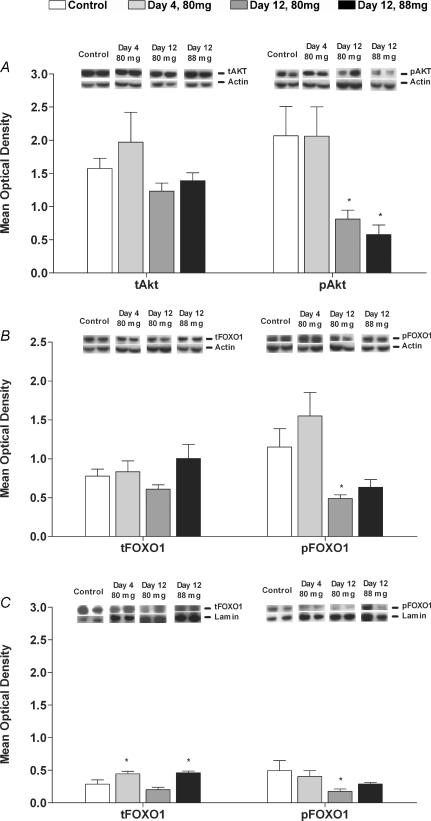
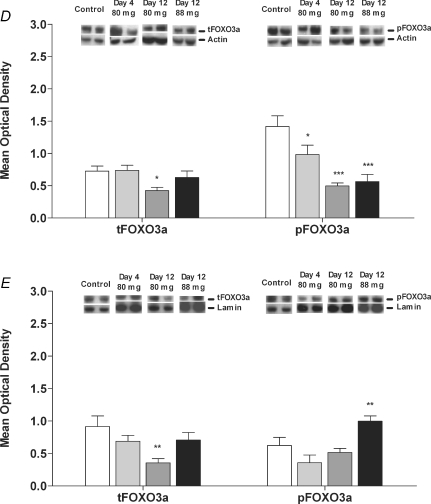
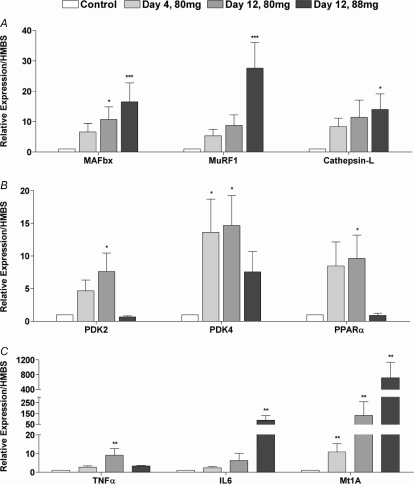
Statins are used clinically for cholesterol reduction, but statin therapy is associated with myopathic changes through a poorly defined mechanism. We used an in vivo model of statin myopathy to determine whether statins up-regulate genes associated with proteasomal- and lysosomal-mediated proteolysis and whether PDK gene expression is simultaneously up-regulated leading to the impairment of muscle carbohydrate oxidation. Animals were dosed daily with 80 mg kg(-1) day(-1) simvastatin for 4 (n = 6) and 12 days (n = 5), 88 mg kg(-1) day(-1) simvastatin for 12 days (n = 4), or vehicle (0.5% w/v hydroxypropyl-methylcellulose and 0.1% w/v polysorbate 80; Control, n = 6) for 12 days by oral gavage. We found, in biceps femoris muscle, decreased Akt(Ser473), FOXO1(Ser253) and FOXO3a(Ser253) phosphorylation in the cytosol (P < 0.05, P < 0.05, P < 0.001, respectively) and decreased phosphorylation of FOXO1 in the nucleus after 12 days simvastatin when compared to Control (P < 0.05). This was paralleled by a marked increase in the transcription of downstream targets of FOXO, i.e. MAFbx (P < 0.001), MuRF-1 (P < 0.001), cathepsin-L (P < 0.05), PDK2 (P < 0.05) and PDK4 (P < 0.05). These changes were accompanied by increased PPARalpha (P < 0.05), TNFalpha (P < 0.01), IL6 (P < 0.01), Mt1A (P < 0.01) mRNA and increased muscle glycogen (P < 0.05) compared to Control. RhoA activity decreased after 4 days simvastatin (P < 0.05); however, activity was no different from Control after 12 days. Simvastatin down-regulated PI3k/Akt signalling, independently of RhoA, and up-regulated FOXO transcription factors and downstream gene targets known to be implicated in proteasomal- and lysosomal-mediated muscle proteolysis, carbohydrate oxidation, oxidative stress and inflammation in an in vivo model of statin-induced myopathy. These changes occurred in the main before evidence of extensive myopathy or a decline in the muscle protein to DNA ratio.
Figures
Comment in
-
The battle to keep or lose skeletal muscle with ageing.J Physiol. 2009 Jan 15;587(1):1-2. doi: 10.1113/jphysiol.2008.167049. J Physiol. 2009. PMID: 19119178 Free PMC article. No abstract available.
References
-
- Armstrong RB, Phelps RO. Muscle fiber type composition of the rat hindlimb. Am J Anat. 1984;171:259–272. - PubMed
-
- Backman JT, Kyrklund C, Neuvonen M, Neuvonen PJ. Gemfibrozil greatly increases plasma concentrations of cerivastatin. Clin Pharmacol Ther. 2002;72:685–691. - PubMed
-
- Baracos V, DeVivo C, Hoyle D, Goldberg AL. Activation of the ATP-ubiquitin-proteasome pathway in skeletal muscle of cachectic rats bearing a hepatoma. Am J Physiol Endocrinol Metab. 1995;268:E996–E1006. - PubMed
-
- Blough E, Dineen B, Esser K. Extraction of nuclear proteins from striated skeletal muscle. Biotechniques. 1999;26:202–206. - PubMed
Publication types
MeSH terms
Substances
LinkOut - more resources
Full Text Sources
Medical
Research Materials
Miscellaneous
