. 2009 Jan;29(1):57-67.
doi: 10.1128/MCB.00989-08. Epub 2008 Nov 10.

Monomethylation of lysine 20 on histone H4 facilitates chromatin maturation

Affiliations

Monomethylation of lysine 20 on histone H4 facilitates chromatin maturation

Annette N D Scharf et al. Mol Cell Biol. 2009 Jan.

Abstract

Histone modifications play an important role in shaping chromatin structure. Here, we describe the use of an in vitro chromatin assembly system from Drosophila embryo extracts to investigate the dynamic changes of histone modifications subsequent to histone deposition. In accordance with what has been observed in vivo, we find a deacetylation of the initially diacetylated isoform of histone H4, which is dependent on chromatin assembly. Immediately after deposition of the histones onto DNA, H4 is monomethylated at K20, which is required for an efficient deacetylation of the H4 molecule. H4K20 methylation-dependent dl(3)MBT association with chromatin and the identification of a dl(3)MBT-dRPD3 complex suggest that a deacetylase is specifically recruited to the monomethylated substrate through interaction with dl(3)MBT. Our data demonstrate that histone modifications are added and removed during chromatin assembly in a highly regulated manner.


Figures
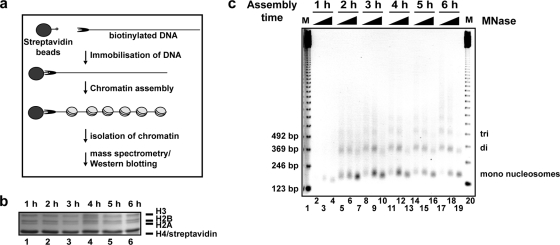
FIG. 1.
FIG. 1.
DREX-mediated chromatin assembly. (a) Scheme of chromatin reconstitution protocol. The DNA used for chromatin assembly is a linearized biotinylated fragment containing 12 repeats of a 5S nucleosome positioning sequence. Two micrograms of DNA bound to paramagnetic beads was reconstituted into chromatin for 1 to 6 h at 26°C using 80 μl DREX. (b) Corresponding histones stained with Coomassie blue. When boiling streptavidin-coated beads, a strongly stained streptavidin band appeared at the same molecular weight as H4. It is therefore labeled H4/streptavidin. (c) Micrococcal nuclease digestion pattern of the reconstituted chromatin. M, lanes containing the 123-bp ladder as a molecular weight marker; MNase, micrococcal nuclease.
FIG. 2.
FIG. 2.
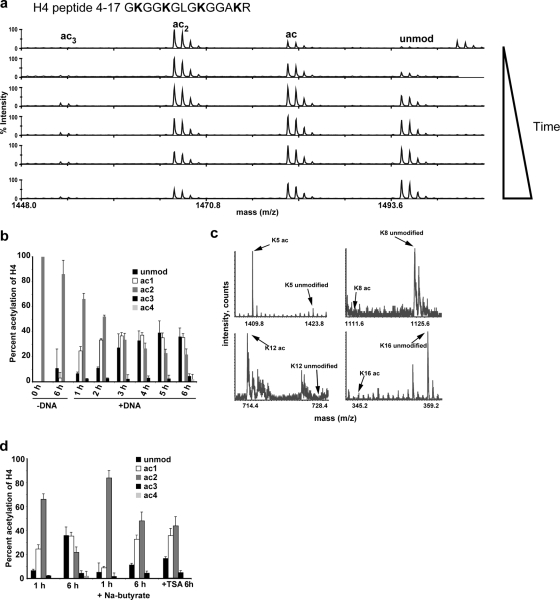
Dynamics of modifications on H4 peptide 4-17 during DREX assembly. (a) Top, sequence of H4 peptide 4-17; bottom, time course analysis of H4 peptide 4-17 by matrix-assisted laser desorption ionization-time of flight (MALDI-TOF) analysis. Chromatin was reconstituted as described above. The reconstitution was stopped after 1, 2, 3, 4, 5, and 6 h, chromatin attached to paramagnetic beads was washed, and histones were separated by 18% SDS-PAGE. H4 was cut out and subjected to mass spectrometric analysis. (b) Quantification of MALDI-TOF data that are shown in panel a. As a control, DREX was incubated at 26°C without DNA for 0 h or 6 h and labeled as −DNA 0 h/6 h. unmod, unmodified; ac, acetylation. (c) MS-MS spectra generated from the diacetylated peak from 1 h DREX assembly. (d) Quantification of MALDI-TOF analysis. HDAC inhibitors were added to the chromatin assembly reaction, and H4 was analyzed as described above. TSA, trichostatin A; Na-butyrate, sodium butyrate.
FIG. 3.
FIG. 3.
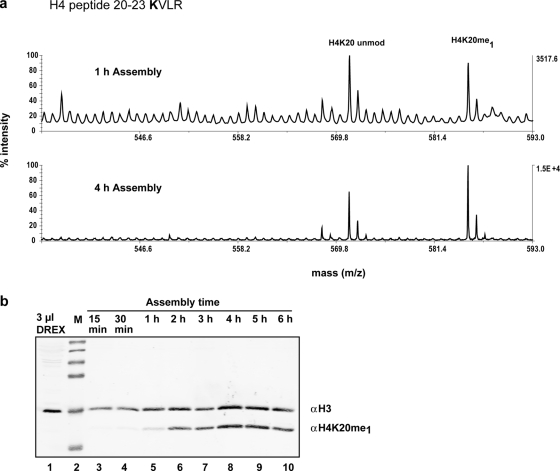
H4 becomes monomethylated at K20 after assembly. (a) Chromatin was assembled as shown before using DREX. Corresponding histones were separated by 18% SDS-PAGE and then digested with AspN prior to mass spectrometric analysis. Also shown is a comparison of posttranslational modifications of the H4 peptide 20-23 1 h (top) and 4 h (bottom) after the assembly reaction. (b) Western blot analysis of kinetics of H4K20me1. H3 is serving as a loading control. M, molecular weight marker; αH3, anti-H3; αH4K20me1, anti-H4K20me1.
FIG. 4.
FIG. 4.
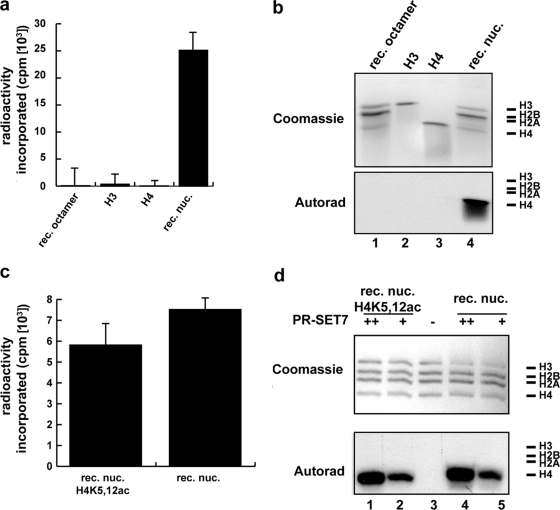
PR-SET7 needs nucleosomes as a substrate. (a) Recombinant dPR-SET7 was cloned into a pMyb vector, expressed in bacteria, purified over chitin affinity chromatography according to the manufacturer's instructions (New England Biolabs), and assayed for HMTase activity on different substrates. The histogram shows the radioactivity incorporated. rec. nuc., recombinant nucleosomes; rec. octamer, recombinant octamer. (b) Autoradiography of the experiment described for panel a. (c) Methylation of recombinant nucleosomes and nucleosomes acetylated at K5 and K12 by dPR-SET7. (d) Autoradiography of the experiments described for panel c.
FIG. 5.
FIG. 5.
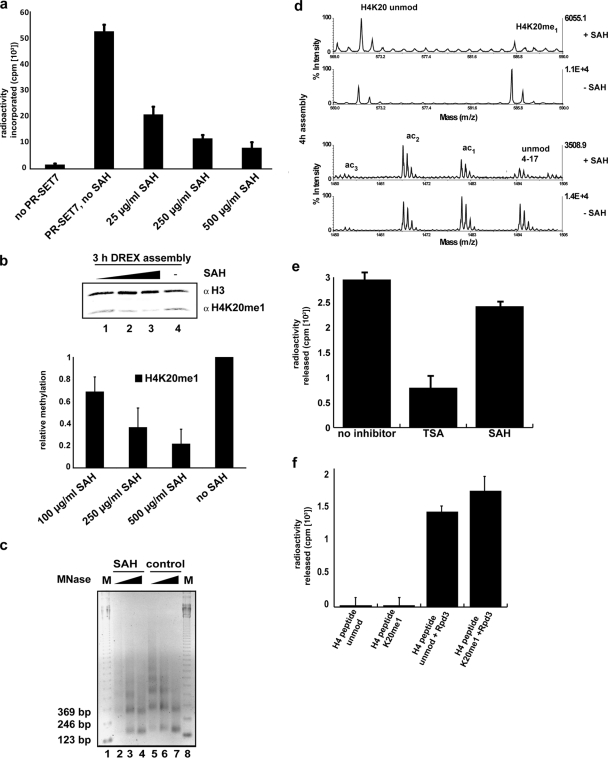
Deacetylation of H4K5/K12 is dependent on H4K20 monomethylation. (a) A histone methyltransferase assay was performed in the presence and absence of SAH with and without PR-SET7. (b) Quantification of Western blot analysis. Chromatin was reconstituted for 3 h using DREX treated with and without SAH. Chromatin was washed, separated on an 18% protein gel, blotted to a nitrocellulose membrane, and detected with H4K20me1 antibody. H3 was used as a loading control. (c) Micrococcal digestion pattern of the reconstituted chromatin incubated with or without SAH. M, lanes containing the 123-bp ladder as a molecular size marker. (d) Chromatin was assembled for 4 h. Histones were separated by 18% SDS-PAGE and then digested with trypsin prior to mass spectrometric analysis. Top two panels, comparison of unmodified H4K20 and monomethylated K20 peak of chromatin treated with or without SAH (shown is the peptide 20-23) (Fig. 3); bottom two panels, comparison of acetylation ratios of peptide 4-17 of chromatin that has been treated with and without SAH. (e) HDAC assay using 5 μl of chromatin assembly extract in the presence of either 500 μM TSA or 500 μg/ml SAH. (f) Deacetylation of an in vitro-acetylated peptide containing amino acids 9 to 29 of H4 carrying a methylation or no modification at K20.
FIG. 6.
FIG. 6.
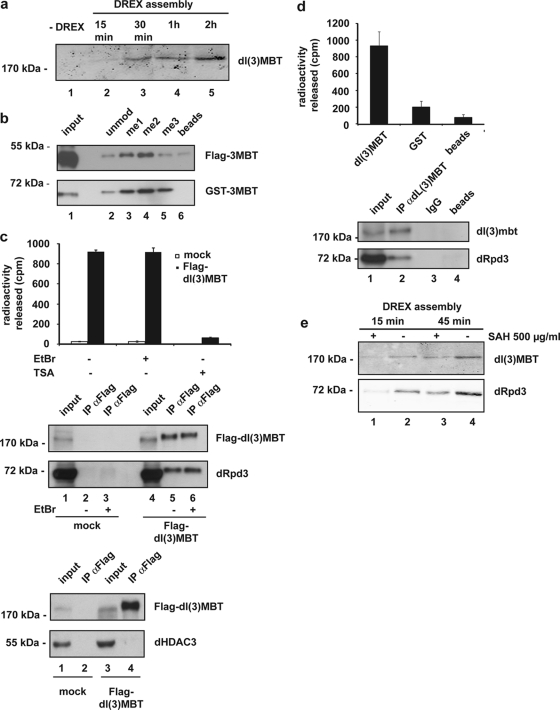
Binding of dl(3)MBT to chromatin is inhibited by SAH, and dl(3)MBT is found in a complex with dRpd3. (a) After chromatin was reconstituted using DREX, bound dl(3)MBT was detected by Western blotting. (b) Immobilized H4 peptides (amino acids 16 to 25) were incubated with recombinant baculovirally expressed FLAG-3MBT (top) or recombinant GST-3MBT expressed in bacteria (bottom). Binding of GST- and FLAG-tagged proteins was analyzed by immunoblotting using anti-GST and anti-FLAG antibodies. unmod, unmodified H4 16-25 peptide; me1, me2, and me3, H4 peptide mono-, di-, and tri-methylated at K20; control, beads without peptide. (c, top) HDAC assays were performed with anti-FLAG immunoprecipitates (IP αFlag) from nuclear extracts of S2 cells (mock) and an S2 line stably expressing FLAG-tagged dl(3)MBT [Flag-dl(3)MBT]. Immunoprecipitations were carried out in the absence or presence of ethidium bromide (EtBr), and HDAC reactions were performed with or without TSA as indicated (middle and bottom). Anti-FLAG immunoprecipitates were analyzed by Western blotting for the presence of Flag-dl(3)MBT, dRpd3, and dHDAC3 as indicated. Ten percent of nuclear extracts were loaded as input. (d) HDAC assays were performed with immunoprecipitates obtained with a mixture of two monoclonal anti-dl(3)MBT antibodies (at a ratio of 1:1), anti-GST antibody, or no antibody (beads only) (top), and S2 nuclear extract was precipitated with dl(3)MBT antibody (bottom). Immunoprecipitations were subjected to Western blotting using anti-dRpd3 and anti-dl(3)MBT antibody as shown. (e) Chromatin was reconstituted for a specific time and treated with or without SAH (500 μg/ml). The reconstitution was stopped after 15 and 45 min. Chromatin attached to beads was washed (100 mM NaCl) and separated by 18% SDS-PAGE. dl(3)MBT and dRPD3 were detected by a polyclonal antibody.

References

    1. Ahmad, K., and S. Henikoff. 2002. Histone H3 variants specify modes of chromatin assembly. Proc. Natl. Acad. Sci. USA 99(Suppl. 4)16477-16484. - PMC - PubMed
    1. Akey, C. W., and K. Luger. 2003. Histone chaperones and nucleosome assembly. Curr. Opin. Struct. Biol. 136-14. - PubMed
    1. Bannister, A. J., R. Schneider, and T. Kouzarides. 2002. Histone methylation: dynamic or static? Cell 109801-806. - PubMed
    1. Becker, P. B., and C. Wu. 1992. Cell-free system for assembly of transcriptionally repressed chromatin from Drosophila embryos. Mol. Cell. Biol. 122241-2249. - PMC - PubMed
    1. Benson, L. J., Y. Gu, T. Yakovleva, K. Tong, C. Barrows, C. L. Strack, R. G. Cook, C. A. Mizzen, and A. T. Annunziato. 2006. Modifications of H3 and H4 during chromatin replication, nucleosome assembly, and histone exchange. J. Biol. Chem. 2819287-9296. - PubMed

Publication types

MeSH terms

LinkOut - more resources