


Carbendazim inhibits cancer cell proliferation by suppressing microtubule dynamics
- PMID: 19001156
- PMCID: PMC2682274
- DOI: 10.1124/jpet.108.143537
Carbendazim inhibits cancer cell proliferation by suppressing microtubule dynamics
Abstract
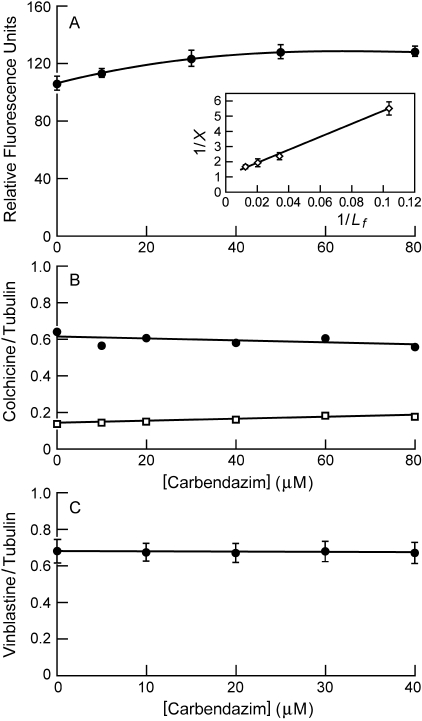
Carbendazim (methyl 2-benzimidazolecarbamate) is widely used as a systemic fungicide in human food production and appears to act on fungal tubulin. However, it also inhibits proliferation of human cancer cells, including drug- and multidrug-resistant and p53-deficient cell lines. Because of its promising preclinical anti-tumor activity, it has undergone phase I clinical trials and is under further clinical development. Although it weakly inhibits polymerization of brain microtubules and induces G(2)/M arrest in tumor cells, its mechanism of action in human cells has not been fully elucidated. We examined its mechanism of action in MCF7 human breast cancer cells and found that it inhibits proliferation (IC(50), 10 microM) and half-maximally arrests mitosis at a similar concentration (8 microM), in concert with suppression of microtubule dynamic instability without appreciable microtubule depolymerization. It induces mitotic spindle abnormalities and reduces the metaphase intercentromere distance of sister chromatids, indicating reduction of tension on kinetochores, thus leading to metaphase arrest. With microtubules assembled in vitro from pure tubulin, carbendazim also suppresses dynamic instability, reducing the dynamicity by 50% at 10 microM, with only minimal (21%) reduction of polymer mass. Carbendazim binds to mammalian tubulin (K(d), 42.8 +/- 4.0 microM). Unlike some benzimidazoles that bind to the colchicine site in tubulin, carbendazim neither competes with colchicine nor competes with vinblastine for binding to brain tubulin. Thus, carbendazim binds to an as yet unidentified site in tubulin and inhibits tumor cell proliferation by suppressing the growing and shortening phases of microtubule dynamic instability, thus inducing mitotic arrest.
Figures


References
-
- Aneja R, Lopus M, Zhou J, Vangapandu SN, Ghaleb A, Yao J, Nettles JH, Zhou B, Gupta M, Panda D, Chandra R, and Joshi HC (2006) Rational design of the microtubule-targeting anti-breast cancer drug EM015. Cancer Res 66 3782-3791. - PubMed
-
- Bhattacharyya B and Wolff J (1975) The interaction of 1-anilino-8-naphthalene sulfonate with tubulin: a site independent of the colchicine-binding site. Arch Biochem Biophys 167 264-269. - PubMed
-
- Bradford MM (1976) A rapid and sensitive method for the quantitation of microgram quantities of protein utilizing the principle of protein-dye binding. Anal Biochem 72 248-254. - PubMed
-
- Brand L and Gohlke JR (1972) Fluorescence probes for structure. Annu Rev Biochem 41 843-868. - PubMed
-
- Can A and Albertini DF (1997) M-phase specific centrosome-microtubule alterations induced by the fungicide MBC in human granulosa cells. Mutat Res 373 139-151. - PubMed
Publication types
MeSH terms
Substances
Grants and funding
LinkOut - more resources
Full Text Sources
Research Materials
Miscellaneous
