Role of the tau gene region chromosome inversion in progressive supranuclear palsy, corticobasal degeneration, and related disorders
- PMID: 19001166
- PMCID: PMC2680206
- DOI: 10.1001/archneur.65.11.1473
Role of the tau gene region chromosome inversion in progressive supranuclear palsy, corticobasal degeneration, and related disorders
Abstract
Background: An inverted region on chromosome 17 has been previously linked to many Pick complex diseases. Due to the inversion, an exact causal locus has been difficult to identify, but the microtubule-associated protein tau gene is a likely candidate gene for its involvement in these diseases with tau inclusion.
Objective: To search for variants that confer susceptibility to 4 tauopathies and clinically related disorders.
Design: Genomewide association study.
Setting: University research laboratory.
Participants: A total of 231 samples were genotyped from an unrelated white population of patients with progressive supranuclear palsy (PSP), corticobasal degeneration (CBD), frontotemporal dementia, and frontotemporal dementia with amyotrophy. Unaffected individuals from the same population were used as controls.
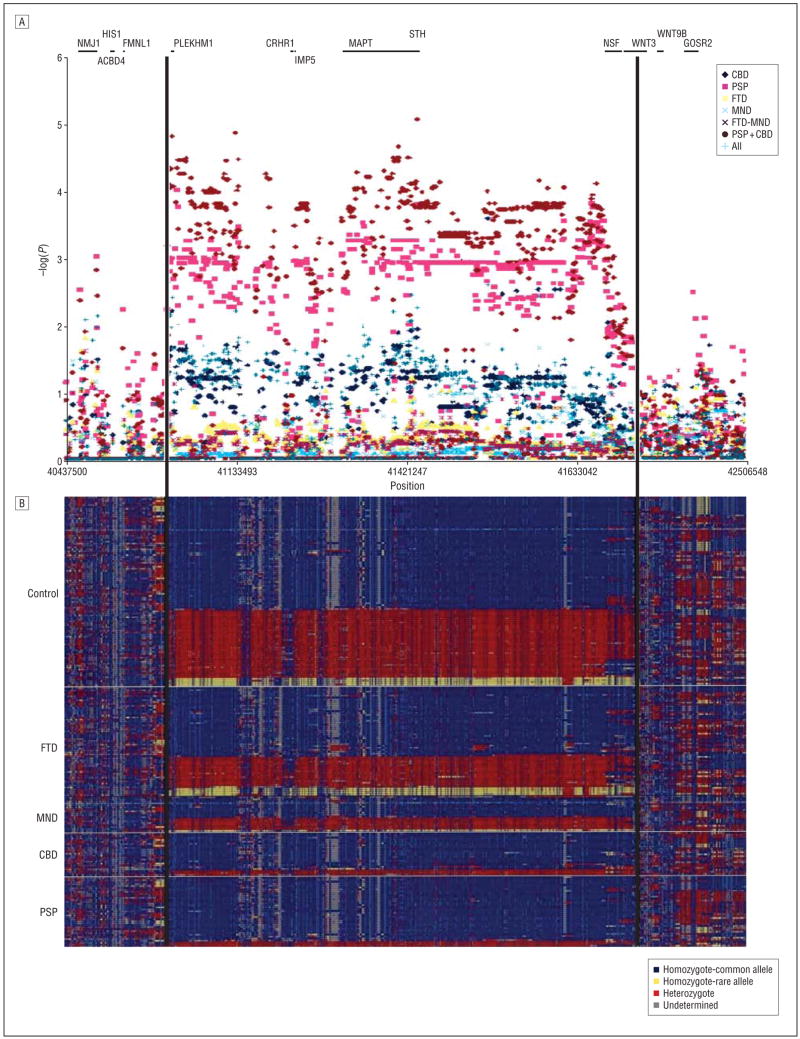
Main outcome measures: The results from an inverted region of chromosome 17 that contains the MAPT gene. Genotypes of cases and controls were compared using a Fisher exact test on a marker-by-marker basis. Haplotypes were determined by visually inspecting genotypes.
Results: Comparing any particular disease and controls, the association was constant across the inverted chromosome segment. Significant associations were seen for PSP and PSP combined with CBD. Of the 2 haplotypes seen in the region, H1 was overrepresented in PSP and CBD cases compared with controls.
Conclusions: As expected, the markers are highly correlated and the association is seen across the entire region, which makes it difficult to narrow down a disease-causing variant or even a possible candidate gene. However, considering the pathologic abnormalities of these diseases and the involvement of tau mutations seen in familial forms, the MAPT gene represents the most likely cause driving the association.
Figures

References
-
- Williams DR. Tauopathies: classification and clinical update on neurodegenerative diseases associated with microtubule-associated protein tau [review] Intern Med J. 2006;36(10):652–660. - PubMed
-
- Neary D, Snowden J, Mann D. Frontotemporal dementia [review] Lancet Neurol. 2005;4(11):771–780. - PubMed
-
- Kertesz A. Pick complex: an integrative approach to frontotemporal dementia: primary progressive aphasia, corticobasal degeneration, and progressive supra-nuclear palsy [review] Neurologist. 2003;9(6):311–317. - PubMed
-
- Rademakers R, Cruts M, van Broeckhoven C. The role of tau (MAPT) in frontotemporal dementia and related tauopathies [review] Hum Mutat. 2004;24(4):277–295. - PubMed
-
- Rademakers R, Melquist S, Cruts M, et al. High-density SNP haplotyping suggests altered regulation of tau gene expression in progressive supranuclear palsy. Hum Mol Genet. 2005;14(21):3281–3292. - PubMed
Publication types
MeSH terms
Substances
Grants and funding
- P50 AG023501/AG/NIA NIH HHS/United States
- R01 DA030976/DA/NIDA NIH HHS/United States
- R01NS36733/NS/NINDS NIH HHS/United States
- K23 NS048855/NS/NINDS NIH HHS/United States
- R01 NS036733/NS/NINDS NIH HHS/United States
- P01 AG19724/AG/NIA NIH HHS/United States
- P41 RR013642/RR/NCRR NIH HHS/United States
- P30 CA013696/CA/NCI NIH HHS/United States
- M01RR00079/RR/NCRR NIH HHS/United States
- P01 AG021601/AG/NIA NIH HHS/United States
- T32 AG023481/AG/NIA NIH HHS/United States
- R21 AG026043/AG/NIA NIH HHS/United States
- P01 AG019724/AG/NIA NIH HHS/United States
- K08 MH065983/MH/NIMH NIH HHS/United States
- M01 RR000083/RR/NCRR NIH HHS/United States
LinkOut - more resources
Full Text Sources
Medical
Miscellaneous