. 2009 Jan 2;284(1):158-164.
doi: 10.1074/jbc.M807976200. Epub 2008 Nov 11.

Nicotinamide riboside and nicotinic acid riboside salvage in fungi and mammals. Quantitative basis for Urh1 and purine nucleoside phosphorylase function in NAD+ metabolism

Affiliations

Nicotinamide riboside and nicotinic acid riboside salvage in fungi and mammals. Quantitative basis for Urh1 and purine nucleoside phosphorylase function in NAD+ metabolism

Peter Belenky et al. J Biol Chem. .

Erratum in

  • J Biol Chem. 2009 Mar 20;284(12):8208

Abstract

NAD+ is a co-enzyme for hydride transfer enzymes and an essential substrate of ADP-ribose transfer enzymes and sirtuins, the type III protein lysine deacetylases related to yeast Sir2. Supplementation of yeast cells with nicotinamide riboside extends replicative lifespan and increases Sir2-dependent gene silencing by virtue of increasing net NAD+ synthesis. Nicotinamide riboside elevates NAD+ levels via the nicotinamide riboside kinase pathway and by a pathway initiated by splitting the nucleoside into a nicotinamide base followed by nicotinamide salvage. Genetic evidence has established that uridine hydrolase, purine nucleoside phosphorylase, and methylthioadenosine phosphorylase are required for Nrk-independent utilization of nicotinamide riboside in yeast. Here we show that mammalian purine nucleoside phosphorylase but not methylthioadenosine phosphorylase is responsible for mammalian nicotinamide riboside kinase-independent nicotinamide riboside utilization. We demonstrate that so-called uridine hydrolase is 100-fold more active as a nicotinamide riboside hydrolase than as a uridine hydrolase and that uridine hydrolase and mammalian purine nucleoside phosphorylase cleave nicotinic acid riboside, whereas the yeast phosphorylase has little activity on nicotinic acid riboside. Finally, we show that yeast nicotinic acid riboside utilization largely depends on uridine hydrolase and nicotinamide riboside kinase and that nicotinic acid riboside bioavailability is increased by ester modification.


Figures
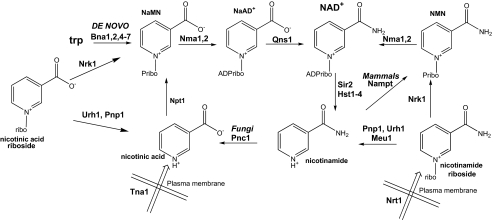
FIGURE 1.
FIGURE 1.
NAD+ biosynthetic pathways in S. cerevisiae and mammals. NAD+ is synthesized from tryptophan by the de novo biosynthetic pathway and from vitamin precursors, NA, Nam, and NR, through salvage pathways (1, 44). Salvage pathways in mammals and yeast differ in the utilization of Nam. Yeast convert Nam to NA via the nicotinamidase, Pnc1, whereas mammals convert Nam to nicotinamide mononucleotide (NMN) through the activity of the nicotinamide phosphoribosyltransferase, Nampt. In yeast, NR is salvaged via the Nrk1 pathway and the Urh1/Pnp1 pathway with slight flux through Meu1 (16). In yeast, NaR is salvaged by Nrk1 and the Urh1/Pnp1 pathway (20). According to the data in this study, mammalian Nrk-independent NR salvage relies solely on Pnp and, in yeast, Nrk-independent usage of NaR relies principally on Urh1. Urh1 is now classified as an NR hydrolase, with lower activity on uridine and NaR. ribo, riboside; ADPribo, ADP-ribose.
FIGURE 2.
FIGURE 2.
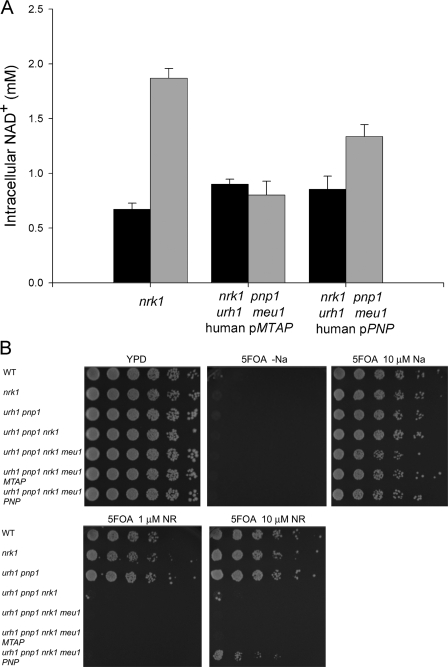
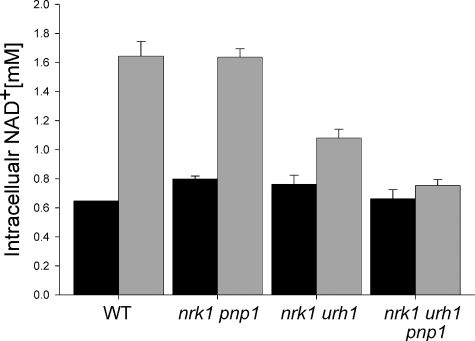
Human Pnp but not Mtap functions in yeast NR utilization. A, intracellular NAD+ concentrations of the indicated genotypes were measured in NA-free SDC media (black bars) and in NA-free SDC media plus 10 μm NR (gray bars). pMTAP and pPNP indicate the addition of a pRS327 plasmid encoding a human cDNA fused to the yeast PNP1 promoter. Expression of human Pnp allows Nrk1-independent NR utilization. B, all strains are gene silencing-deficient on medium without NA and are gene silencing-proficient on medium with 10 μm NA. 10 μm NR restores gene silencing to wild-type (WT) yeast but not yeast strains lacking both NR salvaging pathways. Human Pnp but not Mtap provides a partial rescue of the gene silencing deficiency, indicating function in NR salvage.
FIGURE 3.
FIGURE 3.
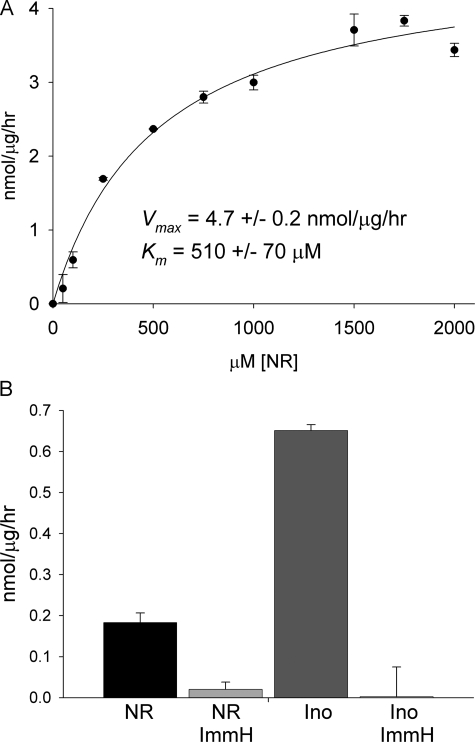
Mammalian NR phosphorylase activity is Pnp. A, crude mouse liver NR phosphorylase activity. B, specific activity of CACO-2 cell lysate phosphorolysis of inosine (Ino) and NR without and with immucillin-H (ImmH) inhibition.
FIGURE 4.
FIGURE 4.
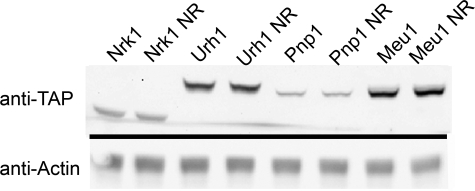
Relative protein abundance of NR salvage enzymes. Yeast strains, containing tandem affinity purification-tagged NR salvage enzymes, were grown in synthetic media without or with the addition of 100μm NR. The relative abundance of the proteins, Meu1 > Urh1 > Nrk1 > Pnp1, was determined by Western blotting with an anti-tandem affinity purification antibody CAB1001 (Open Biosystems). Half of the blot was probed with anti-actin antibody as a loading control.
FIGURE 5.
FIGURE 5.
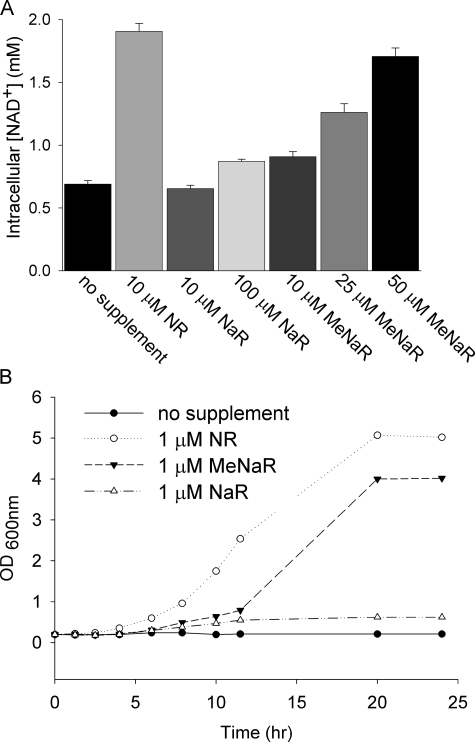
NaR utilization is facilitated by methyl ester modification. A, intracellular NAD+ concentrations of wild-type yeast supplemented with NR, NaR, or meNaR at the indicated concentrations. B, de novo mutant bna1 was grown for 18 h in SDC and then grown to exhaustion for 18 h in NA-free SDC. It was then diluted to a starting A(600 nm) of 0.2 in the specified media. Although 1 μm NR was the best at promoting bna1 growth, meNaR supported bna1 growth after a lag period and 1 μm NaR did not.
FIGURE 6.
FIGURE 6.
Urh1 is principally responsible for Nrk1-independent NaR/meNaR utilization. Intracellular NAD+ concentration of yeast strains was supplemented with 50 μm meNaR. The urh1 deletion from nrk1 greatly reduces meNaR utilization, which is eliminated by deletion of nrk1, urh1, and pnp1. WT, wild type.

References

    1. Belenky, P., Bogan, K. L., and Brenner, C. (2007) Trends Biochem. Sci. 32 12–19 - PubMed
    1. Tanny, J. C., Dowd, G. J., Huang, J., Hilz, H., and Moazed, D. (1999) Cell 99 735–745 - PubMed
    1. Tanner, K. G., Landry, J., Sternglanz, R., and Denu, J. M. (2000) Proc. Natl. Acad. Sci. U. S. A. 97 14178–14182 - PMC - PubMed
    1. Sauve, A. A., Celic, I., Avalos, J., Deng, H., Boeke, J. D., and Schramm, V. L. (2001) Biochemistry 40 15456–15463 - PubMed
    1. Guarente, L. (2000) Genes Dev. 14 1021–1026 - PubMed

Publication types

MeSH terms