. 2009 Feb;94(2):615-22.
doi: 10.1210/jc.2008-1466. Epub 2008 Nov 11.

Estrogen receptor (ER) beta regulates ERalpha expression in stromal cells derived from ovarian endometriosis

Affiliations

Estrogen receptor (ER) beta regulates ERalpha expression in stromal cells derived from ovarian endometriosis

Elena Trukhacheva et al. J Clin Endocrinol Metab. 2009 Feb.

Abstract

Context: Estradiol and its nuclear receptors, estrogen receptor (ER) alpha and ERbeta, play critical roles in endometrium and endometriosis. Levels of ERbeta, due to pathological hypomethylation of its promoter, are significantly higher in endometriotic vs. endometrial tissue and stromal cells, whereas ERalpha levels are lower in endometriosis. Estradiol regulates ERalpha gene expression via its alternatively used promoters A, B, and C.

Objective: The aim of the study was to determine whether high levels of ERbeta in endometriotic stromal cells from ovarian endometriomas regulate ERalpha gene expression.

Results: ERbeta knockdown significantly increased ERalpha mRNA and protein levels in endometriotic stromal cells. Conversely, ERbeta overexpression in endometrial stromal cells decreased ERalpha mRNA and protein levels. ERbeta knockdown significantly decreased proliferation of endometriotic stromal cells. Chromatin immunoprecipitation assays demonstrated that estradiol enhanced ERbeta binding to nonclassical activator protein 1 and specificity protein 1 motifs in the ERalpha gene promoters A and C and a classic estrogen response element in promoter B in endometriotic stromal cells.

Conclusions: High levels of ERbeta suppress ERalpha expression and response to estradiol in endometrial and endometriotic stromal cells via binding to classic and nonclassic DNA motifs in alternatively used ERalpha promoters. ERbeta also regulates cell cycle progression and might contribute to proliferation of endometriotic stromal cells. We speculate that a significantly increased ratio of ERbeta:ERalpha in endometriotic tissues may also suppress progesterone receptor expression and contribute to progesterone resistance. Thus, ERbeta may serve as a significant therapeutic target for endometriosis.


Figures
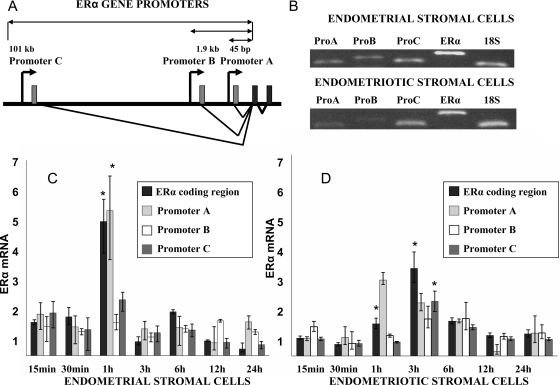
Figure 1
Figure 1
Transcriptional regulation of ERα gene by E2 via specific promoters in endometrial stromal cells and endometriotic stromal cells (from ovarian endometriomas). A, ERα promoters A and B are located proximally to the coding region, and distal promoter C is located at 101 kb upstream of the transcription start site. B, ERα total and promoter A, B, or C-specific mRNA expression in endometrial and endometriotic stromal cells was determined by semiquantitative RT-PCR. Products were analyzed on 1% agarose gel. Total ERα mRNA levels were determined by PCR and primers targeting only the coding region. C, In endometrial stromal cells, total and promoter-specific ERα mRNA up-regulation was noted after 1 h of E2 treatment (*, P < 0.001), with promoter A-specific mRNA being most significantly up-regulated (*, P < 0.05). P values were derived after comparing E2-treatment with vehicle treatment expressed as fold-change. D, In endometriotic stromal cells, ERα mRNA up-regulation was increased significantly 3 h after E2 treatment (*, P < 0.001), with promoter C-specific mRNA being up-regulated (*, P < 0.05). Promoter A-specific mRNA was significantly up-regulated after 1 h of E2 treatment (*, P < 0.05). P values were derived after comparing E2-treatment with vehicle treatment expressed as fold change. Experiments were repeated in both endometrial and endometriotic stromal cells from four different subjects. All graphs are derived from experiments performed in triplicate in one representative subject. ANOVA followed by the Tukey multiple comparisons procedure was used for statistical analysis.
Figure 2
Figure 2
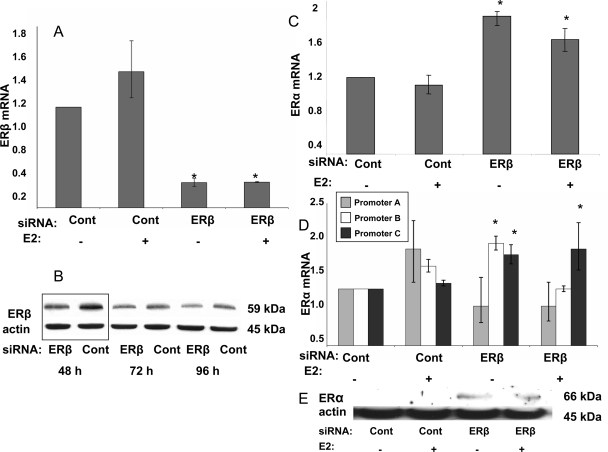
ERβ knockdown with siRNA resulted in significant ERα up-regulation in endometriotic stromal cells (from ovarian endometriomas). A, ERβ mRNA levels significantly decreased in the presence of ERβ-specific siRNAs (*, P < 0.0001). B, Maximum ERβ protein knockdown occurred 48 h after siRNA transfections. The ratio of ER-β protein in ER-β specific siRNA vs. control siRNA-treated cells was the lowest at 48 h after transfections. C, ERβ knockdown resulted in significantly increased total ERα mRNA levels in endometriotic stromal cells (*, P < 0.0001). D, ERα promoter A-, B-, and C-specific mRNA levels in endometriotic stromal cells with ERβ knockdown. Promoter B- and promoter C-specific mRNA levels were significantly up-regulated (*, P < 0.0001; and *, P = 0.0026, respectively). E, Immunoblotting confirmed increased ERα protein levels when ERβ is knocked down. Experiments were repeated in endometriotic stromal cells from five different subjects. All graphs are derived from experiments performed in triplicate in one representative subject. ANOVA followed by the Tukey multiple comparisons procedure was used for statistical analysis.
Figure 3
Figure 3
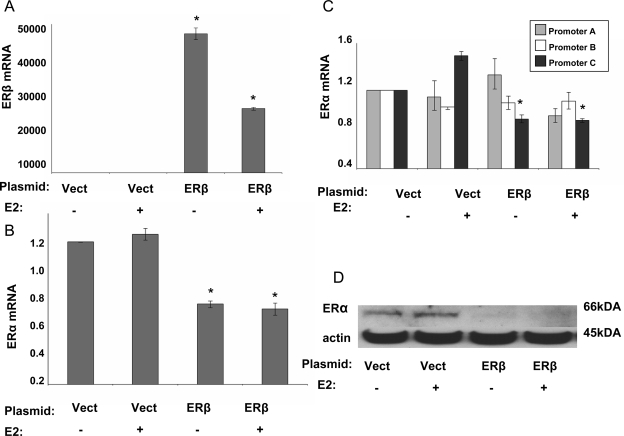
ERβ overexpression resulted in significant ERα down-regulation in endometrial stromal cells. A, Increased ERβ mRNA levels in endometrial stromal cells upon overexpression with and without E2 treatment were confirmed with real-time PCR (*, P < 0.0001). E2 treatment had a suppressive effect on the ERβ levels (*, P < 0.0001). B, In endometrial stromal cells, ERβ overexpression resulted in a significant decrease in ERα mRNA levels (*, P < 0.001). C, ERα promoter C-specific mRNA level was significantly down-regulated in the presence or absence of E2 (*, P < 0.001). D, Immunoblotting confirmed decreased ERα protein levels in the presence of ERβ overexpression. Experiments were repeated in endometrial stromal cells from five different subjects with reproducible results. Data are presented from one representative subject. ANOVA followed by the Tukey multiple comparisons procedure used for statistical analysis. Vect, Vector.
Figure 4
Figure 4
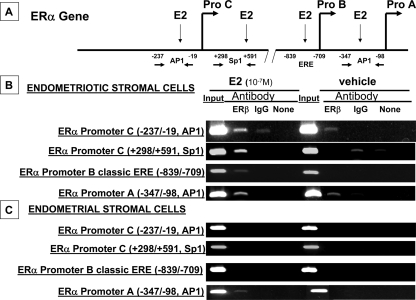
ChIP assay characterized ERβ binding to specific ERα promoter regions in stromal cells from ovarian endometriomas and endometrial stromal cells. A, ERα gene structure with selected potential cis-acting elements within each promoter region characterized in the ChIP assay. B, In the presence or absence of E2, ERβ binds via Sp1 and AP1 sites in ERα promoter C and the AP1 site in promoter A. ERβ binds to a classical ERE within ERα promoter B only in the presence of E2. C, In an E2-dependent manner, ERβ interacts only with the ERα promoter A via an AP1 site. All experiments were repeated in at least three subjects. Data are presented from one representative subject.
Figure 5
Figure 5
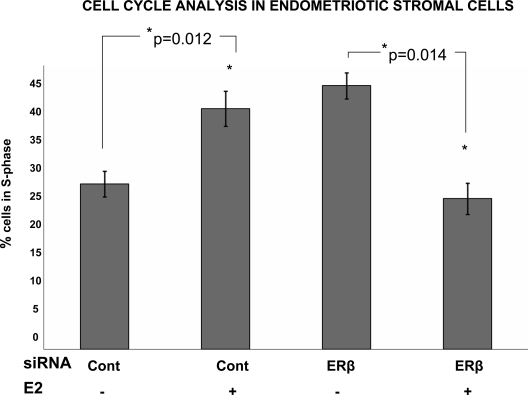
Cell cycle analysis in stromal cells from ovarian endometriomas. Treatment with E2 induced proliferation of endometriotic stromal cells as indicated by a significant shift of cells into the S-phase (*P = 0.012). Ablation of ERβ eliminated E2-induced proliferation in endometriotic stromal cells (*, P = 0.014). All experiments were repeated in at least three subjects. Data are derived from experiments performed in triplicate in one representative subject. ANOVA followed by the Tukey multiple comparisons procedure was used for statistical analysis. Cont, Control.

References

    1. Eskenazi B, Warner ML 1997 Epidemiology of endometriosis. Obstet Gynecol Clin North Am 24:235–258 - PubMed
    1. Giudice LC, Kao LC 2004 Endometriosis. Lancet 364:1789–1799 - PubMed
    1. Thomas EJ 1995 Endometriosis, 1995–confusion or sense? Int J Gynaecol Obstet 48:149–155 - PubMed
    1. Attia GR, Zeitoun K, Edwards D, Johns A, Carr BR, Bulun SE 2000 Progesterone receptor isoform A but not B is expressed in endometriosis. J Clin Endocrinol Metab 85:2897–2902 - PubMed
    1. Bulun SE, Cheng YH, Yin P, Imir G, Utsunomiya H, Attar E, Innes J, Julie Kim J 2006 Progesterone resistance in endometriosis: link to failure to metabolize estradiol. Mol Cell Endocrinol 248:94–103 - PubMed

Publication types

MeSH terms